How Long Does It Take to Potty Train a Puppy?
Four to six months is the honest answer, and some puppies need up to a year. Here's what actually moves that number — age started, breed size, confinement, prior history — and why the 'potty trained in 3 days' promise is describing your schedule, not your puppy's bladder.

Contains affiliate links · our policy
In this guide
- What the Four-to-Six-Month Number Actually Means
- A Realistic Timeline by Age
- The One-Hour-Per-Month Rule, and Where It Breaks
- Why Small and Toy Breeds Take Longer
- Four Other Things That Move the Timeline
- About Those "Potty Train in 3 Days" Promises
- Accidents Are Normal for Weeks, So Clean Them Like It Matters
- When Slow Progress Is a Medical Problem
- What We'd Do
- Our Top Picks
- FAQ
Most puppies take four to six months to become reliably house-trained, and some need up to a year. If your nine-week-old is still having accidents after two weeks at home, nothing has gone wrong — you are on schedule. How long it takes to potty train a puppy depends far more on their age, size, and your consistency than on any technique.
Healthy Puppy Review is reader-supported: if you buy through a link on this page we may earn a small commission, at no extra cost to you.
This page is about the timeline specifically — what the range means, what shortens it, and what quietly doubles it. If you want the actual method, we cover it step by step in our guide to puppy potty training.
What the Four-to-Six-Month Number Actually Means
Two respected sources bracket this well, and they don't quite agree.
Humane World for Animals states that housetraining a puppy typically takes 4 to 6 months, but that it varies with the puppy's size, age, and previous housetraining habits. WebMD's guidance, medically reviewed by Amy Flowers, DVM, gives the same 4-to-6-month range and adds the tail: some puppies may take up to a year.
The American Kennel Club sets a nearer milestone: if training begins early, a six-month-old puppy is usually able to be depended on most of the time to eliminate outside.
Read together, those give you a fair mental model. Around six months, most puppies are mostly reliable. Somewhere between six months and a year, they become genuinely trustworthy. Those are two different events, and the gap between them is where most owners think they've failed.
The variation is real, not a hedge. A large-breed puppy who came home at eight weeks from a clean, attentive breeder and lives with someone working from home can be close to done at four months. A Yorkie who arrived at fourteen weeks from a pet store, into a fifth-floor apartment, may still be having weekly accidents at ten months. Same effort, different math.
A Realistic Timeline by Age
Here's what "on track" looks like, using the AKC's holding-time rule as the ceiling for each stage.
| Puppy's age | Where most puppies are | Max time between breaks | | --- | --- | --- | | 8–10 weeks | Accidents most days; no signalling yet | About 3 hours | | 10–16 weeks | Fewer accidents; starts heading for the door | 3–5 hours | | 4–6 months | Mostly clean in supervised rooms; occasional misses | 5–7 hours | | 6–12 months | Reliable in the house; can hold overnight | Up to about 8 hours |
Two honest caveats. Those maximums are ceilings, not targets — a four-month-old can hold it five hours, but building a day around that is how you get accidents. And progress is not a straight line: WebMD notes that setbacks are common and that accidents happen with puppies up to a year old, so we'd treat one bad week as noise rather than evidence.
Week to week, the routine matters more than the milestone. If you want the specific intervals, meal timings, and overnight plan for your puppy's current age, we've laid out a puppy potty training schedule by age that you can follow without doing the arithmetic at 6 a.m.
The One-Hour-Per-Month Rule, and Where It Breaks
The most repeated number in house-training is that a puppy can hold their bladder about one hour per month of age. Humane World for Animals cites it directly. The AKC's version is a touch more generous: take your puppy's age in months and add one, and that's the maximum hours they can hold it — a three-month-old plus one equals four hours.
It's a useful rule. It is also frequently misused in three ways.
- It's a maximum, not a schedule. Humane World recommends taking a puppy out at least every two hours regardless, and especially after waking, after play, and after eating or drinking.
- It describes bladder capacity, not bladder awareness. A puppy who can physically hold it for four hours will still squat mid-play at hour one, because holding it requires noticing the signal in time.
- It doesn't scale forever. WebMD frames the one-hour-per-month rule as holding until a puppy is about a year old, and nobody's four-year-old dog should be asked to hold it fourteen hours. We'd treat roughly eight hours as the practical ceiling for a healthy adult dog.
The practical use of the rule is diagnostic. If your twelve-week-old is having accidents at the three-hour mark, that's biology and your interval is too long. If your six-month-old is having accidents at the two-hour mark, something else is going on — and that's a different article, on why your puppy isn't potty training, which we'll publish soon.
Why Small and Toy Breeds Take Longer
This is the single most under-explained variable, and it frustrates owners who did everything right.
Per WebMD's veterinary-reviewed guidance, size can be a factor: smaller breeds have smaller bladders and higher metabolisms, and require more frequent trips outside. That's the whole mechanism. A Chihuahua puppy isn't being stubborn. Their bladder is a fraction of the size of a Labrador's, and the one-hour-per-month rule is a population average that they sit at the wrong end of.
The knock-on effects add up. More trips per day means more chances to get the timing wrong. Small dogs also produce small accidents, which are easier to miss and therefore easier to leave uncleaned, which quietly builds a scent-marked indoor spot. And in cold or wet weather, a four-pound puppy has a much stronger opinion about going outside than a Lab does.
None of this makes it impossible — it makes it slower. If you have a toy breed, mentally move your expectations toward the six-to-twelve-month end of the range and stop comparing notes with your neighbor's Golden Retriever.
Four Other Things That Move the Timeline
When you started. WebMD notes you can begin as soon as your puppy comes home, but that puppies may not become consistent until they're between 12 and 16 weeks old. Starting at eight weeks doesn't make a puppy reliable at ten weeks; it means the habits are already forming when the plumbing catches up.
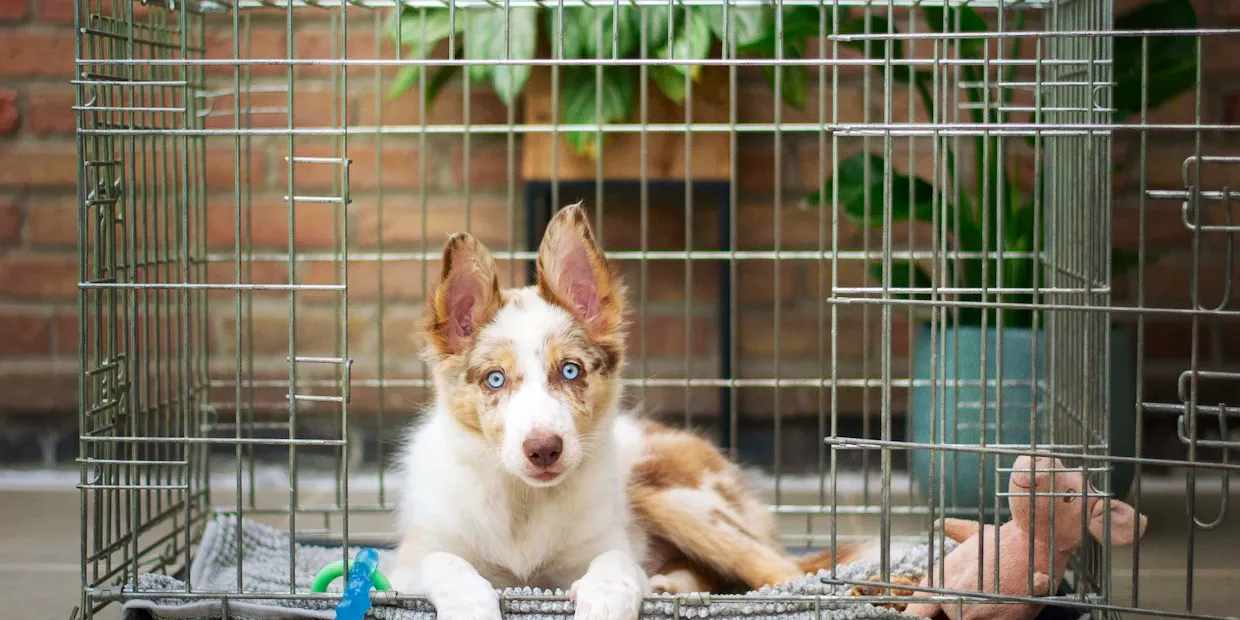
How tightly you manage freedom. This is the biggest lever you actually control. Confinement doesn't teach anything by itself — it prevents unsupervised accidents, and every accident prevented is one repetition of the wrong habit that never happened. The ASPCA's guidance is to limit your dog's run of the house to the one or two rooms where you can see her at all times, and to enlarge her territory only slowly as the training takes hold. This is where crate training earns its reputation, because most dogs are reluctant to soil the space they sleep in.
Whether meals are on a clock. Predictable input, predictable output. The AKC advises waiting only 5 to 30 minutes after a meal before taking your puppy outside, with younger puppies going sooner. That guidance only works if meals happen at the same times each day, which is one reason we push a fixed puppy feeding schedule so hard — free-feeding smears the signal across sixteen hours and takes away your best predictor.
Where your puppy came from. WebMD notes that previous living conditions matter and you may need to help a puppy break old habits before establishing new ones. There's research behind that concern: a Penn Vet study of dogs obtained as puppies from pet stores versus non-commercial breeders found significantly greater house soiling among the pet-store group, which fared worse on 12 of the 14 behavioral measures taken and better on none. A puppy raised in a wire enclosure where the only option was to soil their own bedding has already learned something you now have to undo. Add a month or two to your expectations and don't take it personally.
About Those "Potty Train in 3 Days" Promises
You can have three accident-free days. That part is true, and it's a reasonable goal for a first weekend.
What you can't have is a nine-week-old with bladder control, because by the AKC's own rule that puppy tops out around three hours. Three clean days achieved by taking a puppy out every 45 minutes and never letting them out of your sight demonstrate excellent management. They don't demonstrate that the puppy has learned to hold it when the opportunity isn't handed to them — and that skill is what "potty trained" actually means.
We're not being cynical about it. Intensive early management is genuinely the fastest route to a house-trained dog — it's just the beginning of a four-to-six-month process rather than a substitute for one. The trouble with the three-day framing is what it does to owners in week five, when a normal setback reads as personal failure instead of as Tuesday.
Accidents Are Normal for Weeks, So Clean Them Like It Matters
Expect accidents well into month three, and occasional ones for months after that. The mistake that costs the most time isn't the accident itself — it's cleaning it in a way your puppy's nose can still read.
VCA Animal Hospitals puts it plainly: dogs are often attracted to previously soiled spots, and to eliminate as much odor as possible it's best to use a commercially available product containing enzymes that degrade urine or feces. The AKC gives the same advice — dogs are attracted to areas that retain odors from previous accidents, so keep enzymatic pet stain cleaners on hand and follow the product instructions carefully to get rid of the odor completely.
This is why an enzymatic cleaner is the one supply we'd buy before the first accident rather than after the third. Nature's Miracle Dog Stain & Odor Remover runs about $10.77 as of August 2026 for a 32 oz bottle, and the maker says the enzymatic formula begins breaking down stains on contact and keeps working as long as bio-based mess is present. Keep it where the accidents happen, not under the sink two rooms away.
One more thing both VCA and Humane World are firm about: don't punish accidents. Scolding or rubbing a puppy's nose in it makes them fearful and slows progress, and a puppy who learns that eliminating near you is dangerous will start hiding it behind the couch.
When Slow Progress Is a Medical Problem
There's a point where more training is the wrong answer.
VCA notes that a wide range of illnesses can affect a dog's house-training — including infections, parasites, cystitis, diabetes, and kidney disease — and that if a dog is house soiling, particularly if the behavior started suddenly, it's important to ask your veterinarian to check for a physical illness. Veterinary Partner, from the Veterinary Information Network, adds that a dog with a urinary tract infection, kidney failure, or incontinence needs veterinary care, and that housetraining problems from these causes can usually be solved or vastly improved by treating the condition. It also notes that intestinal parasites and other bowel illnesses can cause a dog to lose control of their bowels.
Call your vet rather than adjusting your schedule if your puppy suddenly can't hold what they used to hold, strains or squats repeatedly with little coming out, dribbles urine while asleep or lying down, or produces urine with blood in it. Persistent diarrhea in a puppy warrants a call too, and a fecal test for parasites is a reasonable early step. None of these have a home remedy, and none of them get better with more repetitions at the door.
What We'd Do
Plan for six months. Hope for four. Don't panic at nine.
Set your interval from your puppy's age rather than your convenience, take them out after every wake-up, meal, and play session, and keep them confined or directly supervised whenever you can't watch. Clean every accident with an enzymatic product the same day. Then leave the schedule alone for a few weeks — the most common self-inflicted delay we see is owners changing systems every time there's a bad night.
Expand freedom only on evidence. VCA's benchmark is eight to twelve weeks with no mistakes before a puppy is probably ready for more freedom, and then you widen their territory gradually rather than all at once. That's the moment you'll know, better than any calendar can tell you, that your puppy is actually house-trained.
For the full method behind this timeline — the schedule, the cues, the crate setup, and how to handle the setbacks — start with our complete potty training guide.
Our top picks

Nature's Miracle Dog Stain & Odor Remover, Enzymatic Cleaner (32 oz)
An enzymatic cleaner for the part of house-training nobody warns you about — the one spot on the rug your puppy keeps going back to. The maker says the formula begins breaking down stains on contact and keeps working as long as bio-based mess is present, which is the mechanism that matters for removing the scent cue rather than just the stain.
What we love
- Enzymatic formula the maker says keeps working as long as bio-based mess is present
- Begins breaking down stains on contact, per the manufacturer
- Manufacturer states it can be used around pets when used and stored as directed
Keep in mind
- The performance claims are the manufacturer's, not an independent test
- Adds a light citrus scent, which not everyone wants layered over a cleaning job
Frequently asked questions
How long does it take to potty train a puppy?
Housetraining a puppy typically takes four to six months, according to Humane World for Animals, and WebMD's veterinary-reviewed guidance notes some puppies take up to a year. The American Kennel Club's benchmark is narrower: if training starts early, a six-month-old puppy can usually be depended on most of the time to eliminate outside. Read those two figures together and you get the real picture — most puppies are mostly reliable around six months, and fully reliable somewhere between six months and a year. Small breeds, late starts, and inconsistent schedules push you toward the long end.
When is a puppy fully potty trained?
When they can hold it through a normal day, ask to go out, and stay clean in rooms you aren't watching — not when they've had a good week. VCA Animal Hospitals suggests that once a puppy has gone eight to twelve weeks without mistakes, they are probably ready for more freedom — and then you widen their territory gradually rather than all at once. That staged handover is the actual test. A puppy who is perfect in the kitchen and untested in the guest bedroom is not finished yet.
How long can a puppy hold their bladder?
The common guideline is roughly one hour per month of age. The American Kennel Club states it slightly more generously: take your puppy's age in months and add one, and that's the maximum number of hours they can hold it, so a three-month-old puppy plus one equals four hours. Humane World for Animals recommends taking a puppy out at least every two hours regardless, plus after waking, after play, and after eating or drinking. Treat the formula as a ceiling you rarely approach, not a schedule to aim for.
Why is my puppy taking so long to potty train?
The usual causes are a small bladder, an inconsistent schedule, too much unsupervised freedom too early, or a spot in the house that still smells like a toilet. But sudden or worsening accidents in a puppy who was doing well are different. VCA Animal Hospitals advises that if a dog is house soiling, particularly if the behavior started suddenly, it's important to ask your veterinarian to check for a physical illness. Urinary tract infections, intestinal parasites, and incontinence all stall house-training and none of them respond to more training.
Can you really potty train a puppy in 3 days?
Not in the sense most owners mean. You can absolutely have three accident-free days by taking a puppy out every hour and never leaving them loose, and that's genuinely useful. But it doesn't prove bladder control, because per the AKC's own rule of thumb, a nine-week-old can only hold it about three hours. What changed in those three days was your schedule, not your puppy's plumbing. The real test comes when the intervals stretch, which happens over months.
About the author
James Martin
I'm an animal lover through and through. I grew up with dogs, my family always had at least one pet, and today I share my home with a rescue who is the love of my life. I started Healthy Puppy Review to help owners cut through the marketing noise and make confident, well-researched choices about their dog's health and happiness.