How to Clean Puppy Accidents So They Don't Go Back to the Same Spot
A spot that looks clean to you can still read as a toilet to your puppy. Here is the enzymatic method that actually removes the scent cue — carpet, hard floors, grout, bedding and the old spots you cannot see.

Contains affiliate links · our policy
In this guide
- Why Clean to You Isn't Clean to Your Puppy
- The Ammonia Mistake, and Why Vinegar Only Gets You Halfway
- What an Enzymatic Cleaner for Dog Urine Actually Does
- How to Get Dog Pee Smell Out of Carpet, Step by Step
- Hard Floors, Grout and Baseboards
- Finding the Old and Invisible Spots
- Crate Bedding, Upholstery and Anything Washable
- Cheat Sheet by Surface
- When It Isn't the Cleaning
- What to Skip
- The Bottom Line
- Our Top Picks
- FAQ
Cleaning a puppy accident is a training step, not a chore. To clean puppy accidents so they do not become a habit: blot up everything you can, saturate the spot with an enzymatic cleaner, leave it wet for the full time on the label, then blot again and let it air dry. Household cleaners can leave a spot that still smells like a toilet to your dog.
Healthy Puppy Review is reader-supported: if you buy through a link on this page we may earn a small commission, at no extra cost to you.
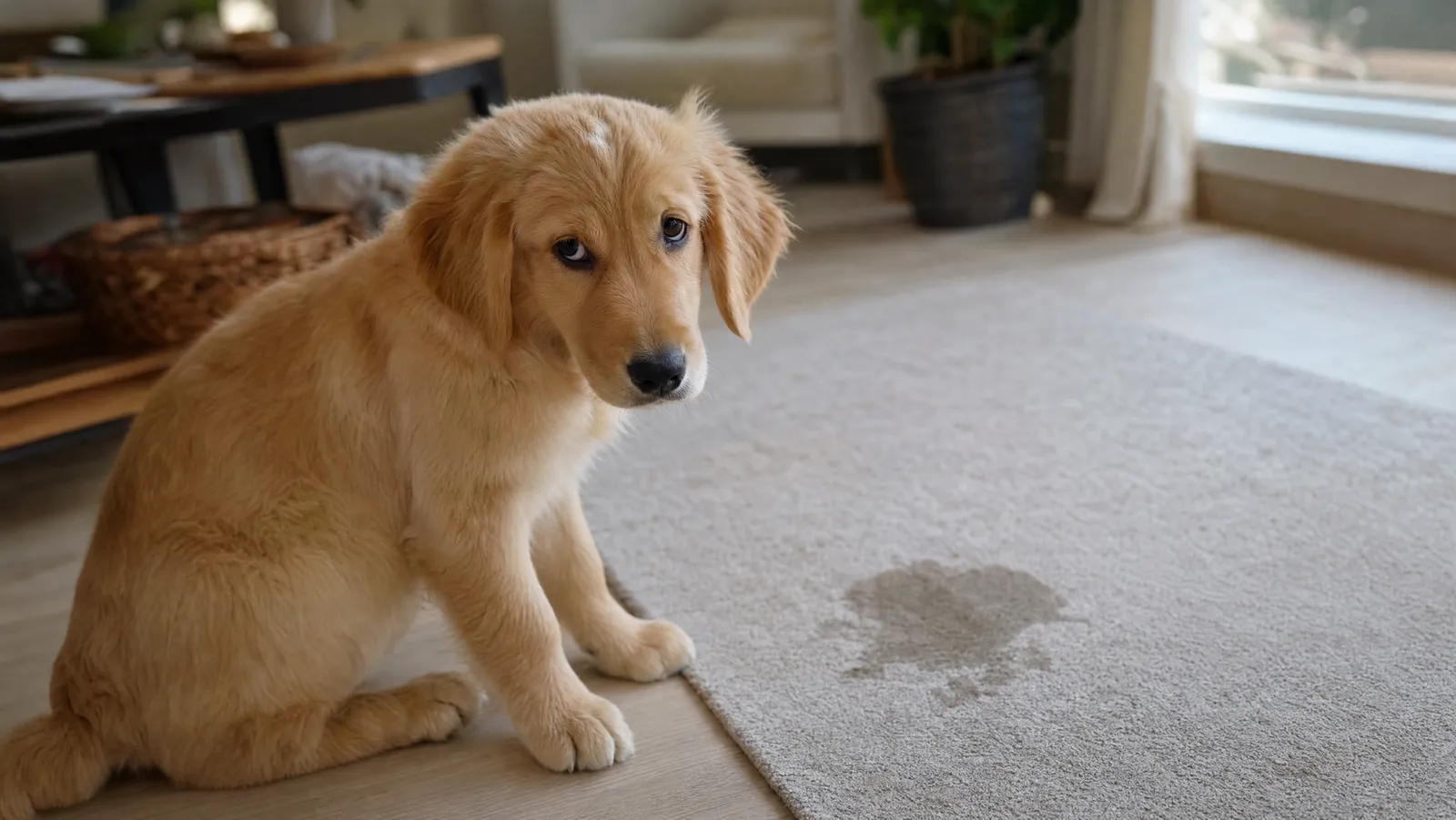
That last sentence is the part almost everyone misses. A spot can look clean, smell clean to you, and still read as an established bathroom to a nose that VCA Animal Hospitals describes as having more than 100 million sensory receptor sites, against about six million in people. If your puppy keeps choosing the same rug, the residue is usually the reason — and all the work you are putting into potty training a puppy properly gets undone by one square foot of carpet that is still advertising itself.
Why Clean to You Isn't Clean to Your Puppy
The gap is not small. VCA Animal Hospitals states that dogs can smell anywhere from 1,000 to 10,000 times better than people, and that the area of the canine brain devoted to analyzing odors is about 40 times larger than ours. You are not grading the same test your puppy is.
What that residue does is behavioral, not just unpleasant. Old urine marks the spot as a place that gets used. Humane World for Animals puts it directly: as long as your pet can smell their personal scent, they may continue to return to the accident zone. VCA Animal Hospitals says the same from the veterinary behavior side — the odor of urine or feces is a cue to use that location again. PetMD's Dr. Tiffany Tupler describes the mechanism as pheromones, noting that smelling them may encourage your dog to urinate again in the same spot.
So a half-cleaned spot is not neutral. It is a signpost you left up.
The Ammonia Mistake, and Why Vinegar Only Gets You Halfway
Reach under most kitchen sinks and you will find at least one ammonia-based general-purpose or glass cleaner. That is the worst possible bottle for this job.
Humane World for Animals advises avoiding cleaning chemicals such as ammonia or vinegar on pet urine, warning that strong chemical odors may encourage your pet to reinforce the urine scent mark in that area. The concern is not that the cleaner fails to disinfect. It is that the smell you leave behind may invite the dog to go over the top of it.
Vinegar and baking soda are the internet's default answer, and the guidance is genuinely split: the American Kennel Club's dog urine guide offers a one-to-one white vinegar and water solution as a home option, while Humane World for Animals puts vinegar in the avoid column. Our position: both deodorize, but neither does what an enzyme cleaner is built to do. The AKC describes enzyme-based cleaners as the most effective option specifically because they break down odor-causing compounds instead of masking the smell.
What an Enzymatic Cleaner for Dog Urine Actually Does
In plain language, an enzymatic cleaner digests the organic residue rather than covering it. VCA Animal Hospitals recommends a commercially available product containing enzymes to degrade the urine or feces. PetMD's Dr. Tupler describes the result as destroying the proteins and enzymes that make up the pheromones in dog pee — which is the argument for reaching for one on any spot you want your puppy to stop treating as a bathroom.
Three practical things follow from that, and they are where people go wrong:
- It has to stay wet. The reaction needs contact time. Rocco and Roxie's own directions say to apply enough product to wet the entire area and let it sit for 10 minutes or longer before absorbing what is left. A light mist that dries in ninety seconds is close to doing nothing.
- Don't bring heat to it first. Humane World for Animals advises avoiding steam cleaners on urine odors, because the heat will permanently set the stain and the odor by bonding the protein into man-made fibers. The AKC repeats the warning. Save the steam for after.
- Don't layer it over another cleaner. Rocco and Roxie's instructions have you blot, then dilute the area with plain water, then apply the product — not spray it on top of whatever you already tried. If you have already hit the spot with a household cleaner, rinse with plain water and blot before switching.
The one we keep under the sink is the Rocco & Roxie Enzyme Stain & Odor Eliminator, about $23.92 as of September 2026 for 32 fl oz. The maker says it carries the Carpet and Rug Institute Seal of Approval, that it is chlorine-free and color-safe with no hazardous propellants or residue, and that it is labeled for carpet, hard floors, furniture, clothing, crates and carriers. Whatever brand you buy, buy the big bottle — and follow the maker's instruction to test an inconspicuous area for colorfastness first.
How to Get Dog Pee Smell Out of Carpet, Step by Step
Carpet is a three-layer problem and only one layer is visible: the fiber you can see, the backing underneath, then the pad and subfloor. Urine spreads outward and downward, which is why Humane World for Animals warns that the job gets much harder once urine has soaked into the padding, and why the AKC notes a spot may need repeated treatments.
For a fresh accident:
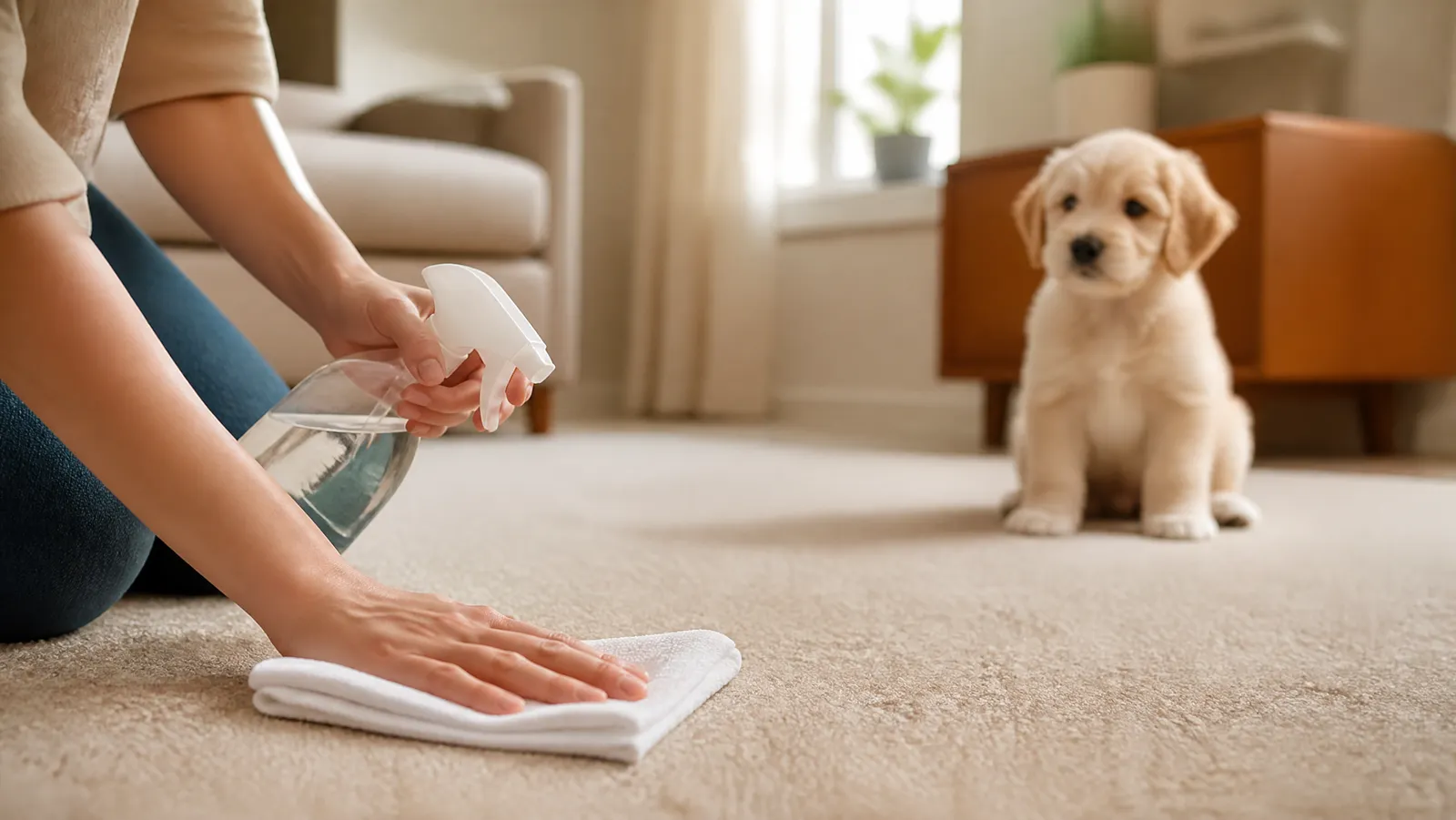
- Blot, do not rub. Dr. Tupler's guidance at PetMD is explicit that rubbing or wiping can cause the urine to spread through the fabric. Press a thick pad of paper towels straight down.
- Blot with weight. The AKC suggests covering the wet spot with a thick layer of paper towels, then newspaper, and pressing down for several minutes. Humane World for Animals goes further and says to stand on that padding for about a minute, repeating until the area is barely damp.
- Dilute, then saturate. Rocco and Roxie's directions call for a few ounces of fresh water on the area first, blotted up, before the cleaner goes on.
- Go wider than the stain. The visible mark is smaller than the wet zone in the pad. Treat several inches past the edge, all the way around.
- Let it dwell. Full label time, minimum. For deeper odor the maker says to use enough product to penetrate both the carpet and the pad, and to leave it considerably longer.
- Blot again, with weight. Fold a dry towel over the spot and put something heavy on it to wick liquid back up out of the pad.
- Air dry, uncovered. Check it with your nose once it is fully dry and re-treat if anything survived.
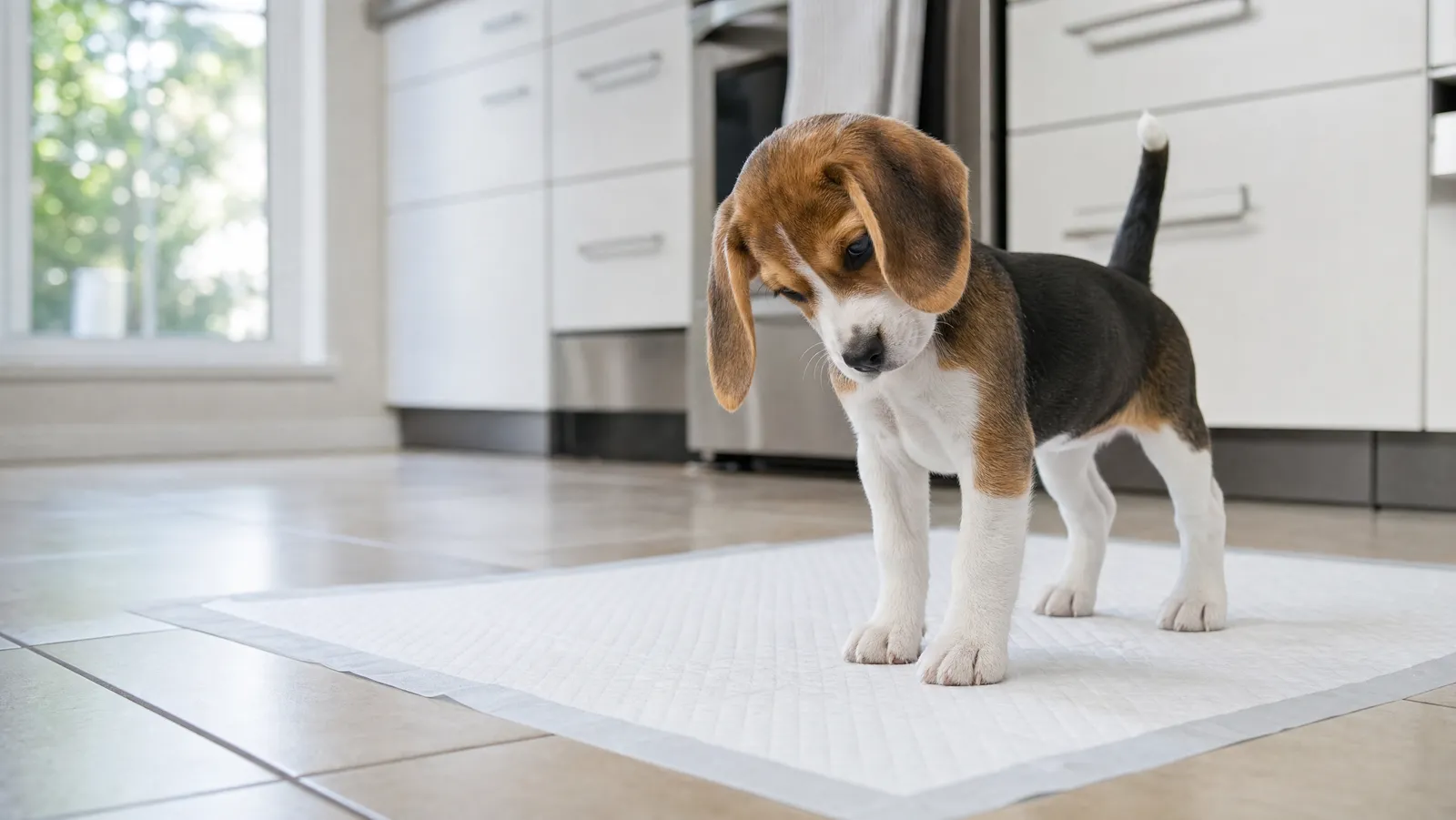
If the accident landed next to a pee pad rather than on it, treat the floor the same way — a pad works by giving the puppy a scent-marked target, so a rug beside it that smells of urine is competing for the same job. We cover that trade-off in our piece on whether pee pads actually work.
Hard Floors, Grout and Baseboards
On sealed tile, laminate or vinyl, the puddle is easy and the seams are the problem. Urine runs to the lowest available gap: grout lines, plank joints, the gap under a baseboard, the toe kick under your cabinets. Wipe the surface, then wet the seam and let an enzymatic product sit there rather than mopping over it. Rocco and Roxie's directions for hard surfaces are to pour or spray the product on the area and leave it, and to let wood dry completely before reapplying rather than soaking it.
Baseboards are worth a specific look with a flashlight. Humane World for Animals notes that if the wood on your furniture, walls, baseboard or floor is discolored, the varnish or paint has reacted to the acid in the urine, and you may need to remove and replace that layer of varnish or paint. A cleaner will not undo discoloration, but it can stop the smell that keeps drawing the puppy back to that corner.
Finding the Old and Invisible Spots
Some accidents you never see happen. If you work away from the house you are usually cleaning something that dried hours ago, which is a different problem from a fresh puddle — we cover that wider situation in our guide to potty training a puppy while working full time.
The tool for this is a UV blacklight, used with the lights off. Humane World for Animals suggests using a black light to identify soiled areas and lightly outlining them with chalk, and PetMD recommends a UV or black light urine detector when you are not sure where the smell is coming from. We use painter's tape instead of chalk on carpet, then treat every marked spot in one session rather than chasing a new one each week.
The Vansky 51-LED UV blacklight runs about $12.99 as of September 2026. Vansky states that it reveals dried urine stains on carpet, rugs and clothing that are invisible under normal light, and rates the LED lifespan at 15 years; the maker notes the three AA alkaline batteries are not included, so buy them at the same time.
Be honest about what you are seeing. Urine is not the only thing that fluoresces — forensic guidance from HORIBA notes that the optical brighteners in laundry detergents are designed to fluoresce under UV-violet excitation, and that body fluids such as semen and saliva are naturally fluorescent as well. Mark everything that lights up, then use your nose at floor level to sort real spots from laundry-soap ghosts.
Crate Bedding, Upholstery and Anything Washable
Washable items are the easy win, with one trap at the end. Humane World for Animals recommends adding a one pound box of baking soda to your regular detergent and washing as usual, air drying if possible. If the item is heavily soiled, pre-treat first: Rocco and Roxie's laundry directions are to treat the area, let it sit about 30 minutes, then machine wash normally.
The trap is the dryer. Humane World for Animals warns that heat permanently sets urine stains and odor by bonding the protein into man-made fibers — that warning is aimed at steam cleaners, but the same organization also tells you to air dry washables if possible. If any odor survived the wash, we would not risk a hot dryer on the item. Smell the item wet, before it goes anywhere near heat. If it still smells, wash it again.
Upholstery you cannot put in a machine gets the carpet treatment: blot, saturate, dwell, blot with weight, air dry, then check with your nose.
Cheat Sheet by Surface
| Surface | What we use | Dwell time | The common mistake | | --- | --- | --- | --- | | Carpet and rug | Enzymatic cleaner, generously | Full label time, longer for deep odor | Misting the visible stain only | | Carpet pad and subfloor | Same product, until it reaches the pad | Longer than the surface treatment | Treating only what you can see | | Sealed hard floor | Wipe, then enzymatic product in the seams | Per label, sitting on the grout lines | Mopping over a seam instead of soaking it | | Wood and baseboards | Enzymatic product, dried fully between coats | Per label, no soaking | Saturating wood, or expecting it to undo discoloration | | Bedding and washables | Detergent plus baking soda, pre-treated | About 30 minutes pre-treat, per maker | Machine drying before the odor is gone |
When It Isn't the Cleaning
If you have cleaned properly and the same spot keeps getting used, stop buying cleaner and start looking at three other things.
The schedule. A puppy who cannot hold it is not making a choice about location. Our puppy potty training schedule by age has the intervals worth checking against.
Supervision. Accidents that only happen out of sight are a management problem, not a cleaning one.
Health. VCA Animal Hospitals advises that if a dog is house soiling, particularly if the behavior has started suddenly, it is important to ask your veterinarian to check for a physical illness. PetMD, in an article reviewed by Melissa Boldan, DVM, lists straining to urinate, painful urination, passage of small amounts of urine or dribbling, frequent urination, bloody urine, licking the genital region and urinary accidents among the signs associated with a urinary tract infection in dogs, and notes that untreated infections can lead to serious complications. Those signs belong in front of a vet, not in a cleaning routine — no product on this page treats a medical cause.
A puppy who was reliable and has stopped being reliable is its own category, and it deserves a proper triage rather than a stronger mop. We walk through it in our guide to puppy potty training regression.
What to Skip
- Scented cover-up sprays. They add an odor on top of an odor, and the scent cue underneath is untouched.
- Ammonia-based cleaners. Humane World for Animals specifically advises avoiding them, on the grounds that strong chemical odors may encourage your pet to reinforce the urine scent mark in that area.
- Deterrent sprays used instead of cleaning. A deterrent on an uncleaned spot is two competing signals, and the one your puppy has already acted on is winning. Clean first; a deterrent afterward is a separate decision, and one we will get to in our roundup of the best puppy potty training supplies.
- Hot water and steam as a first step. Both the AKC and Humane World for Animals warn that heat can set the stain and odor permanently.
The Bottom Line
Cleaning up after a puppy is not housekeeping. It is the part of house-training that happens indoors, and it runs on the same logic as the rest: make the right spot obvious and the wrong spot boring. Blot hard, saturate wider than the stain, give the enzymes their time, keep heat away until the odor is gone, and walk the house with a blacklight now and then so your map is the real one.
Do that, keep the schedule tight, and the accidents stop being a pattern. If the schedule side needs work too, start with our house-training guide.
Our top picks

Rocco & Roxie Enzyme Stain & Odor Eliminator, 32 fl oz

The enzymatic spray we reach for on a fresh carpet accident, mostly because the 32 oz bottle lets you saturate a spot properly instead of misting it. Rocco and Roxie say it carries the Carpet and Rug Institute Seal of Approval and that it is chlorine-free and color-safe, with no hazardous propellants or residue. It is labeled for carpet, hard floors, furniture, clothing, crates and carriers, so one bottle covers most of the surfaces a puppy will find.
What we love
- 32 oz bottle is enough volume to soak a carpet spot and the pad beneath it
- Carries the Carpet and Rug Institute Seal of Approval, per the manufacturer
- Labeled for carpet, hard floors, furniture, clothing, crates and carriers
Keep in mind
- The performance and safety claims are the manufacturer's, not an independent test
- Costs noticeably more per ounce than supermarket carpet spray, and one bottle does not go far across several saturated spots
A pocket-sized UV flashlight for the one job no cleaner can do: showing you where the old accidents actually are. Vansky states that the 51 UV LEDs reveal dried urine stains on carpet, rugs and clothing that are invisible in normal light, and rates the LED lifespan at 15 years. Use it with the lights off, mark what glows, then treat every spot in one session.
What we love
- Turns an invisible odor problem into a visible map of spots to clean
- Pocket-sized, so it can live in the drawer nearest the accidents
- Cheap enough to be worth it even if you only use it once, at about $12.99 as of September 2026
Keep in mind
- Requires three AA alkaline batteries, which the maker notes are not included
- Urine is not the only thing that fluoresces, so expect false positives on a first sweep
Frequently asked questions
What is the best way to clean puppy pee out of carpet?
Blot first, then saturate with an enzymatic cleaner and leave it wet. PetMD's Dr. Tiffany Tupler advises against rubbing or wiping the spot, because that can cause the urine to spread through the fabric, so press absorbent towels down instead. The American Kennel Club's cleanup guide recommends enzyme-based cleaners as the most effective option because they break down odor-causing compounds instead of masking the smell. Use more product than looks necessary — Humane World for Animals notes the job gets much harder once urine has soaked into the padding under the carpet.
Do vinegar and baking soda work on dog urine?
They deodorize, but the guidance is genuinely split. The American Kennel Club's stain guide offers a one-to-one white vinegar and water solution as a home option, while Humane World for Animals lists vinegar alongside ammonia in its avoid column, warning that strong chemical odors may encourage your pet to reinforce the urine scent mark in that area. Neither approach does what enzyme-based cleaners are designed to do, which the AKC describes as breaking down the odor-causing compounds rather than covering them. We use an enzymatic product on any spot a puppy has used twice.
How long should an enzymatic cleaner sit on the spot?
Follow the label, and expect it to be longer than you would guess. Rocco and Roxie's own directions tell you to apply enough product to wet the entire area and let it sit for 10 minutes or longer before absorbing what is left and letting it air dry. The mechanism needs contact time, so a light mist that dries in two minutes is close to doing nothing. On carpet, the maker also suggests covering the treated area with a dry towel and placing a weight on top to draw liquid back up out of the padding.
Why does my puppy keep peeing in the same spot even after I clean it?
Because the spot still smells like a bathroom to them, even if it does not to you. Humane World for Animals puts it plainly: as long as your pet can smell their personal scent, they may continue to return to the accident zone. VCA Animal Hospitals adds that the odor of urine or feces is a cue to use that location again in the future. If you have cleaned properly with an enzymatic product and the accidents keep landing in the same place, VCA advises asking your veterinarian to check for a physical illness, particularly when the house soiling started suddenly.
Can I use a carpet steam cleaner on a puppy accident?
Not as your first move on a urine spot. Humane World for Animals advises avoiding steam cleaners for urine odors on carpet or upholstery, because the heat will permanently set the stain and the odor by bonding the protein into man-made fibers. The American Kennel Club gives the same warning in its dog urine guide, noting that heat can set the stain and odor permanently. Treat the spot with an enzymatic cleaner first and let it dry fully. Steam and hot water are for after the odor problem is solved, not before.
About the author
James Martin
I'm an animal lover through and through. I grew up with dogs, my family always had at least one pet, and today I share my home with a rescue who is the love of my life. I started Healthy Puppy Review to help owners cut through the marketing noise and make confident, well-researched choices about their dog's health and happiness.