Puppy Potty Training Regression: Why It Happens and How to Fix It
A puppy who was clean for weeks and is suddenly having accidents again has usually not forgotten anything. Here is the triage — medical first, then freedom, schedule, adolescence and old odor — plus a two-week reset that actually holds.

Contains affiliate links · our policy
In this guide
- Run This First: A Same-Day Triage
- A Puppy Having Accidents Again Needs a Vet Check Before a Training Fix
- Why Is My Puppy Regressing in Potty Training? Usually, Freedom Came Too Early
- Something in the Schedule Changed
- Adolescence: Do Puppies Regress in Potty Training Around Six Months?
- A Spot That Still Smells Like a Toilet
- Stress, a Move, or Anything New in the House
- Submissive and Excitement Urination Is Not a House-Training Failure
- The Two-Week Reset: How to Fix a Potty Training Setback
- How to Tell the Reset Is Working
- Our Top Picks
- FAQ
A puppy who was clean for three weeks and is suddenly having accidents again has not forgotten anything. Puppy potty training regression is almost always a change — in their health, their freedom, their schedule, or their environment — and your job is to work out which one. Before you change anything about your training, rule out a medical cause.
Healthy Puppy Review is reader-supported: if you buy through a link on this page we may earn a small commission, at no extra cost to you.
That order matters: no amount of extra crate time fixes a urinary tract infection.
If your puppy never got reliable in the first place, this is not your article — start with the full puppy potty training method, and we have a separate piece coming on why your puppy isn't potty training. What follows is for the puppy who had it and lost it: what changed, where the accidents are landing, and a two-week reset that holds.
Run This First: A Same-Day Triage
Ten minutes, five questions. They sort most regressions into the right bucket before you change anything.
- Is anything else different? Drinking more, straining, blood in the urine, loose stool for more than a day, new lethargy. Any of those moves this to the vet today.
- How old are they? Under four months, the likeliest answer is that your interval is too long for their bladder. Over five months, look at freedom first.
- What changed in the last two weeks? New rooms, new schedule, new food, a house guest, a move, a return to the office. Write it down — there is almost always something.
- Where exactly are the accidents? One rug or one corner is an odor problem. Everywhere is a management or medical problem. Only by the door is a signalling problem.
- When do they happen? Overnight only, mid-play only, or only as you walk through the door — the last one may not be a house-training problem at all.
A Puppy Having Accidents Again Needs a Vet Check Before a Training Fix
VCA Animal Hospitals is direct: if your dog is house soiling, particularly if the behavior has started suddenly, it is important to ask your veterinarian to check for a physical illness.
That is not a formality. Ordinary conditions produce exactly the picture you are looking at, grouped below by what you would notice at home.
| What you are seeing | Conditions VCA lists | | --- | --- | | Drinking and urinating more than usual | Kidney or liver disease, infection, diabetes mellitus, diabetes insipidus, Cushing's disease, corticosteroids such as prednisone | | More frequent or larger stools | Inflammatory bowel disease, food hypersensitivity, maldigestion or malabsorption, intestinal parasites, a high-fiber diet | | Discomfort while eliminating | Cystitis, urinary stones, colitis, orthopedic or neurologic pain |
Today's Veterinary Practice describes the baseline work-up for a house-soiling dog as a physical examination and a urinalysis, with imaging of the lower urinary tract, plus an intestinal parasite screen if your dog is defecating indoors. Some patterns warrant a call the same day rather than a wait-and-see week:
- straining or squatting repeatedly with little coming out
- blood in the urine, or urine that looks unusually dark or cloudy
- dribbling urine while asleep or lying down
- a clear jump in how much they drink
- diarrhea lasting more than a day, or containing blood
- lethargy, vomiting, or a puppy off their food
Why Is My Puppy Regressing in Potty Training? Usually, Freedom Came Too Early
Once medical is cleared, this is where we look first — and the cause owners resist hardest, because the accidents follow a stretch of good behavior.
The pattern is almost a script. Two clean weeks at four months, so you stop latching the crate and leave the baby gate open, and the puppy inherits the hallway and the spare room. Four days later there is a puddle behind the sofa. Nothing regressed — you changed the experiment.
The ASPCA's guidance is to limit the dog's run of the house to the one or two rooms where you can see her at all times. VCA sets the benchmark for letting go of that: once your puppy has gone 8 to 12 weeks without mistakes, they are probably ready for more freedom.
Eight to twelve weeks, not days. Most of us expand at the two-week mark because the puppy seems fine — and the puppy is fine, in the rooms we are watching. This is the job a crate quietly does for you.
Something in the Schedule Changed
Puppies house-train to a routine, not to an idea. Shift the routine and the accidents come back before the understanding does.
The culprits are boring: you went back to the office, the kids went back to school and the 3 p.m. yard trip vanished, dinner moved an hour later, or the weather turned hot and your puppy started drinking more.
Food is the sleeper cause. A new bag, a new topper, a well-meant table scrap — looser stool means less warning and more urgency, which is not a training lapse. We have covered whether puppy food can cause diarrhea separately.
The most common version is overnight. A puppy who slept through for weeks starts waking at 3 a.m. and going on the floor, and usually the last water bowl or the last trip outside has quietly drifted by an hour. We break that case down in our guide to puppy potty training at night.
Adolescence: Do Puppies Regress in Potty Training Around Six Months?
Cornell University's Riney Canine Health Center puts the start of adolescence at around six months, though it can start later, and says it generally ends around 18 months and can run to two years depending on the breed. During that window, Cornell notes, hormones are turning on and off to control growth and sexual maturity and the prefrontal cortex is still developing — which is why it suggests reviewing basic skills, because hormones and a lack of self-control may have made a dog appear to forget them.
The honest caveat: Cornell is describing obedience and impulse control, not house-training. The idea of a distinct adolescent potty training regression is largely trainer observation — we could not find a veterinary school or peer-reviewed source documenting it in its own right. Treat it as a last resort, after medical, freedom and schedule have been checked.
A setback at five to eight months is inside the normal timeline. Humane World for Animals puts typical housetraining at four to six months, varying with a puppy's size, age and previous housetraining habits. For the month-by-month picture, see how long potty training a puppy takes.
A Spot That Still Smells Like a Toilet
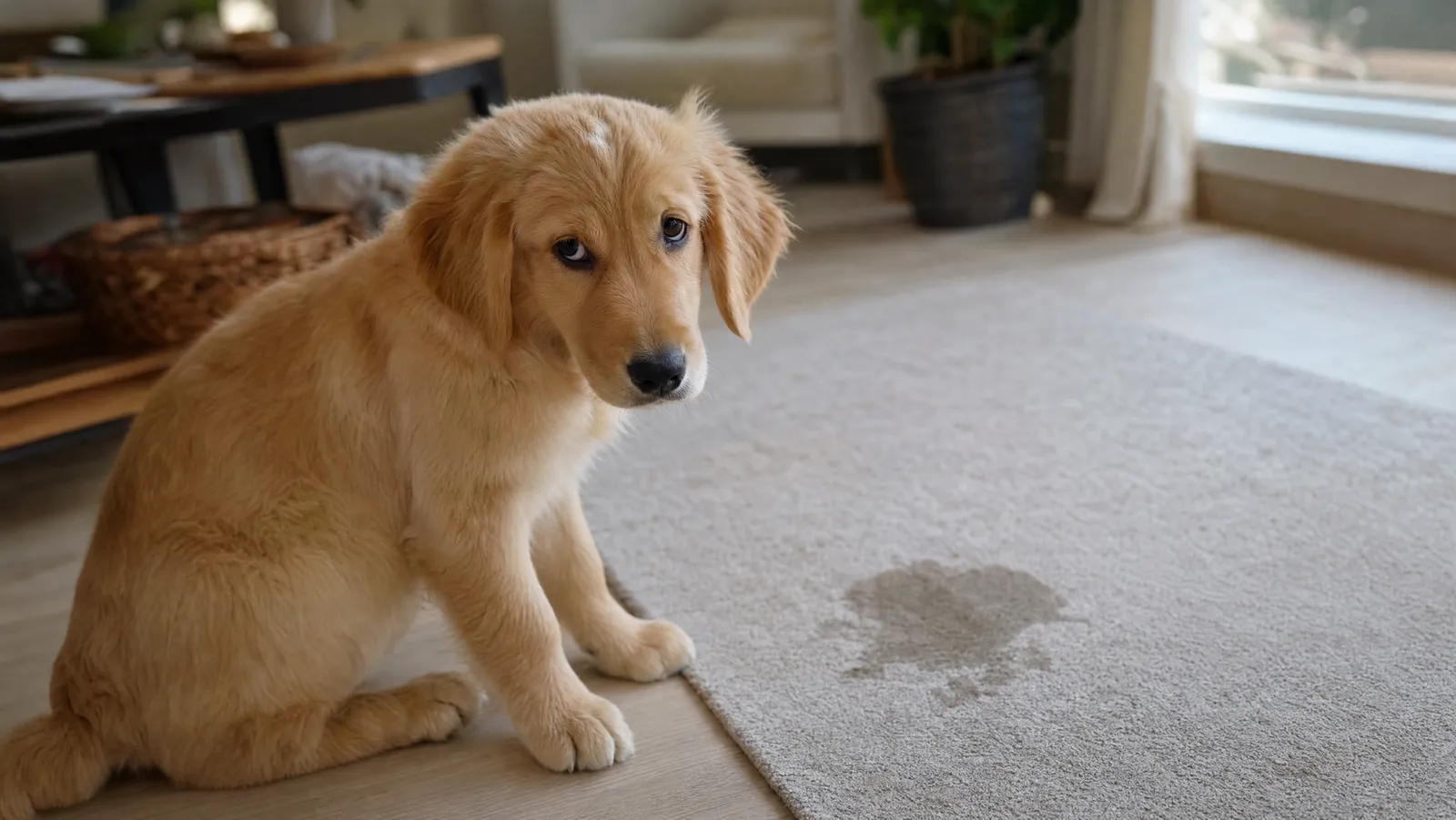
If the accidents keep landing in the same two places, you do not have a training problem. Your puppy is following instructions you cannot read.
VCA states plainly that dogs are often attracted to previously soiled spots, and that to remove as much odor as possible it is best to use a product containing enzymes that degrade urine or feces. Humane World for Animals puts it the other way round: as long as your pet can smell their personal scent, they may keep returning to the accident zone.
The hard part is finding those spots — a three-week-old accident on a beige rug is invisible to you and obvious to your puppy. Preventive Vet explains that the wavelengths in a blacklight cause phosphorus and proteins in urine to glow, making old stains easier to spot, and that it works best the darker the room is. Go around after dark with the lights off and mark what glows. Two caveats: Preventive Vet notes that plenty of harmless things fluoresce too — laundry detergent, milk, cooking oil, ketchup — and it frames the technique as a way to find dried, older stains rather than a fresh puddle. The Vansky UV Flashlight Black Light runs about $11.69 as of September 2026; Vansky says its 51 UV LEDs have a 15-year lifespan and that it takes three AA batteries, not included.
Then clean what you found, and what you clean with matters more than how hard you scrub. Humane World for Animals advises avoiding cleaning chemicals such as ammonia or vinegar, because strong chemical odors may encourage a pet to reinforce the urine scent mark there; on carpet it recommends a high-quality pet odor neutralizer, and for washable items an enzymatic cleaner, which it says breaks down pet waste odors. The ASPCA spells out the mechanism in its cat guidance: urine contains ammonia, so cleaning with ammonia can attract a pet back to that spot to urinate again. Nature's Miracle Dog Stain & Odor Remover is about $10.79 as of September 2026 for a 32 oz bottle, and the maker says the enzymatic formula begins breaking down stains on contact and keeps working as long as bio-based mess is present.
On carpet the urine is in the pad, not the fibers, so saturate rather than mist. We will publish the full method separately, as a guide to how to clean puppy accidents.
Stress, a Move, or Anything New in the House
A puppy who has just moved house, gained a baby, lost a person, or acquired a construction site next door is not being difficult.
VCA notes that behavioral illnesses related to fear, anxiety or frustration can cause house soiling, and describes a mechanism worth knowing: a dog frightened by something outside the house, or anticipating being frightened, may be too distracted to eliminate. That is the loop most owners miss: the puppy goes out, a garbage truck goes past, they come back in with a full bladder, and ten minutes later there is a puddle in the kitchen that reads as defiance.
Two fixes. Go out with them rather than opening the door, and stay long enough for them to settle. And if the accidents started within days of a move, treat the new house as a new project — the room map has changed, and there may be a previous animal's odor in the flooring.
Submissive and Excitement Urination Is Not a House-Training Failure
Some of what gets called regression is not a house-training problem at all, and treating it as one makes it worse. Three tells:
- it happens only on greeting, on approach, or when someone reaches over the puppy — never when they are alone
- the puddle is small, and the puppy is crouching, rolling over, tucking their tail or flattening their ears
- the puppy does not seem to notice it happened
VCA describes this as most commonly seen in puppies and young female dogs, and notes that many dogs grow out of it, either because they become less excitable during greetings or because they develop greater urine control with sexual maturity. Crucially, VCA warns that verbal reprimands or punishment only serve to make a dog more submissive, more anxious, more fearful and more conflicted at further approaches.
So do the opposite of what instinct suggests. Greet outside, ignore your puppy for the first two or three minutes when you get home, crouch sideways rather than leaning over them, keep your voice low and flat, and do not reach over their head. Clean up without comment. If it has not improved by around a year old, ask your vet — persistent urine leakage has medical causes too.
The Two-Week Reset: How to Fix a Potty Training Setback
VCA's advice for a dog who is physically and behaviorally healthy but still eliminating indoors is to restart training as though your dog were a young puppy, with careful supervision so they do not get the opportunity to eliminate indoors. That is the whole plan. Fourteen days:
- Shrink the house. Back to one or two rooms you can see into, per the ASPCA. Crate, pen or tether whenever you cannot watch.
- Reset the interval by age, not by history. A five-month-old who was going four hours goes back to two; our puppy potty training schedule by age has the numbers.
- Go outside with them, every time. You cannot reward what you did not see. Praise within about three seconds of the last drop, not once they are inside.
- Fix the meal times. Predictable input, predictable output. If nights are the problem, many trainers lift the water bowl an hour or two before bed — ask your vet first, though, because restricting water is not right for every puppy.
- Blacklight and enzyme-clean every old spot on day one. All of them, at the start, not as you find them.
- Keep a paper log on the fridge. Time out, result, and any accident with its location. Two weeks of that shows a pattern memory will not.
- Punish nothing. Humane World for Animals is blunt that scolding a puppy or rubbing their nose in it will only make them fearful and slow progress, and the ASPCA says not to yell at a dog for a mess she made earlier.
Then change nothing else for fourteen days. The most common self-inflicted delay we see is owners switching systems after every bad night, so no plan gets a fair test.
How to Tell the Reset Is Working
Measure days between accidents, not accidents per day — that one change makes progress visible while it is still small.
Week one is not evidence — accidents drop because you removed the opportunity, which tells you nothing. Week two is where you look for three things: your puppy heading for the door on their own, holding past the scheduled interval, and staying clean on the one or two occasions you were slow.
When they appear, re-expand one room at a time toward VCA's 8-to-12-weeks-clean benchmark: give back the hallway, hold it a week, then the next room.
Know what failure looks like, too. If two weeks of genuinely tight management changes nothing, that is information, not a reason to tighten further. Go back to your vet — VCA advises consulting one when a previously well-trained dog begins soiling indoors, and a clear urinalysis six weeks ago does not rule out a problem that started five weeks ago.
Most regressions we have seen resolve inside those two weeks; the ones that drag usually belong to owners who kept changing the plan. Pick the interval, hold it, and let the calendar do the work. The system this reset is built on — schedule, cue word, crate setup, reward timing — is in our guide to how to potty train a puppy.
Our top picks


Nature's Miracle Dog Stain & Odor Remover, Enzymatic Cleaner (32 oz)
A pocket-sized UV flashlight for the one job nothing else does — showing you where the old accidents actually are. Vansky says the 51 UV LEDs are rated for a 15-year lifespan and that the light runs on three AA batteries, which are not included. Use it with the lights off, and mark what glows before you start cleaning.
What we love
- Turns an invisible odor problem into a visible map of spots to clean
- Vansky states the 51 UV LEDs have a lifespan of 15 years
- Ultra-compact, so it can live in the drawer nearest the accidents
Keep in mind
- Needs three AA alkaline batteries, which the manufacturer says are not included
- Plenty of harmless things fluoresce too, so expect some false positives on a first sweep
The follow-up to the blacklight: an enzymatic cleaner aimed at removing the scent cue rather than just the stain. Nature's Miracle says the formula begins breaking down stains immediately on contact and keeps working as long as any bio-based mess is still present, which is the mechanism that matters when a puppy keeps returning to the same rug. Saturate the spot rather than misting it, because on carpet the urine is in the pad underneath.
What we love
- Enzymatic formula the maker says keeps working as long as bio-based mess is present
- Begins breaking down and removing stains immediately on contact, per the manufacturer
- Nature's Miracle states it can be used around pets when used and stored as directed
Keep in mind
- The performance claims are the manufacturer's, not an independent test
- A 32 oz bottle does not go far if you are saturating carpet padding on several spots
Frequently asked questions
Why is my puppy suddenly having accidents in the house again?
Something changed, and the first thing to rule out is health. VCA Animal Hospitals advises that if a dog is house soiling, particularly if the behavior has started suddenly, it is important to ask your veterinarian to check for a physical illness. The conditions VCA lists include kidney or liver disease, diabetes, Cushing's disease, cystitis, urinary stones and intestinal parasites, none of which respond to more training. Once your vet has cleared them, work through the behavioral causes in order: freedom expanded too early, a change in schedule or diet, an old spot that still smells, and stress.
Do puppies regress in potty training?
Often enough that most trainers plan for it, though we could not find a citable figure for how many puppies it happens to, so treat any percentage you see online with suspicion. What we can say is that a setback in the second half of the first year sits inside the normal timeline rather than outside it. Humane World for Animals puts typical housetraining at four to six months, varying with the puppy's size, age and previous housetraining habits. Cornell's Riney Canine Health Center adds that adolescence starts around six months, and that hormones and a still-developing prefrontal cortex can make a dog seem to forget what they learned.
How long does potty training regression last?
With a tight two-week reset — one or two supervised rooms, an age-appropriate interval, every old spot enzyme-cleaned — most of the regressions we have seen improve within those two weeks. Full trust takes considerably longer. VCA Animal Hospitals suggests that once a puppy has gone 8 to 12 weeks without mistakes, they are probably ready for more freedom. So treat two weeks as the point at which accidents stop, and the following two months as the point at which you stop supervising. If nothing improves at all in two weeks, go back to your vet rather than tightening further.
Should I punish my puppy for having accidents again?
No, and with a regression it tends to backfire. Humane World for Animals states that scolding a puppy or rubbing their nose in it will only make them fearful and slow progress, and the ASPCA's guidance is not to yell at a dog for a mess she made earlier. It matters most when the accidents are emotional rather than physical: VCA Animal Hospitals notes that verbal reprimands or punishment only serve to make a dog more submissive, more anxious, more fearful and more conflicted at further approaches. A puppy who learns that eliminating near you is risky will start going behind the sofa instead.
Is a small puddle every time I come home a regression?
Usually not. Excitement and submissive urination are a different phenomenon from a house-training failure, and the giveaway is that they happen only on greeting, on approach, or when someone reaches over the dog — often with crouching, a tucked tail, or a roll onto the back. VCA Animal Hospitals describes this as most commonly seen in puppies and young female dogs, and notes that many dogs grow out of it as they become less excitable during greetings or develop greater urine control with sexual maturity. Greet outside, keep it low-key, and do not scold.
About the author
James Martin
I'm an animal lover through and through. I grew up with dogs, my family always had at least one pet, and today I share my home with a rescue who is the love of my life. I started Healthy Puppy Review to help owners cut through the marketing noise and make confident, well-researched choices about their dog's health and happiness.