Potty Training a Puppy While You Work Full Time
You cannot teach a young puppy to hold it for nine hours, and you should not try. Here is the honest math on hold times by age, how to cover the midday gap, and the pen setup that protects your training instead of wrecking it.

Contains affiliate links · our policy
In this guide
- The Math, Up Front: Hold Time Against a Nine-Hour Day
- How to Potty Train a Puppy When You Work 9-5: Covering the Midday Gap
- The Pen-Not-Crate Rule for a Puppy Alone During the Work Day
- Puppy Pen Setup While at Work: What Goes Inside
- The Weekday Routine That Actually Decides This
- Weekends Are Where the Real Training Happens
- Troubleshooting the Four Things That Go Wrong
- Realistic Expectations for a Working Owner
- The Short Version
- Our Top Picks
- FAQ
Yes, you can potty train a puppy while working full time — but not by teaching the puppy to hold it. A young puppy physically cannot hold a bladder for a nine-hour day, and asking them to is how you get a puppy who learns to soil their own bed. The real job is arranging midday coverage and a containment setup that keeps the training honest while you are gone.
Healthy Puppy Review is reader-supported: if you buy through a link on this page we may earn a small commission, at no extra cost to you.
Most advice on this topic treats the workday as a training problem. It is a logistics problem with a training problem bolted to it, and the logistics come first. Below: the math on hold times, the coverage options ranked, the pen setup, and a weekday timeline you can actually run. For the underlying method — cue words, reward timing, how the interval stretches — see a full puppy potty training schedule.
The Math, Up Front: Hold Time Against a Nine-Hour Day
Start with the number, not the guilt. According to the American Kennel Club, you take your puppy's age in months and add one, and that is the maximum number of hours your puppy should be able to comfortably hold it between potty breaks. Run that against a workday plus a commute and the gap is not subtle.
| Puppy's age | Maximum hold (AKC month-plus-one) | Gap left in a 9-hour absence | | --- | --- | --- | | 8 weeks | about 3 hours | about 6 hours | | 12 weeks | about 4 hours | about 5 hours | | 16 weeks | about 5 hours | about 4 hours | | 5 months | about 6 hours | about 3 hours | | 6 months | about 7 hours | about 2 hours |
Two caveats. First, those are ceilings, not schedules. The month-plus-one figure describes a puppy resting quietly in a crate, not one who has just woken and drunk half a bowl of water. Humane World for Animals suggests taking a puppy out at least every two hours while you are around.
Second, there is a hard cap that overrides the arithmetic. Humane World for Animals states that puppies under six months of age should not stay in a crate for more than three or four hours at a time, because they cannot control their bladders or bowels for that long. So even a five-month-old whose arithmetic says six hours should not be crated for six.
Humane World for Animals also puts the underlying question plainly: if you will be away from home for more than four or five hours a day, consider whether this is the right time for a puppy. If your puppy is already home, that is a to-do list, not a verdict. You have a two-to-six-hour gap, and you cover it with a person or with a pen.
How to Potty Train a Puppy When You Work 9-5: Covering the Midday Gap
Ranked by what they do for your training, not by what is easiest to book.
1. A midday dog walker or pet sitter. The option that keeps the whole thing honest, because it turns one nine-hour absence into two four-and-a-half-hour ones. The AKC's advice for puppies still peeing in the crate is that they may need more frequent potty breaks with you or a dog walker, and VCA Animal Hospitals suggests finding a friend or pet sitter to stop by when a puppy is left more than three hours. It is also likely the biggest line item of your first six months.
2. A neighbor, a family member, or a partner on a different shift. Free, and often better than a walker because it is the same person every day. The catch is reliability: one missed visit is one forced accident. Have a paid backup.
3. Going home at lunch. Workable if your commute is short and your lunch is genuinely yours. A 20-minute round trip does not fit a 30-minute break once you add the potty trip itself.
4. Doggy daycare. Good for exercise and socialization, but it starts later than most people expect and the rules are not universal. The American Kennel Club frames the start point as once a puppy has received their important vaccines — typically between 12 and 16 weeks of age — and stresses consulting your veterinarian for a specific timeline. Requirements differ by facility: the AKC notes that all Dogtopia centers require two doses of DHPP, Bordetella and rabies, with some locations also requiring canine influenza. Call your vet and the facility before you count on it.
5. Leave, spent in the first two weeks. If you have paid time off or remote days, spend them in the fortnight after the puppy comes home. That window is when the interval is shortest — the AKC's ceiling for an eight-week-old is roughly three hours — and when the habit is most fragile. Every week after that, the arithmetic gets easier on its own.
The Pen-Not-Crate Rule for a Puppy Alone During the Work Day
This is the part most guides get wrong. A crate works because of the den instinct. VCA Animal Hospitals explains that since most dogs instinctively avoid eliminating in their sleeping and eating areas, dogs that use their crate as a bed or den will seldom eliminate inside — unless they have been left in the crate for too long or are excessively anxious when confined. That instinct does the heavy lifting in your training, and a full workday in a crate is the fastest way to break it.
Once a puppy has been pushed past their limit a few times, the crate stops being a bed. The AKC observes that some dogs learn they can soil the crate and cover the mess with their bedding, and that some puppies prefer to relieve themselves on something soft, like their bed. Undoing that is harder than making slow progress. Humane World for Animals adds the welfare side: a dog crated all day and night does not get enough exercise or human interaction and can become depressed or anxious.
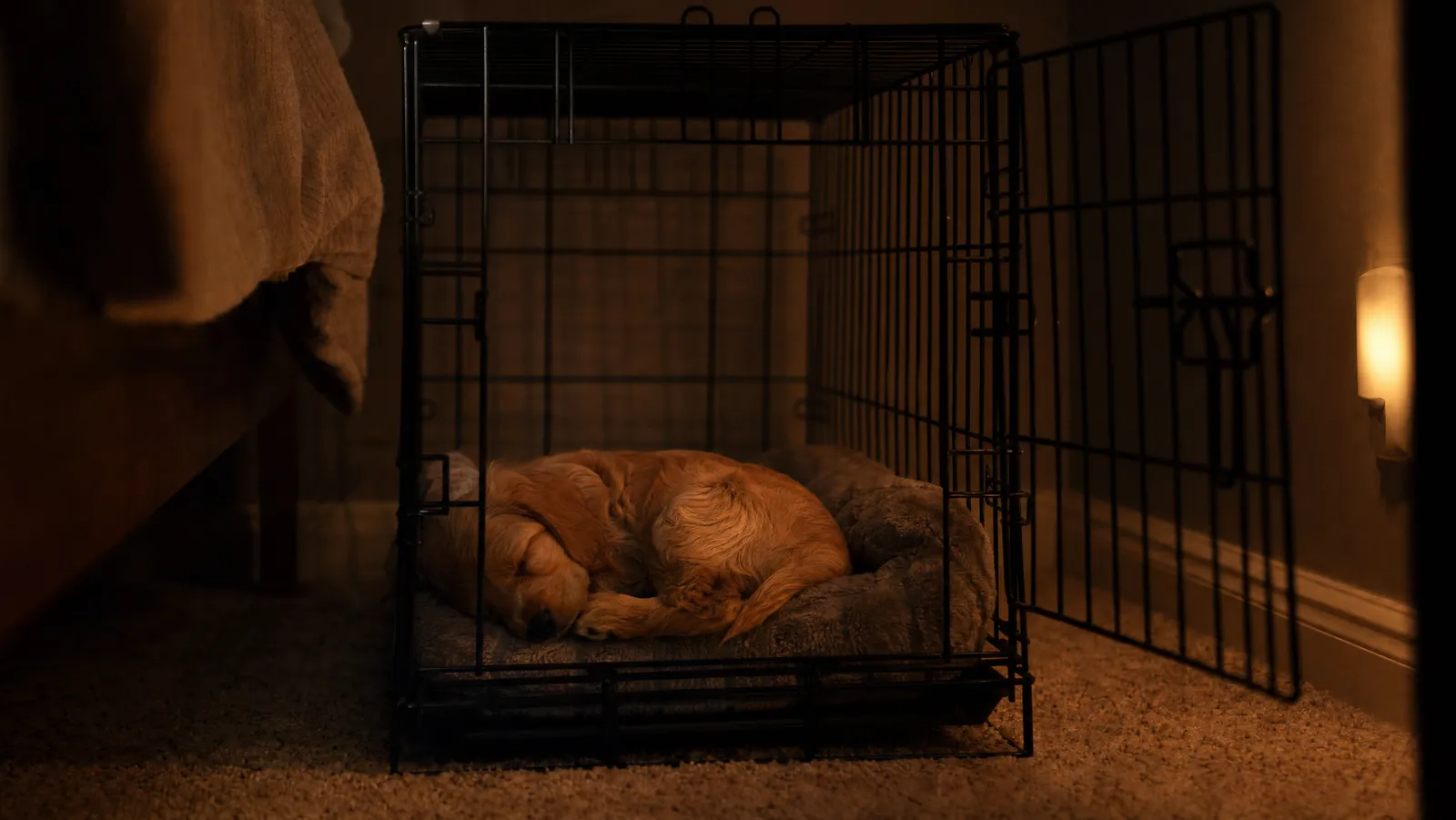
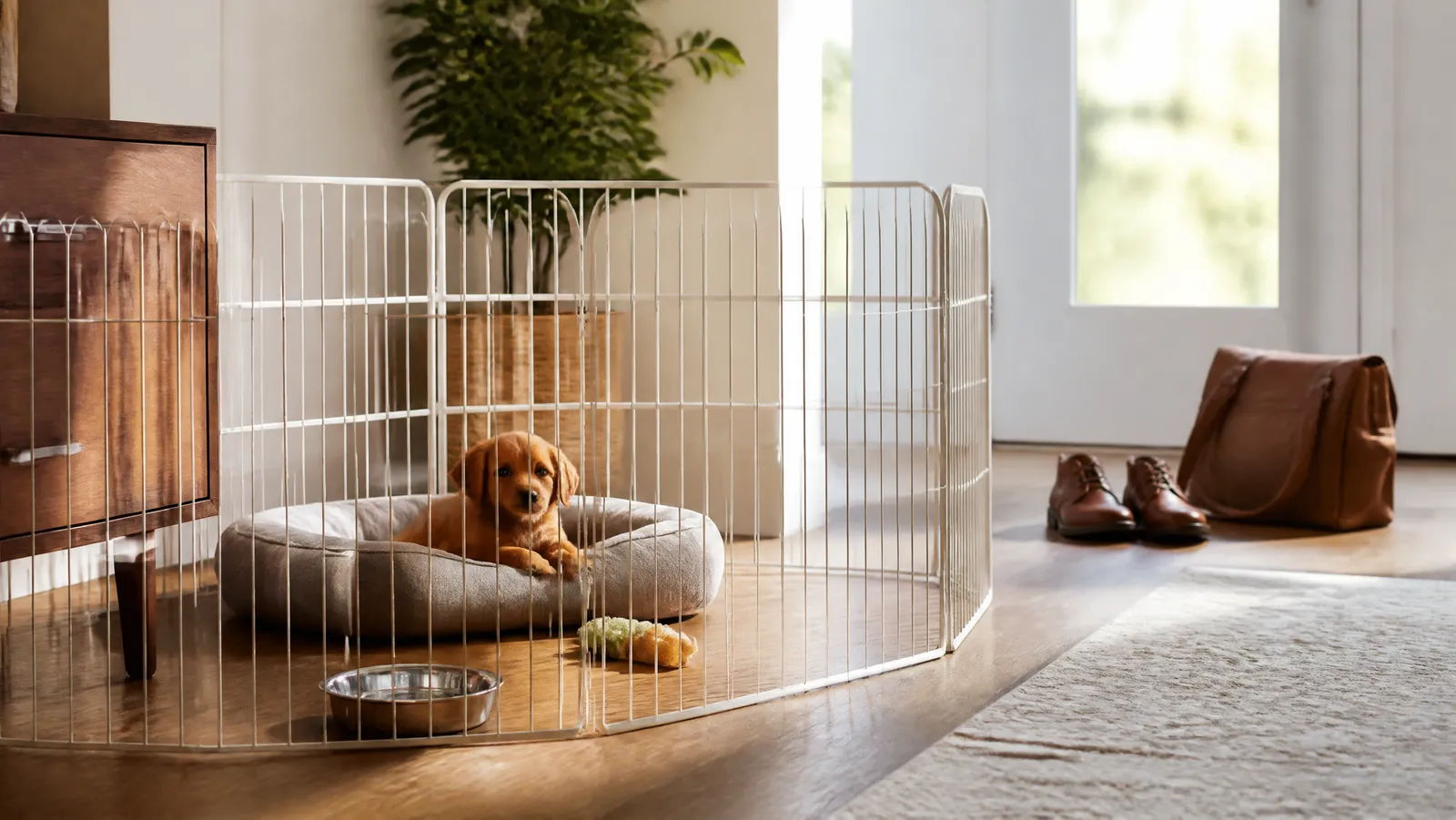
The crate is for stretches your puppy can actually hold — overnight, a nap, a two-hour errand. For a longer absence, use an exercise pen or a puppy-proofed room. VCA Animal Hospitals recommends exactly that: an exercise pen or gated enclosure with a resting spot such as a crate at one end and an appropriate toileting substrate — a piddle pad or artificial turf — at the other. Humane World for Animals describes the low-tech version: restricting the puppy to a small area where they will not want to eliminate, such as a bathroom or laundry room sectioned off with baby gates.
This is a deliberate compromise, and worth naming as one. You give up a little outdoor-only purity to protect the don't-soil-where-you-sleep instinct. That is the right trade.
If you are buying a pen, floor area matters more than features: you need real distance between the bed and the relief surface. The eight-panel PETIME foldable exercise pen is about $59.97 as of September 2026; PETIME says its included bottom pad is 600D Oxford fabric with a water-resistant coating. The VEVOR 8-panel playpen is about $49.90 as of September 2026 and adds a walk-through door, with a bottom mat VEVOR describes as waterproof. Those are maker specifications, not findings we tested; our notes on each are in the cards above.
Puppy Pen Setup While at Work: What Goes Inside
Four things, arranged deliberately.
- The bed or crate, door open, at one end. Preventive Vet's guidance on long-term confinement areas is to put the puppy's regular crate on one side of the zone with the door left open, so it stays a bed rather than a trap.
- Water, near the sleeping end. Preventive Vet recommends a spill-proof bowl or a hung no-drip bottle. Do not pull the water to cut down on accidents over a nine-hour day; if wetting has you thinking about restricting water at all, that is a conversation for your veterinarian.
- A safe chew. Preventive Vet's advice is to choose toys that are safe to leave with a puppy while they are unsupervised — which rules out anything that shreds into swallowable pieces.
- The relief surface, as far from the bed as the pen allows. Preventive Vet is explicit that the potty area should be as far from the crate and sleeping area as possible. That distance is the whole mechanism.
Be honest about the trade-off on that last one. A pad or turf square does slow full outdoor training, because your puppy gets daily practice on a surface that is not grass. That is a real cost — and a much smaller one than a puppy who has learned their bed is an acceptable toilet. If you have no yard and the indoor surface is a longer-term part of your setup, our guide to apartment puppy potty training goes deeper on making it work for you.
The Weekday Routine That Actually Decides This
Coverage buys you time. The routine converts it into training. A realistic weekday, shifted to your own hours:
| Time | What happens | | --- | --- | | 6:15 a.m. | Straight out of the crate and outside. No coffee first. | | 6:30 a.m. | Breakfast, then outside again within about 15 minutes | | 6:50 a.m. | A real walk or play session, 15 to 20 minutes | | 7:25 a.m. | Final trip out, into the pen, and you leave | | 12:00 p.m. | Midday visit: outside, short play, then outside again before the pen | | 5:30 p.m. | Home. Outside before anything else, including greetings | | 6:00 p.m. | Dinner, then out again | | 7:00 to 9:30 p.m. | Supervised freedom, with trips out every hour or so | | 10:30 p.m. | Last trip out, then crate for the night |
The morning block is the part people cut, and it is the part that pays. A puppy who has eaten, emptied and actually moved before you leave will usually sleep through a large chunk of your morning. One rushed out after a five-minute garden trip is more likely to spend it awake, bored and drinking.
The evening block has one rule: outside before greetings, however pleased you both are.
Weekends Are Where the Real Training Happens
Monday to Friday you are containing. Saturday and Sunday you are training.
On a weekend day, work to the awake interval rather than the ceiling — VCA Animal Hospitals suggests a trip outside every one to two hours while a puppy is awake. Take up the indoor relief surface for the day if you can, so every success happens outdoors, and reward within a second or two of your puppy finishing.
In our experience, two weekend days of tight, outdoor-only repetition move you further than five weekdays of careful containment. That is not a failure of the weekdays; it is what the weekdays are for.
Troubleshooting the Four Things That Go Wrong
An accident waiting for you when you get home. Frustrating, but not a setback — unless the spot becomes a habit. Humane World for Animals warns that as long as your pet can smell their personal scent they may continue to return to the accident zone, and advises avoiding ammonia or vinegar, because strong chemical odors may encourage a pet to reinforce the urine scent mark there. Clean it properly the first time; how to clean puppy accidents covers the products and the order of operations. Do not scold, either: the ASPCA's guidance is not to yell at a dog for a mess she made earlier, because a dog will not learn anything from it.
The puppy who holds all day, then has three accidents in an hour. Usually a routine problem, not a training one: a puppy who did not fully empty at the midday visit comes home with a backlog. Extend that visit so the puppy goes out, plays, and goes out again before being penned — the second trip is the one that matters.
Soiling inside the crate or pen. Treat this as information, not misbehavior. The AKC's position is that frequent crate soiling usually signals an underlying issue with a puppy's health or environment, including their day-to-day routines. Shorten the stretch, re-check that the bed and relief surface are genuinely far apart, and if it keeps happening — or comes with straining, blood, or a sudden jump in frequency — book a vet appointment rather than tightening the schedule. Our guide to potty training regression runs the same triage in more depth.
Barking, howling or destruction while you are out. Some of this is ordinary puppy protest. Some of it is not. The ASPCA describes separation anxiety as a genuine distress response rather than disobedience or spite, with signs including barking or howling that is persistent and not triggered by anything except being left alone, indoor urinating and defecating, pacing, panting, destruction, and escape attempts that can cause self-injury such as broken teeth, cut and scraped front paws, and damaged nails. This is not a DIY fix: the ASPCA's advice is to work with your veterinarian, a veterinary behaviorist, or a Certified Applied Animal Behaviorist, and to consult your vet before giving any medication for a behavior problem.
Realistic Expectations for a Working Owner
Your puppy will probably take longer than the tidy schedules suggest. That is normal, not failure. Humane World for Animals puts typical housetraining at four to six months, varying with the puppy's size, age and previous housetraining habits, and the AKC's timeline is that if training begins early, a six-month-old puppy is usually able to be depended on most of the time to eliminate outside. You are running the same process with fewer supervised hours in it, so expect the longer end.
Look for direction rather than perfection: fewer accidents month over month, a pen dry more mornings than not, a relief surface used less as the interval stretches. Once the pen has stayed dry through a full workday for two or three weeks, start shrinking the relief surface rather than removing it. We have broken the timeline down in how long potty training a puppy takes and mapped the intervals in our potty training schedule by age.
One more thing about where your day ends. VCA Animal Hospitals notes that puppies may need overnight outings until around five months of age, so a working owner is often doing a midday visit and a 2 a.m. trip in the same 24 hours. That stretch is finite, and puppy potty training at night covers how to keep the overnight trip short and boring enough that everyone gets back to sleep.
The Short Version
You cannot train a young puppy to hold it for a workday, and every hour spent trying costs more than it saves. Cover the midday gap with a person. Use a pen rather than a crate for the long absence, bed at one end and relief surface at the other. Front-load the morning with food, emptying and real movement. Train properly on the weekends, outdoors, on a tight interval. Then let the arithmetic do the rest: every month, the gap gets an hour smaller.
For the mechanics this schedule sits on top of, start with our guide to how to potty train a puppy. And if crating is still new to you, three reasons crate training makes your life easier explains why the crate is still worth building — just not for the hours you are at work.
Our top picks
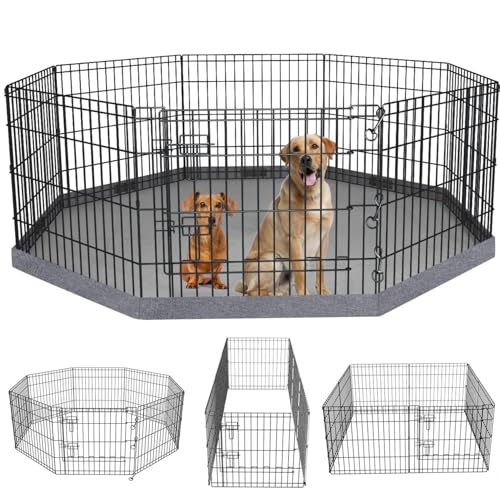
PETIME Foldable 8-Panel Metal Dog Exercise Pen, 24" W x 24" H, with Bottom Pad

Eight connected panels, each 24 inches wide and 24 inches high, that reconfigure into several shapes — which is the whole point for a daytime setup, since you need enough floor to put the bed at one end and the relief surface at the other. PETIME includes a bottom pad and states it is 600D Oxford fabric with a water-resistant coating. The maker also says no tools are needed for setup and that the pen folds flat for storage.
What we love
- Eight panels give you enough length to separate the sleeping end from the relief end, which is the single thing a daytime pen has to do
- Comes with a bottom pad, so you are not improvising floor protection on day one
- Reconfigurable and folds flat, so the same pen works in a kitchen corner on weekdays and a living room on weekends
Keep in mind
- PETIME specifies hand-wash only for the pad, air dry, do not twist — awkward for a surface that sits under a puppy having daytime accidents
- At 24 inches high this is a puppy-stage pen; many athletic adolescents will eventually be able to clear it
The same eight-panel, 24-inch idea for less money, with a walk-through door and latch so you can step in for the midday reset without dismantling a corner. VEVOR says the fitted 600D Oxford bottom mat has a waterproof surface and that its raised edge sits below the lower crossbar to resist shifting, and lists rounded panel edges to reduce accidental scratches.
What we love
- Walk-through door means you can get in and out during a midday visit without lifting a panel
- VEVOR describes the bottom mat as waterproof rather than water-resistant, which matters for a pen doing potty duty
Keep in mind
- The waterproof mat, anti-shift edge and rounded-edge claims are all VEVOR's specifications, not findings we tested
- Same 24-inch height limit, and a latching door is one more thing a determined puppy can work at
Frequently asked questions
Can you potty train a puppy if you work full time?
Yes, but not by asking the puppy to hold it all day. The American Kennel Club's month-plus-one rule puts the maximum comfortable stretch between potty breaks at the puppy's age in months plus one, so a 12-week-old tops out around four hours — well short of a workday with a commute attached. Humane World for Animals is blunter still, suggesting that if you will be away from home for more than four or five hours a day you should consider whether this is the right time for a puppy. The workaround is coverage: a midday visit from a walker, sitter, neighbor or you, plus a containment area the puppy can relieve themselves in without soiling their bed.
How long can a puppy be left alone during the workday?
Longer than they can hold it is the wrong way to plan. VCA Animal Hospitals advises that a puppy left alone for more than three hours will need a potty break, and Humane World for Animals states that puppies under six months of age should not stay in a crate for more than three or four hours at a time, because they cannot control their bladders or bowels for that long. Those are ceilings for a resting puppy, not targets. A puppy can be left in a larger, puppy-proofed pen for longer than they can be crated, but only because the pen gives them somewhere to go that is not their bed.
Should I use a crate or a playpen while I am at work?
A pen, for anything longer than the puppy can genuinely hold. VCA Animal Hospitals explains that dogs which use a crate as a bed or den will seldom eliminate inside unless they have been left in the crate for too long or are excessively anxious when confined — and that is exactly the instinct a full workday destroys. VCA's own suggestion for longer absences is an exercise pen or gated enclosure with a resting spot such as a crate at one end and an appropriate toileting substrate at the other. Humane World for Animals similarly warns that a dog crated all day and night does not get enough exercise or human interaction and can become depressed or anxious.
Should I leave water in the pen while I am at work?
Yes. Preventive Vet's guidance on setting up a long-term confinement area lists access to water as a requirement and recommends a spill-proof bowl or a hung no-drip bottle near the sleeping area. It is tempting to pull the water to cut down on accidents, but you are trading a puddle you can clean for a hydration risk you cannot see, and a young puppy in a warm room over nine hours is not a small margin. If your puppy's overnight or daytime wetting has you thinking about restricting water at all, raise it with your veterinarian rather than deciding alone.
When can a puppy start doggy daycare?
It depends on your vet and the facility, and anyone quoting you a single universal age is guessing. The American Kennel Club frames the timing as being able to start once a puppy has received their important vaccines, which typically happens somewhere between 12 and 16 weeks of age, and stresses consulting your veterinarian for a specific timeline. Requirements also vary by location: the AKC notes that all Dogtopia centers require two doses of DHPP, Bordetella and rabies, with some locations also requiring canine influenza. Call your prospective daycare and your vet before you build a work schedule around it.
About the author
James Martin
I'm an animal lover through and through. I grew up with dogs, my family always had at least one pet, and today I share my home with a rescue who is the love of my life. I started Healthy Puppy Review to help owners cut through the marketing noise and make confident, well-researched choices about their dog's health and happiness.