How to Transition a Puppy From Pee Pads to Going Outside
Usually two to four weeks in our experience, and longer for a puppy who has only ever gone on a pad. Here is the day-by-day protocol — consolidate to one pad, move it a foot or two a day, take it outside, shrink it, then hand the scent over to the grass.

Contains affiliate links · our policy
In this guide
- How to Wean a Puppy Off Pee Pads: The Six-Step Protocol
- The Scent Handoff: The Step Most People Skip When They Transition a Puppy From Pads to Grass
- Pay Far Better Outside Than You Ever Paid Inside
- Front-Load the Easy Wins Outdoors
- When Accidents Start, You Moved Too Fast
- The Puppy Who Will Only Go on a Pad
- How Long to Keep a Pad Down Once You Stop Using Puppy Pads
- When It Is Medical, Not Behavioral
- Signs the Transition Has Actually Taken
- Our Top Picks
- FAQ
In our experience most puppies move from pads to outdoors in two to four weeks, and a puppy who has only ever gone on a pad can take six weeks or more. No veterinary body publishes a fixed timeline for this — Preventive Vet says only that the transition takes time, and that consistency and patience are the keys. Puppy potty training from pads to outside works by moving one pad a few feet a day toward the door, then outside to the spot you want, then shrinking it until there is nothing left to aim at.
Healthy Puppy Review is reader-supported: if you buy through a link on this page we may earn a small commission, at no extra cost to you.
You started with pads for a reason — a third-floor apartment, a work schedule that did not survive a nine-week-old bladder, or a vet who told you to keep an unvaccinated puppy off public ground. All fair, and we have covered whether puppy pee pads work separately. This page assumes that decision is behind you.
One thing sets your expectations: Humane World for Animals notes that indoor potty training can make outdoor housebreaking take longer. You are competing with a surface preference your puppy has rehearsed hundreds of times, and that gets unwound by repetition, not by decision. The method underneath all of this is in our complete puppy potty training guide.
How to Wean a Puppy Off Pee Pads: The Six-Step Protocol
The days below are a template, not a promise. Hold at any step until your puppy has hit it cleanly two or three days running. This method fails the same way every time: six steps in six days.
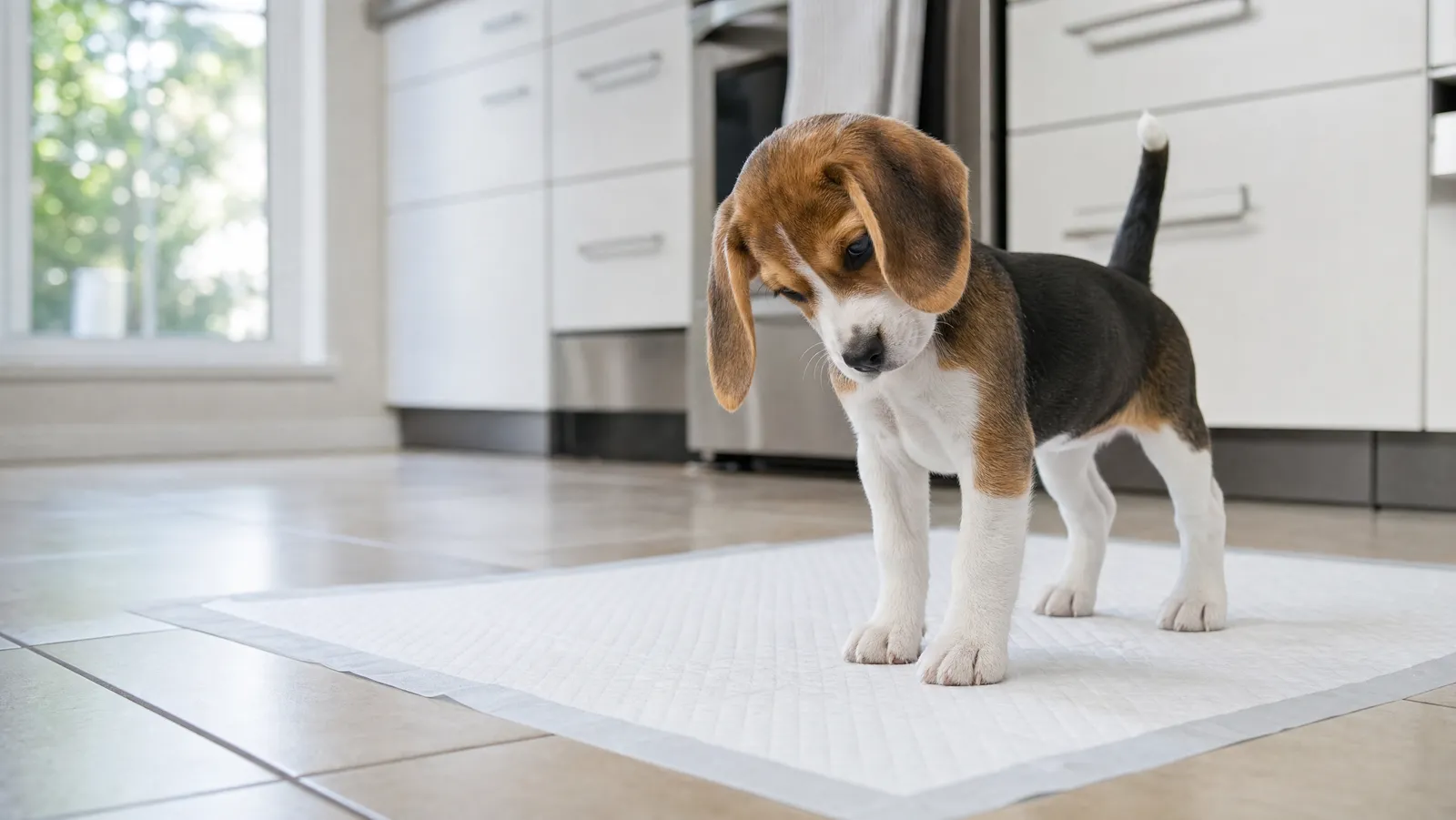
1. Days 1 to 2 — get down to one pad. If pads are scattered across two rooms, your puppy has a bathroom wing, not a bathroom. Preventive Vet suggests consolidating gradually, moving the spare pads closer to the main one in small increments and removing them once they share a room, with baby gates to block off other floors. Keep the pad nearest the door you will eventually use, and stop reusing pads. A 100-count box of Amazon Basics leak-proof puppy pads runs about $18.99 as of September 2026, and the maker states they include a built-in attractant — working in your favor right up until the last week.
2. Days 2 to 10 — move the pad a foot or two a day toward the exit. That is Preventive Vet's instruction almost verbatim, and the AKC frames it as moving the pad only a small distance each day so you do not confuse your puppy. Do the arithmetic on your floor plan first: 20 feet at two feet a day is ten days, and that is normal. Two missed pads in a row usually means the last move was too big.
3. Three to five days — park it at the door. Leave the pad against the threshold and let it sit. The AKC's framing for this stage is that you apply the same routine you used with the pad and simply take your puppy outside rather than to their pad — so when you see your dog heading for it, that is your cue to head for the door. In our experience that one habit does more than anything else on this list.
4. Move the pad outside, to the exact spot. The AKC's sequence is to work toward the door, then just outside that door, then slowly to the final outdoor location. Weight the corners with rocks or pavers or you will spend the week fetching a pad off the fence. Commit to one target spot: Humane World for Animals recommends a consistent bathroom spot, always on a leash, and the Ohio State University Indoor Pet Initiative explains why — your dog builds a visual association with the location and, in time, an olfactory cue.
5. Shrink the pad: half, then a quarter, then a corner. The AKC's guidance is to decrease the pad's size once it is outside, cutting it smaller until your puppy is using the ground instead. Every cut puts more paw on grass while the target stays put.
6. Take the last piece away — but hand the scent over first. That is the next section, and it is the step people skip.
What tends to stretch the timeline, in our experience: a puppy under 12 weeks, months rather than weeks of pad history, a puppy who has never been outdoors, a small or toy breed who dislikes wet grass, and cold weather. Ohio State names that last one directly — the switch is not necessarily easy, particularly if the weather makes it more comfortable to eliminate indoors. For the bigger picture, see how long potty training takes overall.
The Scent Handoff: The Step Most People Skip When They Transition a Puppy From Pads to Grass
Dogs pick their bathroom by nose, not by policy. The Ohio State University Indoor Pet Initiative puts it plainly: dogs generally like to eliminate where they have done so before. VCA Animal Hospitals uses the same fact in reverse, recommending an enzymatic cleaner indoors precisely because dogs are often attracted to previously soiled spots.
Do both halves of the job in one week. Humane World for Animals recommends placing soiled paper towels or rags in the appropriate spot to help your puppy associate the scent with the correct bathroom location: when you cut that last corner of pad, carry one lightly used pad out to the target spot and pin it under a rock for a day or two. Then scrub every retired indoor pad location with an enzymatic cleaner, which VCA recommends for this exact reason.
Skip the handoff and you often get the classic stall: a puppy who holds it for twenty minutes in the yard, comes in, and goes on the exact square of floor where the pad used to be. That is not defiance. It is the only spot in the house that still smells like the right answer.
Pay Far Better Outside Than You Ever Paid Inside
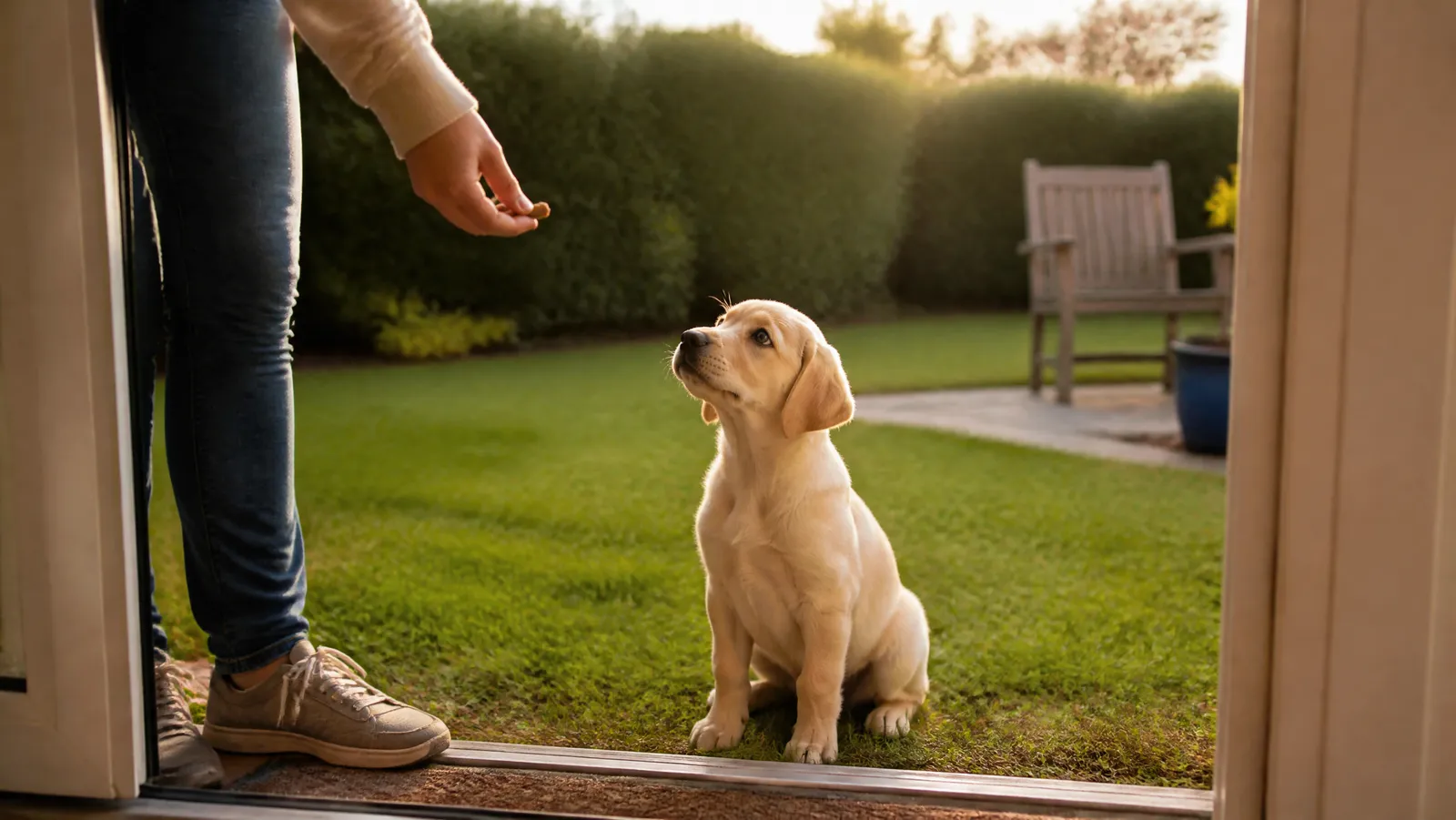
Pay at the spot, outdoors, within a second or two of your puppy finishing. VCA Animal Hospitals is explicit: the reward should be given while you are still outside near the area of elimination rather than when you get back inside. If the treat comes out at the kitchen counter, you have rewarded coming indoors. Humane World for Animals adds the other half — reward immediately once your puppy has finished, not mid-stream, because puppies are easily distracted and may stop halfway if interrupted. Ohio State agrees: praise and give an extra special food treat right as your puppy finishes.
Then raise the pay grade. Preventive Vet describes high-value treats as moist or freeze-dried, extra smelly, and something your dog does not get often outside of training — chicken, liverwurst, tripe — versus the dry, crunchy everyday tier, and recommends the high-value stuff for a new behavior or a distracting environment. Outdoors is both at once.
So the good stuff lives by the door and goes in your pocket before you open it, never after you come back in. And take VCA's other point seriously — play and off-leash freedom should wait until your puppy has finished. If the walk ends the second your puppy pees, you have taught a clever puppy to hold it.
Front-Load the Easy Wins Outdoors
Do not test this protocol at 2 p.m. on a quiet Tuesday. Spend your outdoor trips on the moments when a full bladder is close to certain.
Humane World for Animals recommends taking a puppy out at least every two hours, and especially after waking, after play, and after eating or drinking, noting that a puppy may only hold it about one hour per month of age. Those are your free wins: every success outdoors is a deposit in the scent account, and every success on the pad is a withdrawal.
The awkward hours in between are what the pad is still for, and that is fine while it is still in the protocol. We have mapped the intervals and meal timings week by week in our puppy potty training schedule by age, worth following literally for two weeks rather than improvising. For the first week, carry a small puppy through the door instead of walking them past the pad's old position — you are removing a decision point.
When Accidents Start, You Moved Too Fast
Accidents here are information, not a verdict: they almost always mean the last move was too big or too soon. Go back one step. Not to the beginning. If the pad reached the doormat and accidents started, put it back where it was three days ago, hold for three or four clean days, then move again in a smaller increment. Restarting from scratch throws away a good week you already banked.
Keep two things steady meanwhile. First, supervision: Preventive Vet advises crating or penning your puppy when you cannot watch, and the ASPCA recommends limiting your dog's run of the house to the one or two rooms where you can see her at all times. This is where crate training earns its keep.
Second, do not punish the accident. The ASPCA notes that a dog will not learn anything by being scolded for a past accident, even one only a few minutes old. VCA warns that punishing a puppy for a natural act can make them think they should never toilet near a person. Ohio State names the failure mode that wrecks this project specifically: dogs scolded for eliminating indoors in front of their owners will avoid eliminating if any person is present. A puppy who will not go while you watch cannot be paid at the spot — and everything above depends on that.
The Puppy Who Will Only Go on a Pad
Some puppies are not stubborn about location; they are attached to the texture. Grass is cold, wet and unfamiliar, and a laminated pad is not. For them, and for anyone whose only outdoor option is a balcony, change the surface before you change the room.
An artificial-grass tray is the usual bridge. The PETMAKER artificial grass pee pad with tray runs about $31.50 as of September 2026 in the 30 by 20 inch size. PETMAKER describes a washable turf pad in a three-layer system — a grass mat over a plastic drainage insert that empties into a collection tray, rinsed with soapy water — and positions it as a reusable alternative to disposable pads for small to medium pets. Humane World for Animals also lists a sod box among indoor options, and real sod is closer still to the target surface.
Be clear about what it is: a bridge, not a destination. You are splitting one hard change into two easy ones — surface first, in the room the puppy trusts, then location, running the same six steps with the tray. Slower on paper, and often the only route that works from a fifth floor in February.
If your puppy has never been outdoors at all, the vaccination question deserves a straight answer. PetMD's guidance, reviewed by Molly Price, DVM, is that it is generally safe for a puppy to go outside in your own backyard assuming no sick animals have been in it within the past year, and that puppies should potty in a private outdoor area before being fully vaccinated so they can learn to go on grass. Puppies are not considered fully vaccinated until two weeks after the final vaccine, typically around 18 to 22 weeks, and should stay off the ground in public areas like dog parks and shared apartment lawns until then. If your only green space is communal, ask your vet.
How Long to Keep a Pad Down Once You Stop Using Puppy Pads
Not indefinitely. A pad kept down just in case is a pad that is still teaching, and Humane World for Animals' point that indoor potty training can make outdoor housebreaking take longer does not stop applying because you have mentally retired it.
Our rule: once your puppy has gone outside at every scheduled trip for about a week, pull the last pad off the floor. Keep a handful in a cupboard for a stomach bug or a long drive. Off the floor they are supplies. On the floor they are a curriculum.
If your day genuinely cannot accommodate that — a 10-hour shift, no walker — leaving a pad down is a management decision, not a training one, and the trade is that the transition stalls as long as it stays. Book a midday visit if you can. The rest of the kit belongs in our guide to the best puppy potty training supplies.
When It Is Medical, Not Behavioral
There is a point where more repetitions are the wrong answer. VCA Animal Hospitals advises that if a dog is house soiling, particularly if it started suddenly, it is important to ask your veterinarian to check for a physical illness. It lists conditions that increase urine volume — kidney or liver disease, infection, diabetes, Cushing's disease — plus cystitis and urinary stones that make elimination uncomfortable, and parasites, inflammatory bowel disease and food hypersensitivity on the stool side.
Call your vet rather than adjusting the protocol if your puppy:
- suddenly cannot hold what they were comfortably holding a week ago
- strains or squats repeatedly with very little coming out
- passes urine with blood in it, or dribbles urine while asleep or lying down
- is drinking noticeably more water than usual
- has diarrhea lasting more than a day or two, or that keeps recurring
None of those are training problems you can schedule your way out of, and none should be managed at home first. A urinary tract infection in the middle of this project looks exactly like a training failure.
Signs the Transition Has Actually Taken
Six things, not one good week:
- They go within about two minutes of reaching the spot, without being walked in circles
- They head for the door on their own instead of toward where the pad used to be
- They will go on grass elsewhere — a friend's yard, a rest stop — so the surface has generalized, not just the square foot
- The retired pad location stays clean for two full weeks with nothing on the floor
- They hold overnight at the interval normal for their age
- They go on leash while you stand there watching, which proves nothing has been poisoned by pressure
That last one carries the most weight. VCA's benchmark for widening a puppy's freedom is eight to twelve weeks without a mistake, and the same patience applies here.
If you are rebuilding the whole day around the new outdoor spot, work forward from our puppy potty training schedule.
Our top picks


Amazon Basics Leak-Proof Dog and Puppy Potty Training Pee Pads, Regular 22 x 22 in (100 Count)
The bridge for a puppy who will only go on a pad, and for anyone whose only outdoor option is a balcony. PETMAKER describes a three-layer system, with a synthetic grass mat sitting on a plastic drainage insert that empties into a collection tray, cleaned by rinsing the three layers with soapy water. It changes the surface under your puppy without changing the location, which is the half of the problem that is usually stuck.
What we love
- Moves a pad-loyal puppy onto a grass-like surface without asking them to change rooms at the same time
- PETMAKER says it is washable and reusable, so the pad bill stops while you finish the transition
- Works on a balcony or patio, which is often the only realistic outdoor spot in an apartment
Keep in mind
- At 30 by 20 inches it is described for small to medium pets, so a fast-growing large breed will outgrow it mid-project
- It is a bridge, not a destination: you still have to relocate the tray outdoors and then retire it, which adds a step
The plain workhorse pad for the few weeks you spend moving one pad across the house. Amazon Basics states a 5-layer construction with a quick-dry surface and an absorbent core that turns liquid into gel on contact, plus a plastic border on all four sides. A 100-count box means you are never rationing pads during the stage where a fresh, clean pad in the new position matters.
What we love
- 100 pads per box removes the temptation to reuse a pad you have just moved
- The maker lists a plastic lining and a border on all four sides to keep leaks off the floor
- Amazon Basics says the pads carry a built-in attractant, which is useful while the pad is still the target
Keep in mind
- The built-in attractant works against you in the final week, when you want the pad to be the less interesting option
- Regular size is 22 by 22 inches with a 19 by 19 inch center pad, which is tight for a big puppy who circles before going
Frequently asked questions
How long does it take to transition a puppy from pee pads to going outside?
In our experience, plan on two to four weeks, and longer for a puppy who has never eliminated on grass — no veterinary body publishes a fixed timeline for this one. The pace is set by the method rather than by the calendar: the American Kennel Club advises moving the pad only a small distance each day so you do not confuse your puppy, so a 20-foot hallway is already a week and a half before the pad ever reaches the door. Humane World for Animals also notes that indoor potty training can make outdoor housebreaking take longer, so a puppy who has used pads for three months will usually need more repetitions than one who used them for three weeks.
Should I take a used pee pad outside with me?
Yes, once, and then retire it. Humane World for Animals recommends placing soiled paper towels or rags in the appropriate spot to help your puppy associate the scent with the correct bathroom location, and the Ohio State University Indoor Pet Initiative notes that dogs generally like to eliminate where they have done so before, with an olfactory cue building at a spot you use consistently. Pin one lightly used pad under a rock at your target spot for a day or two. At the same time, clean every retired indoor spot with an enzymatic product, which VCA Animal Hospitals recommends specifically because dogs are often attracted to previously soiled spots.
Why does my puppy still run to the pad even after going outside all week?
Usually because outside pays worse. VCA Animal Hospitals is specific about the failure point: the reward should be given while you are still outside near the area of elimination rather than when you get back inside. If the treat happens at the kitchen counter, the puppy learns that coming in is what earns it. Preventive Vet describes high-value treats as moist or freeze-dried, extra smelly, and something your dog does not get often outside of training, which is the tier you want outdoors, because your yard is the most distracting classroom your puppy has.
Can I leave one pad down just in case?
Not indefinitely, because a pad on the floor is still teaching. Humane World for Animals notes that indoor potty training can make outdoor housebreaking take longer, and every backup use is one more repetition of the surface you are trying to retire. Our rule of thumb: once your puppy has gone outside at every scheduled trip for about a week, pull the last pad and keep a few in a cupboard for illness or travel. If a 10-hour workday means a pad has to stay down, treat that as a management decision and expect the transition itself to stall.
My puppy started having accidents everywhere as soon as the pads came up. What now?
Go back one step in the protocol, not to the beginning, and hold there for three or four days before moving again. Do not scold: the ASPCA notes that a dog will not learn anything by being scolded for a past accident, even one a few minutes old, and the Ohio State University Indoor Pet Initiative warns that dogs punished for eliminating indoors in front of their owners will avoid eliminating when any person is present. If the accidents started suddenly, VCA Animal Hospitals advises asking your veterinarian to check for a physical illness before you change anything about the training.
About the author
James Martin
I'm an animal lover through and through. I grew up with dogs, my family always had at least one pet, and today I share my home with a rescue who is the love of my life. I started Healthy Puppy Review to help owners cut through the marketing noise and make confident, well-researched choices about their dog's health and happiness.