How to Stop Puppy Biting: The Bite-Inhibition Protocol That Works
Stopping puppy biting is a teaching job, not a suppression trick. The loop is redirect, mark and disengage, reward the soft mouth, and manage arousal — plus the overtired evening hour that new owners mistake for aggression. Here's the protocol, the mistakes that make biting worse, and when it's worth asking a professional.

Contains affiliate links · our policy
In this guide
- The Bite-Inhibition Protocol in Four Steps
- Why Punishing a Biting Puppy Backfires
- How to Stop a Teething Puppy From Biting
- The Witching Hour: When Your Puppy Will Not Stop Biting
- Puppy Biting Hands and Clothes: The Specific Fixes
- What Quietly Makes Biting Worse
- When Biting Is a Reason to Ask for Help
- What to Do This Week
- Our Top Picks
- FAQ
To stop puppy biting, teach bite inhibition instead of trying to switch the mouth off. The loop is four steps: redirect onto a toy, mark a hard bite and disengage for 10 to 20 seconds, reward the soft mouth, and manage arousal with naps. The ASPCA defines bite inhibition as a dog's ability to control the force of his mouthing.
Healthy Puppy Review is reader-supported: we may earn a commission from links on this page, at no extra cost to you.
Control, not silence, is the goal — and that distinction is why most advice on how to stop puppy biting quietly fails. Most of what makes a puppy feel unmanageable at 6 a.m. has nothing to do with intent. It is arousal, it is an empty mouth with nothing legal in it, and it is the teething that drives most puppy biting landing exactly when those needle-sharp baby teeth are at their worst.
The ASPCA's sequence is worth holding onto, because it sets the order of operations for everything below: teach the puppy that human skin is delicate and requires a gentle mouth first, then work toward stopping the mouthing altogether. Gentleness first, restraint second.
The Bite-Inhibition Protocol in Four Steps
Run these in order, every time, for weeks. The consistency does more work than any single technique.
1. Redirect before you react. Keep a chew toy within arm's reach in every room the puppy uses. The AKC's advice is to substitute a toy for your hand or the furniture, so the puppy learns what is okay to bite. A toy you have to go and fetch from another room is a toy that arrives ninety seconds too late. If your toy bin is thin, our roundup of must-have toys for a new puppy covers what actually earns its place.
2. Mark the hard bite, then go still. The ASPCA suggests a high-pitched yelp as if you are hurt, letting your hand go limp, then praising the puppy when they stop — and repeating it no more than three times within a 15-minute period. The AKC adds the caveat nobody mentions: a high-pitched sound excites some puppies further. If yours gets faster when you yelp, skip the noise entirely.
3. Disengage on a clock. This is where the teaching happens. The ASPCA's version is to ignore the puppy for 10 to 20 seconds after a hard bite, or get up and move away for 10 to 20 seconds if he starts mouthing again. Later, once the hardest bites have gone and you tighten the rule to any teeth on skin, the ASPCA stretches the time-out to 30 to 60 seconds — and says to leave the room for 30 to 60 seconds if he follows you and keeps nipping. Trainer Kathy Santo, quoted by the AKC, suggests turning around and tucking your hands into your armpits — she describes it as a calming signal and a minor form of attention withdrawal.
4. Pay the soft mouth. Most owners only give feedback for the bad version. When the puppy takes a treat gently, holds a toy without lunging at your fingers, or lies down and chews instead of chewing you, say so and feed a treat. That is the behavior you actually want on repeat.
The part people get wrong is the tempo. This is not four things you do once — it is one loop you will run dozens of times a day for several weeks, and the puppy learns from the pattern rather than from any individual repetition. If three adults in the house respond three different ways, the pattern never forms and the loop teaches nothing.
Worth noting too: puppies do not arrive blank. The AKC describes how littermates and the mother handle this naturally — a pup who bites too hard gets a loud yelp back, which is the feedback loop you are imitating. A puppy who left the litter early, or who never got much rough-and-tumble with siblings, may have had fewer of those lessons, and is likely to need more repetitions from you.
Why Punishing a Biting Puppy Backfires
The ASPCA is unusually blunt here: slapping or hitting, scruff shaking, whacking a puppy on the nose, or sticking your fingers down his throat can cause puppies to bite harder and can make them afraid of you. The AKC makes a related point about yelling — it notes that yelling at your puppy can itself act as a type of reward, because it is attention, and can create fear.
The broader position is not a style preference. The American Veterinary Society of Animal Behavior's humane dog training position statement recommends reward-based methods for all dog training, and notes that aversive methods carry potential adverse effects including increased fear-related and aggressive behaviors, with no evidence they work better.
There is a practical version of this too. Punishment raises arousal, and arousal is the fuel biting runs on. A puppy who was mouthing at a six out of ten is at a nine after you grab their muzzle, and now the teeth are harder. Going boring is the only response that lowers the temperature.
How to Stop a Teething Puppy From Biting
Teething changes the math, because now the puppy has a physical reason to want something in their mouth. VCA Animal Hospitals explains that puppies have 28 deciduous teeth that finish erupting by about six weeks, and that teething begins at roughly 3.5 to 4 months of age, when the baby incisors start being replaced by permanent incisors — the leading edge of the 42 permanent teeth an adult dog ends up with. Our puppy teething timeline breaks that sequence down tooth by tooth.
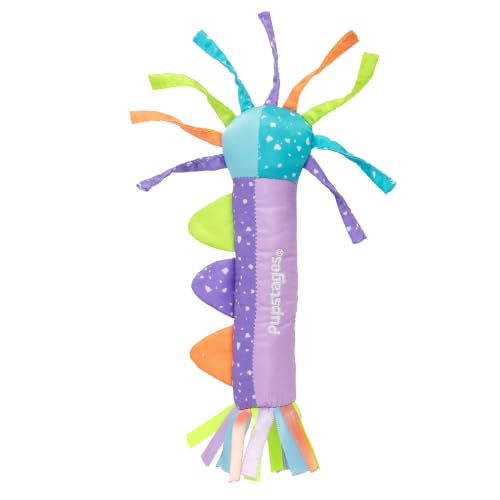
What helps during that window is cold and variety rather than hardness. The Pupstages Cool Teething Stick is built to be soaked and frozen, which is the cheapest way to add a cold option to the rotation — about $5 as of September 2026. Because it is a stuffed polyester toy with fringe, the maker advises supervised play and says to remove and replace it if it is damaged, so it is a supervised chew, not a crate toy.
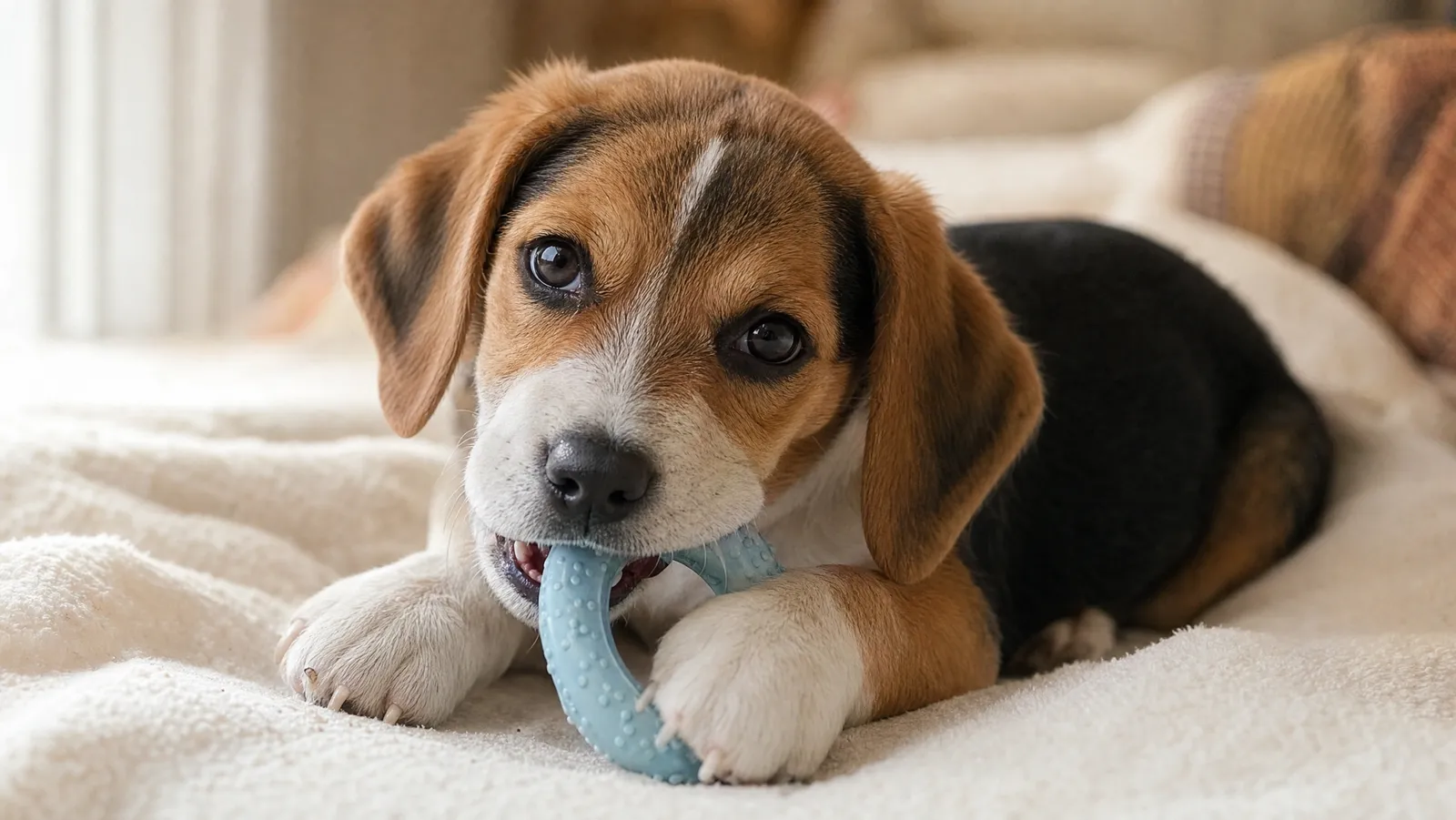
For rubber, we'd stay with formulations made for baby teeth. The KONG Puppy, about $7 as of September 2026, uses a softer natural rubber that KONG says was developed for a growing puppy's 28 baby teeth, and it stuffs — which matters, because a stuffed toy holds attention far longer than an empty one. The KONG Puppy Goodie Bone is the same rubber in a shape a small puppy can pin with both paws, about $8 as of September 2026. Both carry KONG's advice to supervise play and remove the toy if damaged, and both are built around baby teeth — once the adult set is in, you are shopping for an adult-strength chew.
One test worth running on anything you hand over: the veterinary dental practice Animal Dental Specialist advises that you should be able to indent the surface with your fingernail, and that the surface should have some give. The same practice lists bones, cow hooves, hard thick rawhides, nylon bones, and large ice cubes among things to avoid. When a puppy is chewing to relieve sore gums, softer is the point.
If a rubber toy is not holding your puppy, an edible chew can buy a genuinely settled ten minutes. Nylabone Healthy Edibles Puppy is about $4 as of September 2026 for a three-flavor pack, but check the weight limit first — Nylabone states these are for x-small puppies up to 15 pounds.
The Witching Hour: When Your Puppy Will Not Stop Biting
Somewhere between 5 p.m. and bedtime, a puppy who took treats politely all afternoon turns into a shark. Owners read that as aggression or as a training failure. In our experience it is usually a sleep problem.
The AKC says it is common for puppies to sleep 18 to 20 hours per day, and a puppy short on that does not get sleepy — they get faster, louder, and sharper. The single highest-leverage change most owners can make is an enforced nap before the meltdown, not more exercise after it. Adding a second walk to a wired puppy usually buys you a wired, tired puppy.
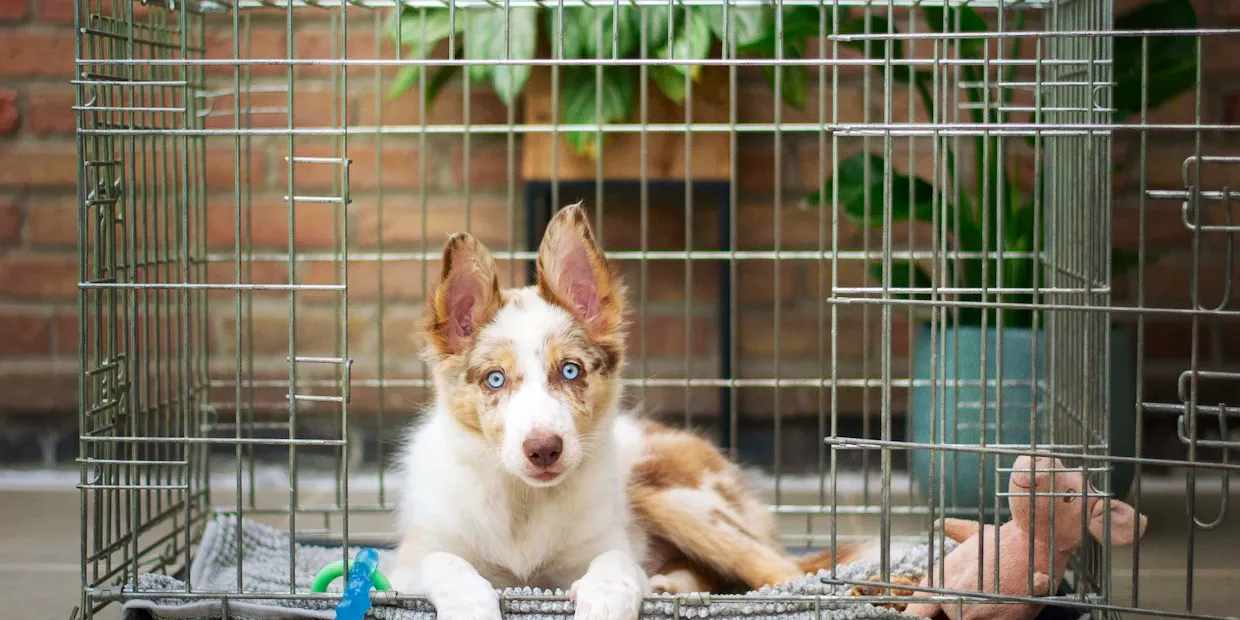
Practically, that means a crate or pen and a stuffed chew roughly every hour or two of wakefulness, on a schedule rather than on demand — the same clock discipline that makes how to potty train a puppy work. If your puppy fights the crate, crate training your puppy is worth fixing first, because without a settle spot you have no way to end an arousal spiral.
The wind-down we'd run, starting fifteen minutes before the hour your puppy usually unravels:
- Potty trip, on leash, boring on purpose.
- Lights and noise down — television off, kids' game paused, nobody doing the excited voice.
- A stuffed chew in the crate or pen, door closed, and you walk away rather than hovering.
- Let them complain for a few minutes if they are going to. Overtired puppies protest the nap they need.
Anyone asking how to stop puppy mouthing and biting in the evening specifically should try this for four or five nights before changing anything else. It is the cheapest experiment on the list, and when overtiredness is the cause, the difference shows up fast.
Puppy Biting Hands and Clothes: The Specific Fixes
Different targets need different responses, and the generic advice to ignore it does not cover all of them.
- Hands. Stop hand-wrestling entirely, including the affectionate version. The ASPCA warns against jerking your hands or feet away, because the sudden movement invites grabbing. Go limp, then disengage.
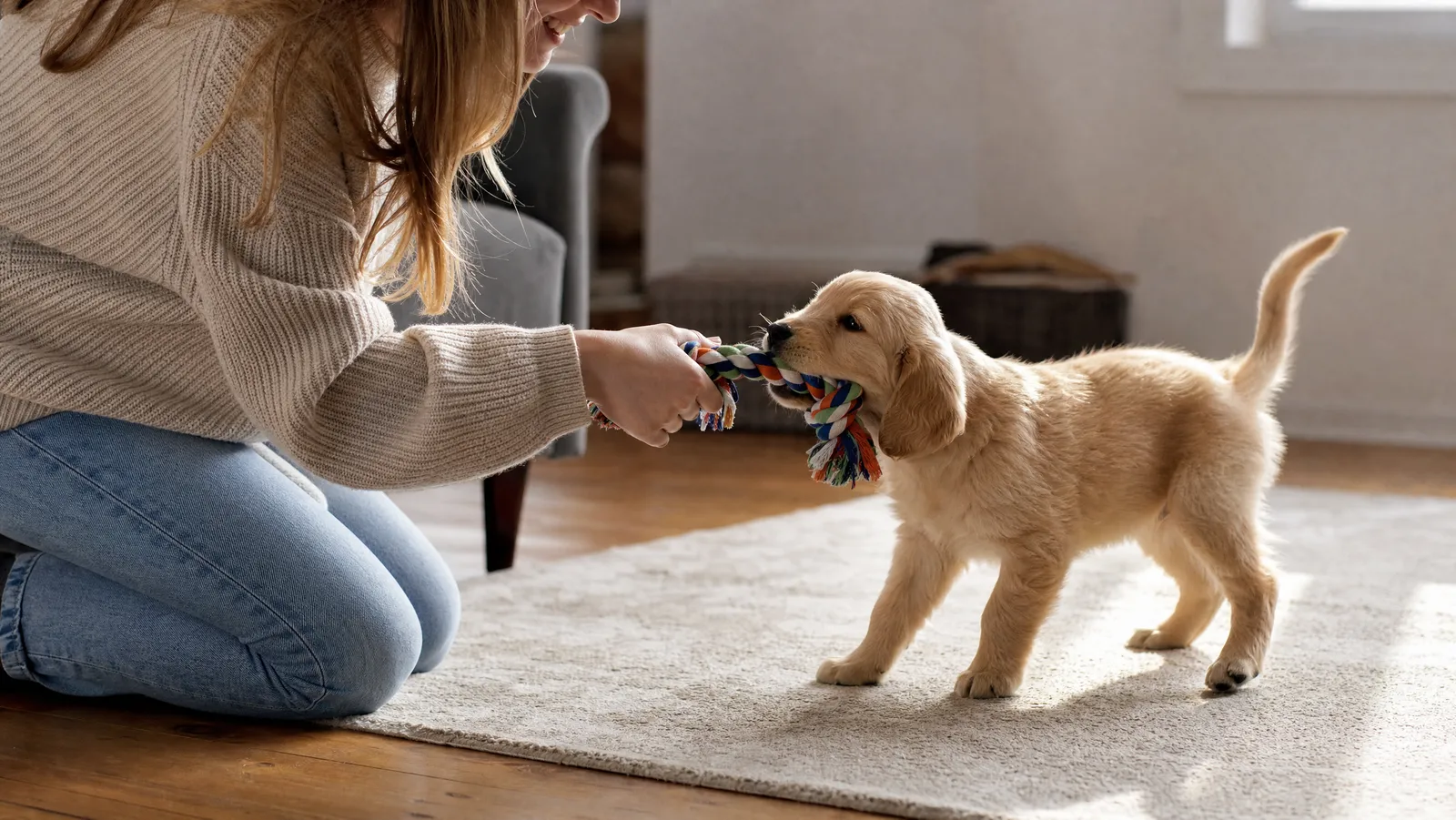
- Ankles and trouser legs. Movement is the trigger, so freeze. Stand still, wait for the puppy to let go, then produce a tug toy and move again once the toy is in their mouth.
- Sleeves and hems. Carry a tug toy on you during known bitey windows so the trade is instant. A puppy dragging a laundry item around is rehearsing the habit.
- Kids. Children cannot reliably go still, and a squealing, running child is the best tug toy in the house. Supervise directly, and give kids a job with a toy rather than a rule about their hands.
- The chase-and-bite loop. A lightweight house line on a flat collar, under supervision only, lets you calmly guide a puppy away instead of grabbing at them.
What Quietly Makes Biting Worse
If you have been searching why does my puppy bite me or when do puppies stop biting at 6 a.m., the answer is usually sitting in this list rather than in the puppy's temperament.
- Overtiredness, which is by far the most common one
- Rough hand play that teaches skin is a toy
- Inconsistency between household members, so the rule is a coin flip
- Too few legal chewing outlets during a teething stretch
- Punishment, which raises arousal and, per the AVSAB, risks increasing fear and aggression
- Time-outs that get abandoned after four seconds because the puppy protested
When Biting Is a Reason to Ask for Help
Most puppy biting is normal play, but the body language tells you when it is not. The ASPCA describes a puppy tantrum as a body that looks very stiff or frozen, with the lips pulled back to expose the teeth, or a growl — and distinguishes that from a relaxed, wriggly play face. It advises seeking qualified help when biting appears fearful or frustrated rather than playful, naming a Certified Applied Animal Behaviorist or a Diplomate of the American College of Veterinary Behavior.
The AKC's timing marker is useful as well: if biting has not improved by the time a puppy is six months old, it recommends consulting a professional trainer or behaviorist.
There is a health angle too. VCA Animal Hospitals advises checking a puppy's mouth every week until about seven to eight months of age to make sure the teeth are coming in normally. If your puppy suddenly becomes mouth-shy, drops food, paws at their face, or has a baby tooth still sitting beside an adult one, that is a reason to have your vet take a look before you treat it as a training problem.
What to Do This Week
Pick the three things that move fastest. Put a chew toy in every room so redirection takes one second. Put naps on a clock instead of waiting for the witching hour. And commit to the 10-to-20-second disengage every single time, including the times it is inconvenient.
Then give it weeks, not days. The force softens before the frequency drops, and the frequency drops before the mouthing stops — that order is the whole reason the ASPCA teaches gentleness first. For the full picture of how the teething calendar, the chewing drive, and the biting all connect, read our complete puppy teething and biting guide.
Our top picks

KONG makes this in a softer natural rubber the company says was developed for a growing puppy's 28 baby teeth, which is the whole reason it belongs in a biting article rather than an adult chew-toy roundup. It is stuffable, so the same toy that absorbs a bitey moment can also buy you twenty quiet minutes.
What we love
- Softer puppy-specific rubber formulation, per KONG
- Stuffs with treats, kibble or paste, which doubles it as a crate-training tool
- Bounces for fetch, per KONG, so it doubles as a redirect toy
- Made in the USA with globally sourced materials
Keep in mind
- Built around baby teeth — once adult teeth are in, you are shopping again
- KONG advises supervised play and says to remove the toy if it is damaged, so this is not a leave-them-to-it chew

The bone shape is easier for a small puppy to pin and grip than a classic cone, and the Goodie Grippers on each end hold snacks or paste. KONG states it soothes sore teeth and gums, which is a manufacturer claim rather than a clinical one, but the softer puppy rubber is the part we care about.
What we love
- Same softer puppy rubber formulation as the KONG Puppy
- Goodie Grippers on both ends hold snacks or paste for longer sessions
- Shape gives a small puppy something to hold down with both paws
- Made in the USA with globally sourced materials
Keep in mind
- Stuffing both ends means more washing-up than a single-cavity toy
- KONG advises supervised play and removal if damaged — check it before every session
A soak-and-freeze stick designed to give a teething puppy something cold to work on, and aimed at pulling chewing away from furniture and shoes. At 8.5 inches it is long enough for a puppy to hold at one end and chew at the other.
What we love
- Designed to be soaked and frozen for a cool chew
- Soft construction rather than a hard chew
- Cheapest way to add a cold option to the toy rotation
Keep in mind
- A stuffed polyester shell with fringe — a determined shredder will find the seams
- The maker advises supervised play and says to remove and replace it if damaged, so it is not an unattended toy
- Needs re-soaking and re-freezing between uses, so you want two in the freezer

An edible chew rather than a toy, which makes it useful for the specific job of buying a settled ten minutes when a rubber toy is not holding attention. Nylabone says these are for x-small puppies up to 15 pounds, so check your puppy's weight before ordering.
What we love
- Made with no artificial preservatives, colors or flavors, per Nylabone
- Three flavors in the pack — roast beef, turkey and apple, and bacon — so you can find what your puppy actually works for
- Turkey and apple variety is formulated with DHA, per the maker
- Made in the USA
Keep in mind
- Sized for x-small puppies up to 15 pounds per the maker, which rules out most medium and large breeds
- Edible, so it is a consumable cost rather than a one-time purchase, and the calories count toward the day's food
Frequently asked questions
How long does it take to stop puppy biting?
Longer than a weekend, and it fades rather than stops. The ASPCA's approach is to teach gentleness first and restraint second, which means the force of the bite softens well before the mouthing disappears. The AKC's practical marker is age six months: if biting has not clearly improved by then, it recommends working with a professional trainer or behaviorist. Progress usually comes across weeks rather than days, with bad evenings scattered through it.
Should I yelp when my puppy bites me?
Sometimes, and not endlessly. The ASPCA suggests a high-pitched yelp as if you are hurt, letting your hand go limp, then praising the puppy when they stop — repeated no more than three times in a 15-minute period. The AKC adds an important caveat: a high-pitched sound excites some puppies further. If yours gets more frantic when you yelp, drop the noise and go straight to disengaging.
Is it ever okay to let a puppy chew on my hands?
We would not build the habit. Hands that wrestle, tap, and dart away teach a puppy that skin is a toy, and the ASPCA specifically warns against jerking your hands or feet away because that movement invites grabbing. Play tug, fetch, and flirt-pole games instead, so there is always an object between your skin and the teeth. The rule is easier for kids and guests to follow, too.
Why does my puppy bite so much more in the evening?
Usually because the puppy is overtired rather than under-exercised. The AKC says it is common for puppies to sleep 18 to 20 hours a day, and a puppy running short on that tends to get faster and sharper, not slower. The fix most owners resist is an enforced nap in a crate or pen before the meltdown, rather than another round of fetch after it has started.
When is puppy biting a reason to call a professional?
When the body language changes. The ASPCA describes a puppy tantrum as looking stiff or frozen, with lips pulled back to expose the teeth or a growl, and says biting driven by fear or frustration rather than play is worth professional assessment — a Certified Applied Animal Behaviorist or a Diplomate of the American College of Veterinary Behavior. Sudden mouth sensitivity is also a reason to have your vet look at the teeth.
About the author
James Martin
I'm an animal lover through and through. I grew up with dogs, my family always had at least one pet, and today I share my home with a rescue who is the love of my life. I started Healthy Puppy Review to help owners cut through the marketing noise and make confident, well-researched choices about their dog's health and happiness.