Puppy Teething and Biting: The Complete Survival Guide
Teething and biting run on the same clock: baby teeth arrive around three weeks, adult teeth start replacing them from around 12 weeks, and most puppies have a full adult set by about six months. Here's what's actually happening in that mouth, what helps sore gums, how to teach a puppy to use their teeth gently, and the few things worth a call to your vet.

Contains affiliate links · our policy
In this guide
- The Short Version
- The Teething Timeline, Week by Week
- What Teething Looks Like (and What It Shouldn't)
- Relief That Actually Helps Sore Gums
- The Toys That Get Them Through It
- Chews and Edible Teething Treats
- When Teething Puts Them Off Their Food
- Why Puppies Bite in the First Place
- Teething or Just Biting? Telling Them Apart
- Teaching a Puppy to Stop Biting
- Kids, Toddlers, and a Mouthy Puppy
- When It Finally Ends
- What to Do This Week
- Explore the full series
- Our Top Picks
- FAQ
Puppy teething and biting run on the same clock. Baby teeth start pushing through at around three weeks of age, adult teeth begin replacing them at roughly three to four months, and VCA Animal Hospitals says that normally, by six months of age, all the permanent teeth have erupted and all the baby teeth have fallen out. The biting that rides along with it is normal behaviour that needs teaching, not punishment.
We may earn a commission from links on this page, at no extra cost to you.
If you found this page at 6am with a puppy fastened to your sleeve, what you're seeing is almost certainly normal puppy behaviour rather than a sign that something is wrong with your dog. What follows is the whole problem on one screen: what's happening in that mouth week by week, what genuinely helps sore gums, what makes the biting worse, and the short list of things that are worth a phone call rather than a forum search.
The Short Version
- Teething is two waves. Baby teeth erupt from around three weeks; adult teeth push them out from around 12 weeks, per VCA Animal Hospitals.
- The hard weeks are roughly three to six months. That's when adult incisors, canines and premolars are all arriving, per PetMD's teething guide.
- Biting is not teething, but teething makes it worse. Mouthing is how puppies play and learn; sore gums add pressure on top of it.
- Chewing gets redirected, not banned. The ASPCA's advice is to substitute a toy, not to punish the mouth.
- Punishment backfires. The ASPCA warns that slapping or hitting a puppy for playful mouthing can make them bite harder or become afraid of you.
- Most of it resolves by six months. The AKC's marker: if you can't moderate the biting by then, bring in a trainer or a behaviour specialist.
The rest of this guide takes each of those pieces in turn.
The Teething Timeline, Week by Week
The timeline is more useful than any single age, because it tells you what's normal right now. Here's the working version, built from the AKC, VCA Animal Hospitals, and PetMD's teething guide, which is authored by veterinary dentist Dr. Mallory Kanwal, DVM, DAVDC.
| Age | What's happening | |---|---| | 2–4 weeks | First baby teeth break through, usually while the puppy is still with the breeder | | 5–8 weeks | A full set of 28 baby teeth is in — the "needle teeth" weeks | | 12–16 weeks | Baby teeth start shedding; adult incisors and canines push through | | 4–6 months | Adult premolars arrive; the peak chewing stretch for most puppies | | 5–7 months | Adult molars finish the set — 42 adult teeth in total |
VCA Animal Hospitals describes the first wave plainly: deciduous teeth start erupting at around three weeks of age and all 28 are normally in by about six weeks, incisors and canines first, then premolars. The AKC's own timeline puts the first baby teeth as early as two weeks and the full set of 28 at about five to six weeks.
The second wave is the one you live through. VCA says the deciduous teeth begin falling out and the permanent teeth begin erupting at around 12 weeks, and that normally, by six months of age, all permanent teeth have erupted and all deciduous teeth have fallen out. The AKC describes weeks 12 to 16 as the point when you start finding "crumb- to rice-sized teeth" around the house. PetMD's guide is more granular: baby teeth begin falling out at around three and a half to five months, adult incisors and canines erupt from three to five months, premolars from four to six, and molars from five to seven.
The number that matters most is 42. Puppies swap 28 baby teeth for 42 adult ones in a few months, which is a lot of hardware moving through a small mouth. We'll break down the full puppy teething timeline in its own article, including what to expect at each checkpoint and how much variation between breeds is normal.
What Teething Looks Like (and What It Shouldn't)
Most of what you'll see is behavioural rather than dramatic. PetMD's teething guide lists increased chewing, mouthing, and a stronger desire to gnaw on objects as the everyday markers, along with seeking out different textures and getting mouthier during play. VCA notes that the baby teeth themselves are "pointed and sharp" — the reason people call them needle teeth — and that chewing on people, furniture and objects appears to relieve the discomfort of the process.
You'll probably also find teeth. Or rather, you won't: they're tiny, they come out during chewing and eating, and plenty of them are never seen again. Finding one on the rug is a milestone, not a problem.
The part worth paying attention to is the mouth check. VCA Animal Hospitals recommends inspecting your puppy's mouth every week until about seven to eight months of age to make sure the teeth are coming in normally. What you're looking for is simple: two teeth in the same spot. VCA describes that as the signature of a retained deciduous tooth, and says it's a reason to book an appointment for your vet to examine the mouth. Retained baby teeth need to be removed, and VCA is specific about the timing: persistent deciduous teeth "need to be removed (extracted) promptly," and "in most cases, it is not recommended to wait until your pet is neutered or spayed."
Why bother? VCA's explanation is that teeth making inappropriate contact with other teeth or with soft tissue can cause pain and infection, and can lead to abnormal wear and eventual fracture. The AKC gives the same instruction in simpler terms: if you notice any baby teeth still present, tell your veterinarian, as they may need to come out.
Anything beyond routine puppy teething symptoms — facial swelling, a mouth your puppy won't let you near, bleeding that doesn't settle, or a puppy who seems genuinely unwell rather than just chewy — is a reason to check in with your vet rather than to keep troubleshooting at home. We'll cover the full picture separately.
Relief That Actually Helps Sore Gums
Cold and appropriate chewing do most of the work. PetMD's teething guide points to soft rubber and chilled chew toys, frozen or chilled treats such as blueberries, green beans and carrots, and kibble frozen inside a puzzle toy, on the basis that cold helps reduce gum inflammation and discomfort. The AKC's specific suggestion for a teething puppy is freezing a stuffed KONG or a frozen Chilly Bone.
A few things we'd do, and a few we'd skip:
- Freeze the toy, not the puppy's jaw. A soaked and frozen fabric chew, or a rubber toy stuffed with wet kibble and frozen, gives cold plus something safe to work on.
- Rotate rather than pile on. Two or three toys out at a time, swapped every couple of days, holds interest better than a bin of fifteen.
- Be careful with ice. VCA Animal Hospitals puts ice cubes on the list of things hard enough to damage teeth, and the AKC suggests shaved ice or appropriately sized pieces if you want to offer ice at all.
- Skip human teething gels entirely. Pet Poison Helpline states that Orajel is not safe for dogs, citing the risk of methemoglobinemia — a condition affecting the blood's oxygen-carrying capacity — and notes that many formulations also contain xylitol, which can cause a dangerous drop in blood sugar and liver failure in dogs.
- Ask before you medicate. Human pain relievers are not a home option for a teething puppy. If your puppy seems to be in real pain, that's a conversation with your vet, not a cabinet decision.
A frozen, wrung-out washcloth is the classic kitchen-drawer trick and a reasonable one, with the obvious caveat: it's supervised only, and it comes away the moment your puppy starts shredding rather than gnawing. Fabric that gets swallowed is a worse problem than a sore gum. Our dedicated guide on how to soothe a teething puppy goes further into cold options, timing, and what to do on the evenings when nothing seems to settle them.
The Toys That Get Them Through It
There's one rule that outranks everything else here, and it comes from veterinary dentistry rather than marketing. VCA Animal Hospitals passes it along directly: don't let your dog chew anything that won't bend. Nylon bones, real bones and antlers are on the avoid list precisely because they can break teeth. The AKC also warns owners off real wooden sticks, though its stated reason is punctures, splinters and obstructions rather than fractured teeth. And VCA is blunt about the rest: supervise your puppy even with recommended toys, because no toy is 100 percent safe.
With that filter applied, two things earn their place in a teething household.
The KONG Puppy Natural Rubber Teething Chew Toy is the default for a reason. KONG says the puppy version uses a customised softer natural rubber developed for a growing puppy's 28 baby teeth, and that it can be stuffed with treats, kibble or paste to occupy a busy pup and help with crate training. It also bounces, so it isn't a single-purpose object. The small size is around 7 dollars as of September 2026. Two honest caveats: the soft puppy formulation is aimed at baby teeth, so you'll be sizing up once the adult set arrives, and KONG advises supervised play with the toy removed if it's damaged.
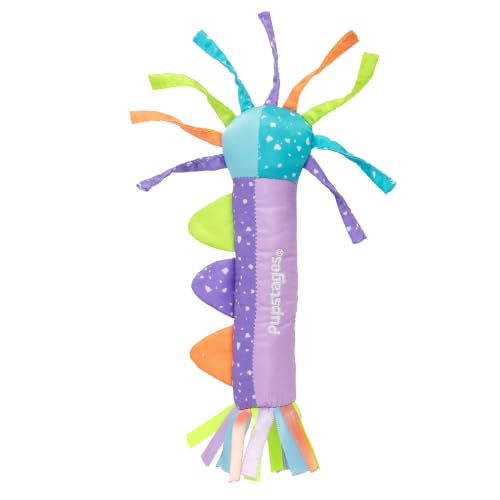
The Pupstages Cool Teething Stick takes the other approach — you soak it and freeze it, and the cold does part of the job. It's an 8.5-inch soft stuffed stick with a fringe, pitched at redirecting chewing away from furniture and shoes, and it runs around 5 dollars as of September 2026. It is not a durable chew and was never meant to be: the maker's own guidance is supervised play, with the toy removed and replaced if it gets damaged. Treat it as a soothing session, not a babysitter.
If you're still assembling the basics, our roundup of must-have toys for a new puppy covers the non-teething side of the toy box. And our full comparison of the best puppy teething toys goes deeper on textures, freezer performance and what holds up as the adult teeth come in.
Chews and Edible Teething Treats
Edible chews solve a different problem from rubber toys. A rubber toy is a place to put the pressure; an edible chew is a finite, high-value event that occupies a puppy for a stretch and then ends. Both are useful. Neither should be hard.
The hardness rule applies with even more force here, because this is the category where teeth actually break. Veterinary dental sources describe a slab fracture — the outer wall of a tooth shearing off when it meets something harder than the tooth itself — with the large upper fourth premolars, the carnassial teeth, the most common casualties. Bones, hooves, hard nylon and antlers are the usual suspects. The homespun version of the test that veterinary dentists use: if you think it would hurt to hit yourself in the knee with it, or you couldn't dent it with a thumbnail, it's too hard for your dog.
For an edible option, our pick of puppy teething chews starts with the N-Bone Puppy Teething Rings in pumpkin flavour, at roughly 9 to 10 dollars for six rings as of September 2026. N-Bone says the rings are enriched with calcium and DHA omega-3, contain no plastic and no rawhide, and are made in the USA, and the company's position is that the chewing action helps soothe sore gums. The limitation is in their own product information: they're designed for puppies three months and older, so they aren't an option for an eight-week-old. They're also consumable — six rings disappear a great deal faster than one rubber toy does.
Whatever you pick, supervise it, and take it away when it gets small enough to swallow whole. That's the part no product page will tell you.
When Teething Puts Them Off Their Food
A fussy eater around four months is one of the most common questions we see, and the honest answer is that it's usually less dramatic than it feels. The telehealth service Vetster's teething guide notes that it isn't usually necessary to switch a puppy to soft food just because they're teething, since most puppies manage hard puppy food throughout the process. But it also says that if your puppy appears to be in pain or shows a loss of appetite, that's a conversation to have with a vet.
The practical middle ground, and the one we'd try first:
- Add warm water to the existing food rather than changing products. The AKC's guidance on switching dog foods is that an abrupt change can cause gastrointestinal upset, and that any switch should be phased in gradually over roughly five to seven days — a heavy teething week is a poor time to start one.
- Give it a few minutes to soften before putting the bowl down, so the kibble is yielding rather than just wet.
- Keep the schedule. Meals at the same times, picked up after 15 or 20 minutes, rather than food left out all day.
- Watch the trend, not the meal. One skipped breakfast during a heavy shedding week is different from three days of declining interest.
Our step-by-step on how to soften puppy food covers water temperature, ratios and how to walk it back once the mouth settles down.
Where we'd stop experimenting: a puppy who refuses all food, who is lethargic, vomiting, or drooling heavily, or whose appetite loss keeps going rather than passing, needs a vet's eyes rather than a kitchen fix. Vetster's guidance is to talk to a vet if your puppy appears to be in pain or shows a loss of appetite, since it may be teething pain but may also be the result of a different health issue. Our full article on a teething puppy who isn't eating works through the timelines and the warning signs in detail.
Why Puppies Bite in the First Place
Because that's how puppies find out what their mouths do. The ASPCA's explanation is that puppies normally learn bite inhibition — the ability to control the force of their mouthing — during play with other puppies. A pup bites a littermate too hard, the littermate yelps and stops playing, and the biter learns that too much pressure ends the game. A puppy who never completes that lesson doesn't understand how fragile human skin is, and bites too hard even in play.
Then you bring them home at eight weeks, and you become the littermate. The AKC frames it the same way: puppies naturally nip at each other while playing and sometimes don't realise how hard they're able to bite down.
Two more drivers sit underneath the social one:
- Sore gums. Pressure feels good on a gum that has a tooth coming through it, and your forearm is available.
- Exhaustion and unmet needs. The AKC's training guidance is to check the basics first — whether the puppy needs a nap, a potty break, food, water, or a real burst of physical and mental exercise. An overtired puppy is a bitey puppy, and the fix is a crate and a nap rather than a training session.
Size is what changes the experience, not the behaviour. The ASPCA notes that mouthing becomes considerably less endearing at around three to four months old, as the puppy gets bigger. The behaviour hasn't escalated; the puppy has.
Worth knowing the difference: the ASPCA describes playful mouthing as coming with a relaxed body and face, while a puppy behaving aggressively looks stiff or frozen, may pull their lips back, may growl, and bites much harder. Our longer piece on why your puppy bites you unpacks the motivations, including the frustration biting that doesn't resolve on its own.
Teething or Just Biting? Telling Them Apart
They overlap constantly, but they call for different responses, so it's worth separating them.
Teething-driven chewing is about objects and pressure. It targets table legs, shoes, cords, the corner of a rug — anything with a texture worth working on. It's steady rather than excitable, it tends to happen when the puppy is settled rather than wound up, and it escalates in the months PetMD identifies as the shedding window, roughly three and a half to five months. The answer is substitution: something legal and chewable, ideally cold.
Play biting is about you. It arrives with a wagging tail, a play bow, and a puppy who is clearly having a wonderful time attached to your sleeve. It spikes during excitement, greetings, and the late-afternoon hour that every puppy owner learns to dread. The answer isn't a better toy on its own — it's feedback about pressure, which is the bite inhibition lesson.
A quick field test: offer a toy. A puppy who takes the toy and settles in with it was looking for something to chew. A puppy who ignores the toy and comes straight back for your hand was looking for a game, or is simply past the point of thinking clearly and needs a nap.
The reason to tell teething versus ordinary puppy biting apart is that one of them has an end date and the other one has a curriculum. Teeth stop arriving. Manners don't install themselves. And the urge to chew doesn't necessarily switch off when the last molar lands — plenty of dogs keep chewing well past the teething months, which is an argument for keeping legal chew options in the rotation permanently rather than packing them away at seven months.
Teaching a Puppy to Stop Biting
This is the part that repays consistency more than cleverness. The ASPCA's core method is to make biting end the fun:
- Let your puppy mouth your hands during play. You're not banning contact, you're grading pressure.
- When they bite hard, give a high-pitched yelp and let your hand go limp, as if you're hurt.
- Praise them for letting go, then resume play.
- If the yelp doesn't work, the ASPCA suggests a stern "Too bad!" instead.
- If that doesn't work, take the game away. Remove your hand and ignore the puppy for 10 to 20 seconds, or get up and move away.
- Raise the bar gradually, responding to progressively softer bites over time until mouthing is gentle by default.
The AKC's version is similar with one useful variation from trainer Kathy Santo: turn quietly away and tuck your hands into your armpits, which she describes as a calming signal and a minor withdrawal of attention. The AKC also suggests that if a puppy is escalating rather than settling, gently putting them into their crate for a few minutes to calm down is fair — as a reset, not a punishment.
What to avoid matters as much as what to do. The ASPCA is explicit that slapping or hitting a puppy for playful mouthing can cause them to bite harder, and can make them afraid of you. It also names scruff shaking, whacking the nose, and putting fingers down the throat as methods to skip. The AKC adds yelling to the list, on the grounds that a big reaction can itself become the reward, and warns against roughhousing in a way that encourages a puppy to lose control.
And keep something legal in reach. Both the ASPCA and VCA make the same point in different words: substitute a toy or a chew for your hands, and don't play in ways that teach a puppy that hands are toys. Our dedicated guide on how to stop puppy biting works through the full progression, including what to do with a puppy who bites harder when you go quiet.
Kids, Toddlers, and a Mouthy Puppy
This is the situation where "normal puppy behaviour" and "family safety" have to be handled at the same time, and the veterinary guidance is consistent enough to take literally.
The AVMA's position is that young children should always be supervised around dogs, no matter how well behaved either one is, and it describes supervision as one of the most effective ways to reduce the risk, with young children never left alone with a dog — even a familiar family pet. Active is the operative word — in the same room, watching, close enough to intervene, not glancing up from a laptop.
The AVMA's other points translate directly to a house with a puppy:
- Teach children not to disturb a dog who is sleeping, eating, or caring for puppies. Those are the moments dogs are most likely to feel cornered.
- Let the dog approach first, and keep petting gentle and on the back or shoulders.
- Understand what's driving a bite. The AVMA notes that bites typically happen when a dog feels stressed, frightened or uncomfortable, often during interactions that seem harmless to us — hugging, approaching too fast, interrupting a meal.
- Think about timing before you add a dog. The AVMA suggests considering waiting until children are older than four before adopting a new dog.
Practically, the thing that helps most is giving the puppy somewhere the children cannot follow. A crate, a pen, or a baby-gated room used generously during the hardest hours does more for everyone than any amount of correction. A puppy who is genuinely overtired cannot make good decisions, and a toddler cannot be expected to read a puppy's warning signals. Separate them before the situation needs managing.
The whole topic of puppy biting around kids and toddlers has enough moving parts — height, fast movement, high-pitched voices, food in hands — that we've given it a full article of its own.
When It Finally Ends
Most of it fades as the mouth finishes changing. The AKC's marker is that things improve at around six months of age, when the adult teeth are in, and its teething guidance is that by six months the baby teeth should be gone. VCA's framing is compatible: normally, by six months of age, all the permanent teeth have erupted and the baby teeth have gone. PetMD puts the last molars at five to seven months, which is why some puppies run a few weeks past the marker.
But a trend is not a guarantee, and this is where honest expectations matter:
- Chewing and mouthing are different problems. The mouthing usually eases with teething and training. The urge to chew often outlasts both, which is why chew toys stay in the rotation.
- What you taught is what you get. The AKC's reason for teaching bite inhibition is forward-looking: any adult dog might put their mouth on someone if they're in pain or fearful, and a dog who learned to moderate pressure as a puppy is a safer dog in that moment.
- There's a clear point to get help. The AKC advises that if you haven't been able to moderate the biting by six months, consult an experienced dog trainer or an animal behaviour specialist.
- Some biting is not a phase. The ASPCA is direct that repeated bouts of biting in frustration are not something a puppy will simply grow out of, and recommends a Certified Applied Animal Behaviorist or a veterinary behaviourist if you suspect aggression or fear rather than play.
Our full piece on when puppies stop biting covers the realistic curve month by month, and what it means if your puppy is still on your hands at eight months.
What to Do This Week
If you want three things to act on rather than a plan to admire:
- Check the mouth on a fixed day. VCA recommends weekly until seven or eight months. Sunday morning, thirty seconds, looking for two teeth in one spot.
- Put two cold options in the freezer tonight. A stuffed rubber toy and a soaked fabric chew, so there's always one ready when the evening gets loud.
- Pick one response to biting and use it every time. Yelp and go limp, or turn away and tuck your hands. Consistency beats the choice.
And give the puppy more sleep than you think they need. A remarkable amount of what gets diagnosed as a biting problem is an overtired puppy with nowhere quiet to go. If you're building the rest of the routine at the same time, our guide to how to potty train a puppy lays out a daily schedule the nap plan can sit inside.
Explore the full series
- Puppy Teething Timeline: When Baby Teeth Come In and Fall Out — When the 28 baby teeth arrive, when they fall out, and what the adult set does between three and seven months.
- Puppy Teething Symptoms: What's Normal and What Means a Vet Visit — Drooling, chewing, a little blood on a toy — what is ordinary teething and what is worth a vet appointment.
- How to Soothe a Teething Puppy: Relief That Actually Works — Cold, texture and timing: the relief that actually helps sore gums, and the products to keep away from them.
- The Best Puppy Teething Toys — The teething toys worth buying, sorted by what stage of the mouth they suit.
- Why Does My Puppy Bite Me? The Five Real Reasons — The reasons behind the mouthing — play, teething, overtiredness — and what each one needs from you.
- How to Stop Puppy Biting: The Bite-Inhibition Protocol That Works — The bite-inhibition protocol step by step, and how to tighten the standard as the weeks go on.
Our top picks


KONG makes a puppy-specific version in a softer natural rubber the company says was developed for a growing puppy's 28 baby teeth. It stuffs with kibble, treats or paste, which turns a chew into something closer to a job, and it still bounces for fetch.
What we love
- Softer natural rubber formulated for baby teeth rather than adult jaws
- Stuffable with kibble, treats or paste to stretch out a chew session
- KONG suggests it doubles as a crate-training occupier
- Made in the USA with globally sourced materials
Keep in mind
- The soft puppy rubber is built for a puppy's 28 baby teeth, so expect to size up in both firmness and dimensions once the adult set is in
- KONG advises supervised play and removing the toy if it's damaged, so it's not a leave-them-alone-with-it option
An 8.5-inch stuffed stick designed to be soaked and frozen, so the cold does part of the work on sore gums. Pupstages positions it as a way to redirect chewing away from furniture and shoes.
What we love
- Soak-and-freeze design puts cold where the discomfort is
- Soft stuffed polyester shell with fringe
- Aimed squarely at redirecting chewing off furniture and shoes
Keep in mind
- A soft stuffed toy is not a durable chew — the maker says to remove and replace it if it's damaged
- Needs soaking and refreezing between sessions, so one stick doesn't cover a whole afternoon
An edible ring that N-Bone says is enriched with calcium and DHA omega-3, with the chewing itself intended to soothe sore gums. Six to a pack, with no plastic and no rawhide.
What we love
- Edible, with no plastic and no rawhide
- N-Bone says each ring is enriched with calcium and DHA omega-3
- Made in the USA
Keep in mind
- N-Bone states they're designed for puppies three months and older, so they're not for the youngest chewers
- They get eaten, so six rings go faster than a rubber toy lasts
Frequently asked questions
When do puppies start teething and when does it end?
Twice, in a sense. VCA Animal Hospitals says deciduous teeth start erupting at around three weeks of age and all 28 are usually through by about six weeks. The second round is the one owners notice: VCA says permanent teeth begin erupting around 12 weeks and that normally, by six months of age, all permanent teeth have erupted and all deciduous teeth have fallen out. PetMD puts the last adult molars a little later, at five to seven months. The American Kennel Club puts the shedding window at roughly 12 to 16 weeks onward.
How do I stop my puppy from biting me?
The ASPCA's approach is to make biting end the fun rather than to punish it. When your puppy bites hard, give a high-pitched yelp and let your hand go limp, praise them for letting go, then resume play. If that doesn't land, the ASPCA suggests removing your hand and ignoring the puppy for 10 to 20 seconds, or walking away. Redirect onto a toy, and tighten the standard over time.
Is it normal for a teething puppy to have bleeding gums?
Some blood around a shedding tooth is commonly described as part of the process, but this is a judgement call worth handing to a professional rather than a website. VCA Animal Hospitals recommends checking your puppy's mouth weekly until about seven or eight months of age, and it flags two teeth in the same socket as a reason to book an appointment. Persistent bleeding, swelling, or obvious pain is a call, not a wait.
What can I give my puppy for teething pain?
Cold and safe chewing, not medication. PetMD's teething guide, written by veterinary dentist Dr. Mallory Kanwal, DVM, DAVDC, points to soft rubber and chilled chew toys, frozen treats such as blueberries or green beans, and kibble frozen inside a puzzle toy. Skip human oral teething gels — Pet Poison Helpline warns that benzocaine products like Orajel are not safe for dogs. Ask your vet before giving any pain medication.
At what age do puppies stop biting?
Most puppies get noticeably less mouthy as the adult teeth finish coming in, which the AKC puts at around six months. That is a trend, not a switch, and it depends on what you taught during the mouthy months. The AKC's guidance is that if you haven't been able to moderate the behaviour by six months, it's worth consulting an experienced dog trainer or an animal behaviour specialist.
About the author
James Martin
I'm an animal lover through and through. I grew up with dogs, my family always had at least one pet, and today I share my home with a rescue who is the love of my life. I started Healthy Puppy Review to help owners cut through the marketing noise and make confident, well-researched choices about their dog's health and happiness.