Potty Training a Puppy at Night: When They Can Finally Sleep Through
Most puppies sleep through the night without a potty break around four months old. Until then: one alarm, one boring trip outside, and an evening routine that starts at dinner. Here is the night-by-night plan, plus what to do about the crate soiler and the puppy who cries but does not need to go.

Contains affiliate links · our policy
In this guide
- When Can Puppies Sleep Through the Night?
- Your Puppy's Night Time Potty Schedule Starts at Dinner
- Water at Night: Handle This One Carefully
- Crate Setup: Where It Goes and How Big It Is
- Puppy Potty Training Overnight: Set the Alarm, Keep It Boring
- The First Two Weeks Are Bad, and You Are Not Doing It Wrong
- When Your Puppy Wakes at the Same Time Every Night
- When the Crying Is Not About the Bladder
- How to Stop a Puppy Peeing in the Crate at Night
- When Night Accidents Mean a Vet Visit
- What We'd Do
- Our Top Picks
- FAQ
Most puppies can go through the night without a potty break at around four months old, and some get there earlier. Before that, plan on one wake-up — two if your puppy is under ten weeks. The good news at 2 a.m.: nights are easier than days, because a sleeping puppy holds it longer than an awake one.
Healthy Puppy Review is reader-supported: if you buy through a link on this page we may earn a small commission, at no extra cost to you.
That last point matters. The American Kennel Club notes that puppies will usually be able to hold their bladder for a longer period when they are asleep and not active, so your daytime interval is not the number you have to survive overnight. Below is how to potty train a puppy at night in practice: the age-by-age expectation, the evening routine that decides everything, and what to do when it goes wrong. For the daytime system it sits on top of, start with our puppy potty training schedule and method.
When Can Puppies Sleep Through the Night?
Sources cluster around four months, with a real spread either side. Certified behavior consultant Cathy Madson, writing for Preventive Vet, says most puppies will sleep through the night by the time they are about four months, or 16 weeks, old. PetMD's guidance from Dr. Rania Gollakner, DVM, MPH, is wider: some manage it by 12 weeks, but holding a bladder six to eight hours can take longer. VCA Animal Hospitals sets the outer edge, noting puppies may need overnight outings until five months of age.
The AKC's month-plus-one rule supplies the arithmetic: take your puppy's age in months, add one, and that is the maximum hours they should comfortably hold it between breaks. Across a seven- or eight-hour night, here is what to plan for.
| Puppy's age | Month-plus-one ceiling | Night wake-ups to plan for | | --- | --- | --- | | 8 weeks | About 3 hours | 2 | | 10 weeks | About 3.5 hours | 1–2 | | 12 weeks | About 4 hours | 1 | | 16 weeks | About 5 hours | 0–1 | | 5 months | About 6 hours | 0 |
The hold times are the AKC's; the wake-up column is our planning guidance, not a published figure. Small and toy breeds sit at the demanding end of every row.
Notice how much easier those are than the daytime numbers: a 12-week-old who needs a trip every two hours awake can often manage four or five asleep. The awake-hours version is in our puppy potty training schedule by age, which the night plan below assumes you are roughly following.
Your Puppy's Night Time Potty Schedule Starts at Dinner
Almost everything that decides whether you are up at 3 a.m. happens before you go to bed.
Move the last meal earlier. The AKC advises choosing a puppy food that digests well and avoiding feeding within two hours of bedtime; PetMD's veterinary guidance is stricter, suggesting you feed at least three hours before sleep so digestion has time to run its course. If dinner is at 8 p.m. and you are in bed at 10, that alone may be producing a middle-of-the-night poop. Moving it to 5 or 6 p.m. is, in our experience, one of the highest-leverage single changes you can make, and it slots into a fixed puppy feeding schedule.
Wind down for the last hour. A puppy who wrestles a rope toy until lights out goes into the crate with a full bladder and a racing metabolism. Quiet play, a chew, then bed.
Do the last trip out last. The AKC is blunt about the order of operations: the last thing you should do before bed is take your puppy out for one final potty break. Not before your teeth, not before the dishes. Last. Dr. Bonnie Beaver of the Texas A&M College of Veterinary Medicine and Biomedical Sciences lists the non-negotiable trips as after eating, before sleeping, after waking up, and after activity. Give it more time than feels reasonable: ten minutes in the cold beats forty stripping a crate.
Water at Night: Handle This One Carefully
This is where night-training advice most often goes wrong.
The AKC does suggest removing the food and water bowls about two to three hours before bedtime during house training — but warns in the same article not to take that too far, because puppies are more prone to dehydration than adult dogs given their greater need for water, and notes a panting puppy in hot weather may need to drink more than usual. Preventive Vet's trainer treats free access to water as a baseline resource and suggests talking to your veterinarian before restricting it. The Dial A Vet veterinary team splits the difference: limiting water a couple of hours before bed is generally safe from around 12 weeks of age, provided the puppy is well hydrated the rest of the day.
What we'd do: change the timing of the last drink, not the total. Water freely all day, bowl up when the wind-down starts, a small drink at the last trip outside if your puppy wants one.
Do not restrict at all if your puppy is under 12 weeks, if the house is warm, if they are on medication, or if they have suddenly started drinking more than usual — that last one is a reason to call your vet, not to take the bowl away.
Crate Setup: Where It Goes and How Big It Is
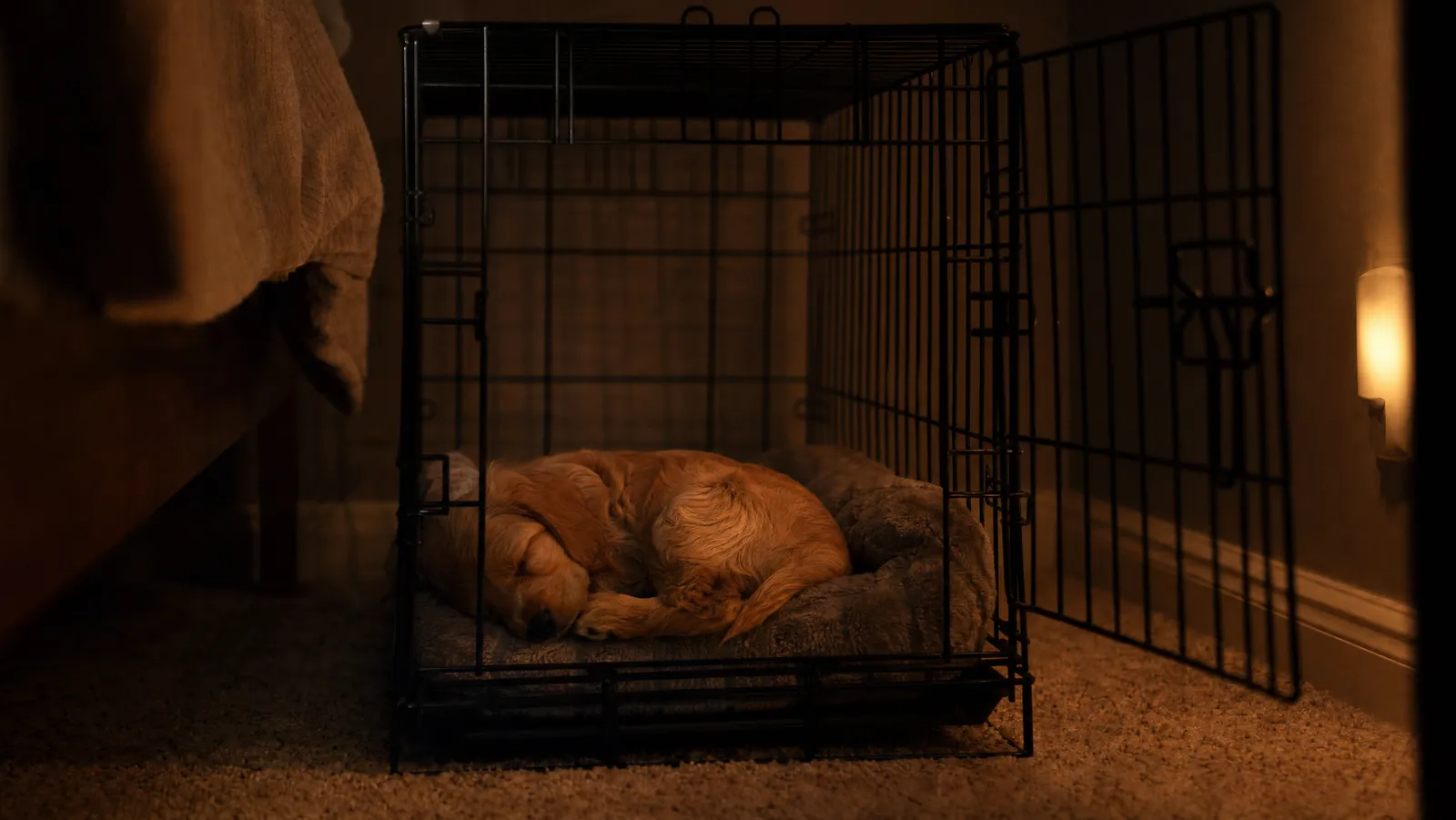
Put the crate in your bedroom. The AKC notes this lets you hear a whimper or a whine if your puppy needs to go out during the night, and PetMD is more direct: for at least the first few weeks the crate should be placed in your bedroom where you sleep. It may also cut the crying: a puppy who was sleeping against their littermates a week ago often objects more to being alone than to the crate itself.
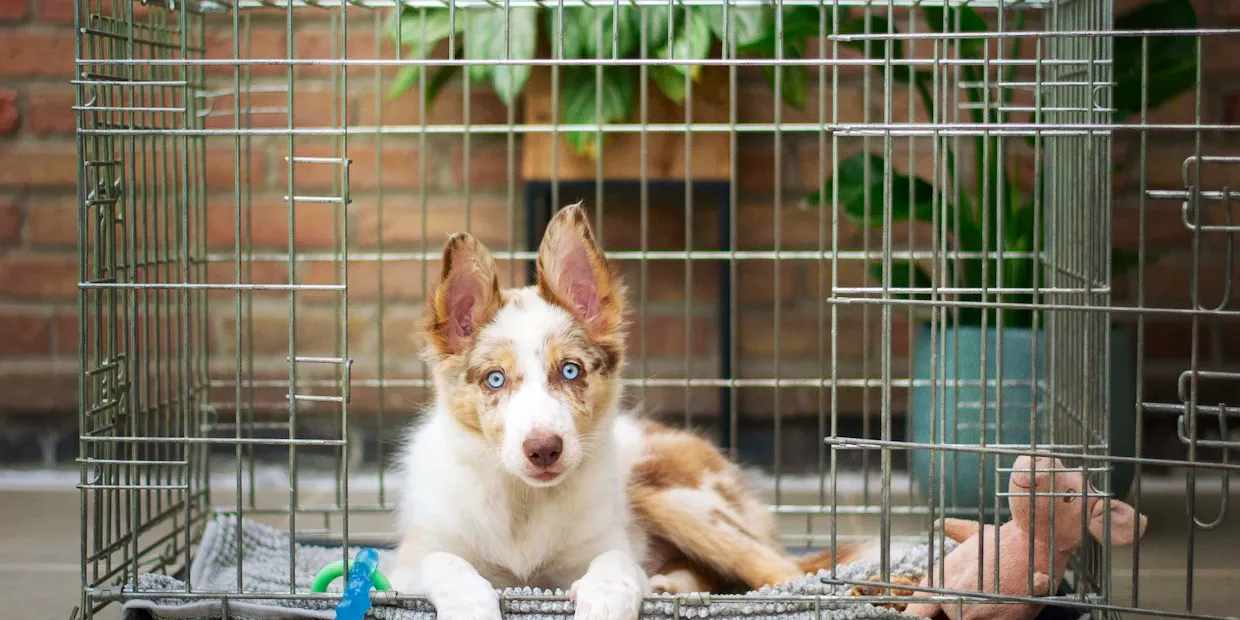
Size it tightly. The AKC calls for a crate large enough for a puppy to stand up, lie down and turn around, and its potty training guide adds the qualifier that matters: not so large that they can go potty in one corner and rest in another. If your puppy has growing left, the AKC's advice is to use the larger crate and section off half with a divider.
The whole method leans on dogs trying not to soil their home, as the AKC puts it, and an oversized crate quietly removes that instinct from the equation. If you are still deciding whether to crate at all, we make the case in three reasons crate training makes your life easier.
One limit: the AKC warns never to leave a puppy crated all day, since they need several bathroom breaks plus play and feeding times. A puppy crated nine hours while you work and asked for eight more overnight does not have a night problem — that is daytime coverage, and the subject of a separate guide on potty training a puppy while working full time.
Puppy Potty Training Overnight: Set the Alarm, Keep It Boring
Set an alarm rather than waiting for the whine. Preventive Vet recommends exactly this — it can be helpful to set an alarm for yourself during the night to take your puppy for a quick potty break — and the reason matters. If the crate door only ever opens after crying, you have taught your puppy that crying opens the crate door. An alarm teaches nothing, which is the point.
Start it about four hours after lights out for a puppy under 12 weeks, then push it 15 to 30 minutes later for each dry week. Once you have been getting up to an empty bladder for a week straight, drop it.
The trip itself should be the least interesting event of the day:
- Lights low. Enough to see the steps, no more.
- No greeting. Lift the puppy out, clip the leash, go.
- Same spot every time. The scent does the prompting for you.
- One quiet word of praise when they finish, then straight back in. Preventive Vet's phrasing: keep it calm and boring, so a sleepy puppy does not find their second wind.
- No water, no treats, no play, no conversation.
Carry a small puppy down the stairs rather than walking them; it keeps them half asleep.
The First Two Weeks Are Bad, and You Are Not Doing It Wrong
Most guides skip this, so plainly: the first ten to fourteen nights are rough, and none of it means the training has failed.
An eight-week-old is on a three-hour ceiling, has just been separated from their litter, and is sleeping in a strange room. PetMD notes puppies sleep anywhere from 12 to 20 hours a day, almost none of it in one block at first. Expect broken sleep, crying, and at least one accident at an unreasonable hour. What gets you out is running the same boring sequence every night without editing it. Going by the sources above, the first unbroken night lands anywhere from about 12 weeks to four months, and later than that for some puppies.
When Your Puppy Wakes at the Same Time Every Night
A puppy who wakes at 2:40 a.m. every single night is often running on a schedule rather than a bladder.
Sometimes it is physical: dinner at 7 p.m. produces a bowel movement at roughly the same hour, and moving the meal moves the wake-up. Check that first, along with the obvious triggers — a heating system kicking on, an early-shift alarm, a streetlight.
If it is habit instead, get there first: set your alarm 30 minutes before their usual wake-up for several nights, then start pushing it later. You are not rewarding the wake-up, you are replacing it. The tell is an empty puppy — outside, a sniff around, nothing produced, and a strong wish to play.
When the Crying Is Not About the Bladder
Take them out anyway the first few times. It is not worth guessing wrong.
But if three nights of trips produce nothing, you are dealing with loneliness, boredom, or a puppy who has learned that crying works. Loneliness is the common one in week one, and many trainers find that a hand resting against the crate door settles a puppy without teaching them that crying opens it.
The tell is what happens outside. A puppy who needs to go will go, promptly, and be ready to go back in. A puppy who wanted company wanders, chews a leaf and looks delighted to see you — in that case, no talking, straight back to the crate, and expect a loud night or two while the pattern fades.
How to Stop a Puppy Peeing in the Crate at Night
Crate soiling almost always comes down to one of three things, in this order.
The crate is too big. Re-read the sizing rule above and fit the divider. A puppy who can use one end as a bathroom will keep using it.
You are asking for more hours than they have. Run the month-plus-one number honestly. A 10-week-old asked for seven unbroken hours is not being stubborn.
The bedding is working against you. The AKC notes that some puppies prefer soft surfaces to eliminate on, and that removing the bedding for a short time can teach a dog it is not in their interest to soil the crate, since they will not want to lie in it. If you are keeping bedding in, a washable mat with a waterproof backing at least keeps the cleanup to a single item rather than the crate pan and the floor under it. The Paw Inspired Washable Padded Crate Mat runs about $19.99 as of September 2026, and the maker says it pairs a moisture-wicking top layer and absorbent core with a leakproof, anti-slip backing that stops moisture seeping through to the crate and floor. Buy two: a 3 a.m. accident should then cost a laundry cycle rather than a crate strip.
Whatever you do, do not scold. VCA Animal Hospitals is unambiguous: never rub a dog's nose in an elimination, and never strike your puppy, because punishing a puppy for a natural act can make them think they should never toilet near a person. The AKC's Dr. Burch advises against making a fuss at all — just clean up the mess. A puppy who learns that a wet crate brings an angry human at 3 a.m. does not learn to hold it. They learn to hide it.
If your puppy was sleeping through and has started waking and soiling again, that pattern has its own causes — we work through them in why puppy potty training regression happens.
When Night Accidents Mean a Vet Visit
There is a point where more training is the wrong answer.
VCA Animal Hospitals lists the signs of a urinary tract infection as attempting to urinate frequently, straining, crying or whining while urinating, visible blood in the urine, dripping urine and frequent licking of the genitals — and says a break in house training is a red flag that something is wrong in the bladder. PetMD's UTI guidance, written by Dr. Michael Kearley, DVM, and reviewed by Dr. Melissa Boldan, DVM, adds urinary accidents, dribbling small amounts, increased urine odor and increased thirst, and warns that an untreated UTI can lead to life-threatening complications including kidney infection and kidney failure.
Call your veterinarian, rather than adjusting your alarm, if your puppy strains or squats repeatedly with little coming out, cries while urinating, passes blood in the urine, dribbles while asleep, suddenly drinks or urinates much more than usual, or was reliably dry overnight and is now wet every morning. VCA's standing advice is that when a previously well-trained dog begins house soiling you should always consult your veterinarian, because there could be a medical or behavioral condition causing the change. None of this improves with a stricter schedule.
What We'd Do
Move dinner to 5 or 6 p.m. Put the crate beside your bed and fit the divider. Take the last trip outside as the genuine last thing before you get in. Set one alarm about four hours later, keep the trip dark and silent, and push it 15 minutes later each dry week until you can drop it.
Then hold that pattern for three weeks before judging it. The most common self-inflicted delay we see is rewriting the routine after every bad night, which resets the clock on the only thing that works — repetition.
If your daytime routine is still improvised, that is where the leverage is: Healthy Puppy Review's house-training guide covers the intervals, the cue word and the cleanup that make the nights possible. And once you have gone a week without an alarm, check how long potty training really takes — night reliability arrives well before daytime reliability does.
Our top picks

A washable crate mat built for the months when 3 a.m. accidents are still on the table. Paw Inspired states it uses a multi-layer design with a moisture-wicking top layer and an absorbent core, plus a leakproof, anti-slip backing the maker says stops moisture from seeping through, protecting the crate and floor. It is machine washable, which is the whole point at this stage.
What we love
- Per the manufacturer, the waterproof backing keeps an accident from seeping through to the crate and floor
- Machine washable and reusable, so the fix for a wet night is a laundry cycle rather than a full crate strip
- Sized per crate rather than generically — the maker lists 18 by 29 inches for 30-inch crates
Keep in mind
- The absorbency and leakproof claims are Paw Inspired's own, not an independent test result
- One mat is not really enough during house training; you want a second on hand for wash days
Frequently asked questions
At what age can a puppy sleep through the night without a potty break?
Around four months for most puppies. Certified behavior consultant Cathy Madson, writing for Preventive Vet, says most puppies will sleep through the night by about four months, or 16 weeks, old. VCA Animal Hospitals is more conservative and notes that puppies may need overnight outings until they are five months of age. PetMD's veterinary guidance adds that some puppies can sleep through the night by 12 weeks, though holding a bladder for six to eight hours usually takes longer. Take the spread seriously — small breeds and late starters land at the far end of it.
Should I take my puppy's water away at night?
Do not remove water outright. The American Kennel Club suggests removing the food and water bowls about two to three hours before bedtime, but warns in the same article not to take that too far, because puppies are more prone to dehydration than adult dogs given their greater need for water. Preventive Vet's trainer treats free access to water as a baseline resource and suggests discussing any restriction with your veterinarian first. The Dial A Vet veterinary team calls limiting water a couple of hours before bed generally safe from around 12 weeks, provided the puppy is well hydrated during the day. Skip it entirely for very young puppies, in hot weather, or if your vet has said otherwise.
Should I wake my puppy up at night to pee, or wait for them to cry?
Wake them, at least at first. Preventive Vet advises that it can be helpful to set an alarm for yourself during the night to take your puppy for a quick potty break, which gets you there before the whining starts. Dr. Bonnie Beaver of the Texas A&M College of Veterinary Medicine and Biomedical Sciences makes the case for the trip itself, noting it is important to take the puppy out at least once during the night because puppy bladders are small. Waiting for the cry teaches a puppy that noise opens the crate door. An alarm teaches nothing at all, which is exactly what you want at 2 a.m.
Why is my puppy peeing in the crate at night?
Usually the crate is too big or the stretch is too long. The American Kennel Club advises that a crate should be large enough for your puppy to stand, turn around, and lie down comfortably, but not so large that they can go potty in one corner and rest in another, and recommends sectioning off a larger crate with a divider while a puppy grows. The other common cause is arithmetic: the AKC's month-plus-one rule puts a 10-week-old's ceiling near three and a half hours, so a seven-hour night with no wake-up is simply more than they can do. If the sizing and the schedule are both right and it is still happening, call your vet.
How many night potty trips does a 10-week-old puppy need?
Plan on one to two. Using the American Kennel Club's month-plus-one guideline, a 10-week-old tops out somewhere near three and a half hours between breaks, though the AKC also notes puppies can usually hold their bladder for a longer period when asleep and not active. Across a seven or eight hour night, that generally means one alarm for most puppies and two for the smallest ones. Set the first alarm about four hours after lights out, and push it 15 to 30 minutes later each week that your puppy stays dry.
About the author
James Martin
I'm an animal lover through and through. I grew up with dogs, my family always had at least one pet, and today I share my home with a rescue who is the love of my life. I started Healthy Puppy Review to help owners cut through the marketing noise and make confident, well-researched choices about their dog's health and happiness.