The Best Puppy Teething Toys
A teething toy only has to do three things: give under a fingernail, stay too big to swallow, and be more appealing than your hand. Here's how to choose one by tooth stage, the six we'd buy, and the chews veterinary dentists tell you to skip.

Contains affiliate links · our policy
In this guide
- What Makes the Best Puppy Teething Toys Safe
- Match the Material to Your Puppy's Tooth Stage
- The 6 Best Puppy Teething Toys
- Puppy Chew Toys for Teething We'd Skip
- How Many Teething Toys Does a Puppy Need?
- How to Get the Most From a Teething Toy for Puppies
- When to Check In With Your Vet
- The Bottom Line
- Our Top Picks
- FAQ
The best puppy teething toys share three traits: they dent under your fingernail, they are too big to swallow, and they are cheap enough to replace when they wear out. Our overall pick is the KONG Puppy, made from a softer rubber formula for baby teeth. Below is how to choose by tooth stage, six picks, and what to skip.
We may earn a commission from links on this page, at no extra cost to you.
Teething is a short, genuinely uncomfortable window with a simple fix. According to the AKC, a puppy's baby teeth start falling out at around 12 to 16 weeks as the adult set pushes through, and the gums are sore while it happens — which is why teething puppies need something to chew that is not your hand or the leg of the sofa. A teething toy has one job: to be the most appealing thing in the room at that exact moment.
So we are going to do the selection logic first. If you understand the four rules below, you can judge any toy on any shelf, including the ones we did not pick.
What Makes the Best Puppy Teething Toys Safe
Four things, roughly in order of how much they matter.
Softness matched to the tooth stage. VCA Hospitals advises choosing chew toys that have a little bend, or that you can indent with a fingernail, and avoiding anything extremely hard such as nylon, bones, or antlers, because very hard objects can fracture developing teeth. That one test does most of the work. Press your thumbnail into the toy in the store. If it leaves no mark, put it back.
A size that cannot be swallowed or wedged. Humane World for Animals, formerly the Humane Society of the United States, warns that toys too small for a dog can easily be swallowed or become lodged in the throat. For a teething puppy we look for something clearly longer than the mouth is deep, with no knobs or end caps small enough to break off and travel. When you are between sizes, size up.
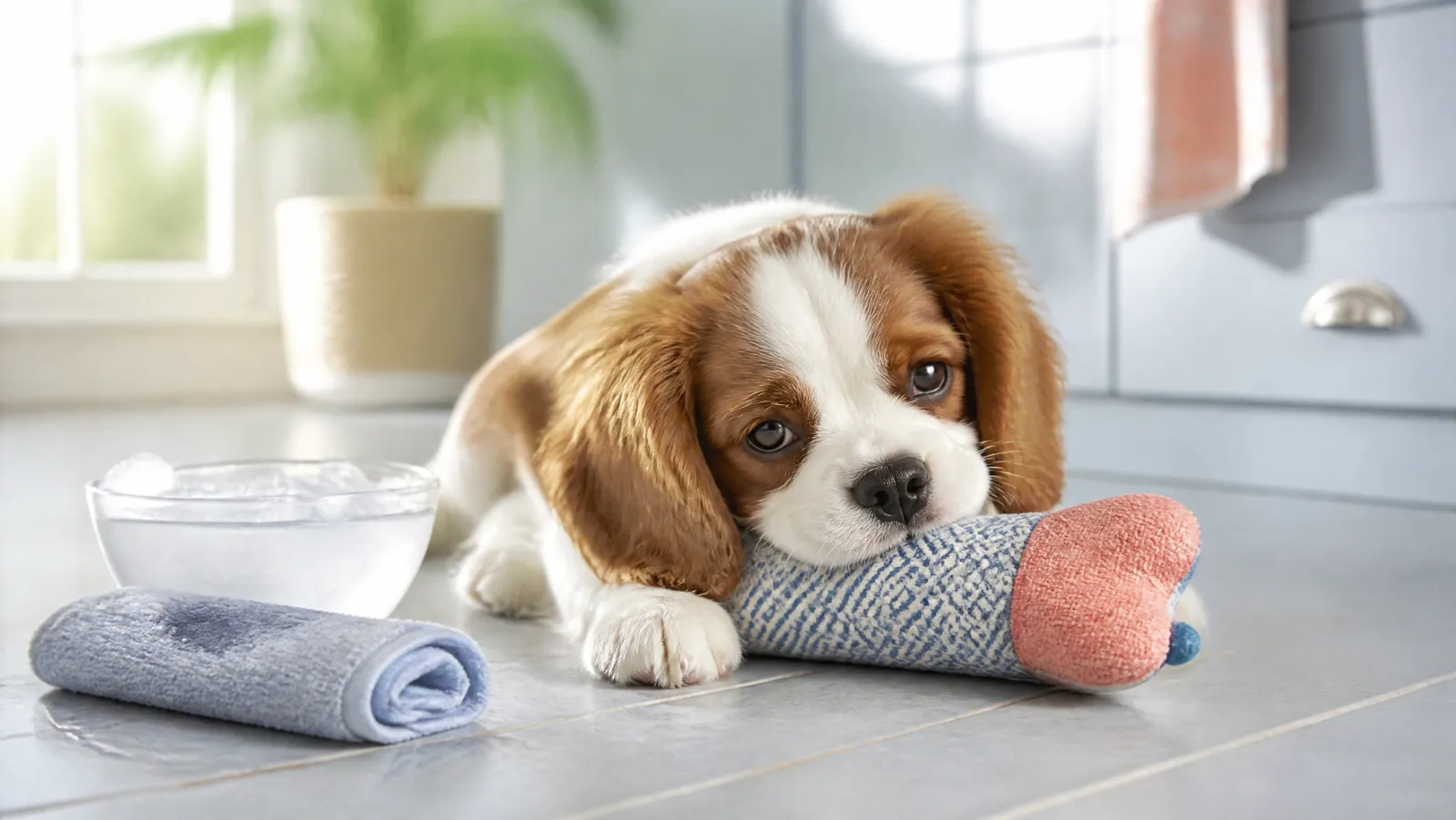
Something you can chill. VCA Hospitals notes that you can freeze toys and treats to help ease inflammation and discomfort, in the same spirit as freezing a teething ring for a human baby. The ASPCA makes a similar point, listing ice cubes, toys made to be frozen, and frozen wet washcloths among the things that may help numb teething pain. At least one toy in your rotation should be freezer-friendly.
The assumption that nothing is indestructible. KONG itself states that no dog toy is indestructible and that you should supervise play and remove the toy if it is damaged. VCA Hospitals says to take a toy away if you notice it breaking apart or missing pieces, and Humane World for Animals says to discard toys once they start breaking into pieces or are torn. Treat every chew as a consumable with a lifespan, not a fixture.
Match the Material to Your Puppy's Tooth Stage
This is the part most buying guides skip, and it is the reason two puppies the same weight can need different toys.
According to the AKC, puppies have about 28 baby teeth, usually all in by five to six weeks of age. Those teeth begin shedding around 12 to 16 weeks — the AKC describes finding crumb- to rice-sized teeth around the house — and by about six months the puppy teeth should be gone and roughly 42 adult teeth should be in. The ASPCA notes that the intensified chewing phase that goes with all of this usually ends by about six months of age.
So, practically:
- Roughly 8 to 16 weeks (baby teeth). Soft natural rubber, soft puppy-specific nylon, fabric freeze toys, and digestible chews. Nothing firm.
- Roughly 4 to 6 months (mixed mouth). Same materials, replaced more often, because chewing gets more determined as the adult teeth arrive.
- After the adult teeth are in. You can step up to a firmer chew, but keep applying the fingernail test rather than trusting a label.
If you want the week-by-week version, we laid it out in the puppy teething timeline, and the signs that your puppy has actually entered this phase are in puppy teething symptoms.
The 6 Best Puppy Teething Toys
Each pick below has a clear "who it's for." Prices are approximate and current as of October 2026.
KONG Puppy Natural Rubber Teething Chew Toy — Our Pick
Who it's for: almost every puppy still on baby teeth, and the one toy to buy if you are buying one.
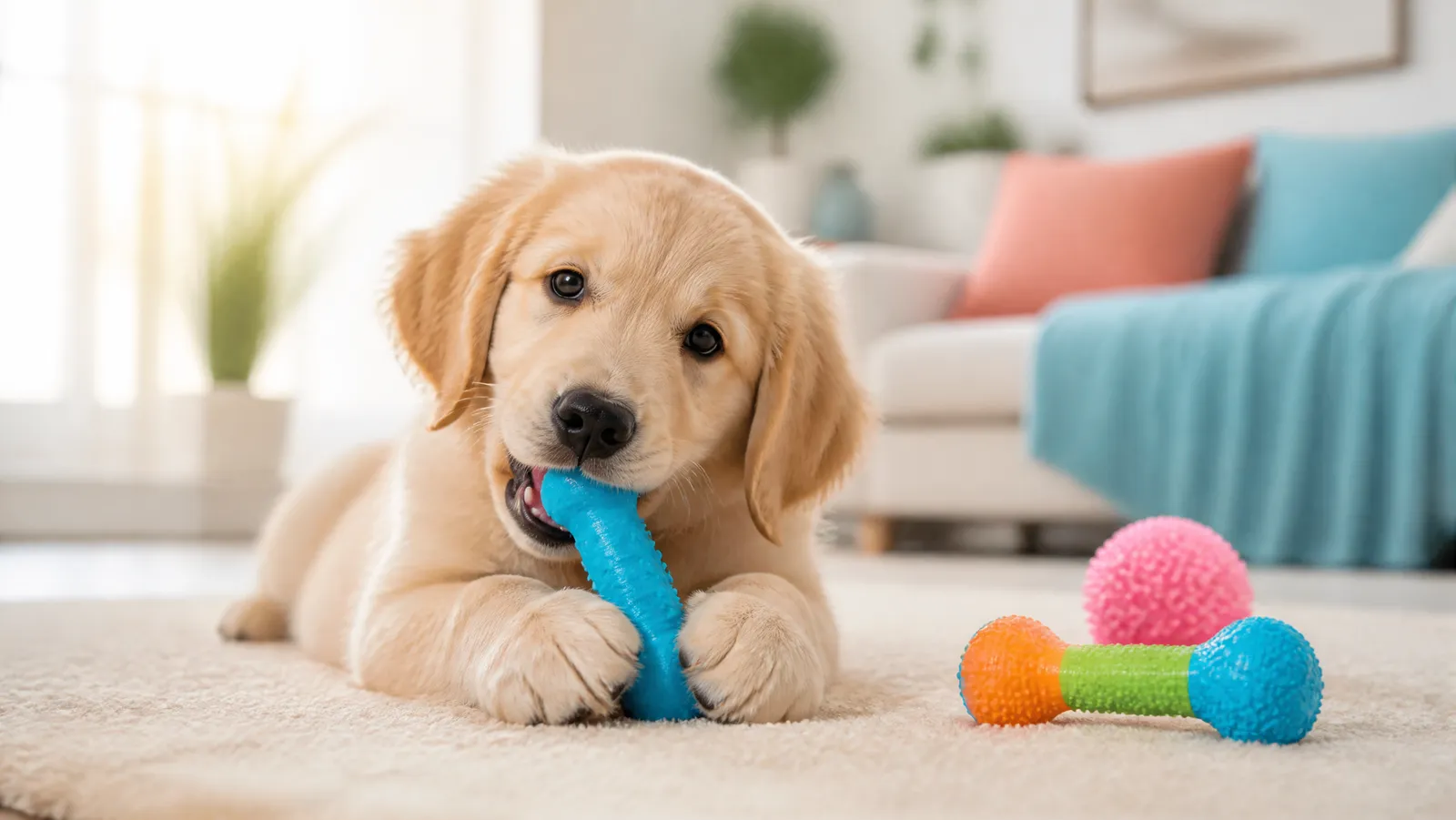
KONG makes this version from a customized soft natural rubber developed for a growing puppy's teeth, which is exactly the "gives under pressure" quality VCA's fingernail rule is describing. Because it is hollow and stuffable, it also solves a second problem: a KONG packed with kibble or paste and frozen can buy you a stretch of quiet on a sore-gum evening, and the same trick pairs well with crate training your puppy. It bounces, too, so it is not a single-purpose purchase.
At about $7 as of October 2026, the KONG Puppy is the smallest sensible spend here. Note that this is the Small size and that KONG is explicit that no toy is indestructible — supervise, and retire it when it starts to tear.
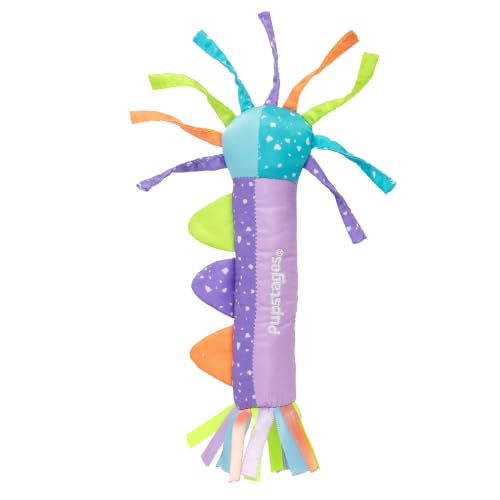
Pupstages Cool Teething Stick — Best Freezable
Who it's for: the puppy whose gums are obviously bothering them in the evenings.
This is a soak-and-freeze toy: wet the soft stuffed polyester shell, freeze it, and the cold does the soothing. It is built specifically to satisfy the need to chew during teething and to pull that urge away from furniture and shoes. We would keep two in the freezer so one is always ready, which is also the honest limitation — it needs prep time.
The 8.5-inch Pupstages Cool Teething Stick runs about $5 as of October 2026. It is a fabric toy, so it belongs in the supervised-only category: the manufacturer says not to leave it with unsupervised pets and to replace it if damaged. For more ways to use cold during this phase, see how to soothe a teething puppy.
Nylabone New Puppy Starter Kit — Best Starter Set
Who it's for: first-time owners who do not yet know what their puppy likes.
The kit is two chew toys plus one edible chew, aimed at different developmental phases: you start with the soft material made for teething puppies and graduate to the tougher material once the adult teeth are in. That staging is the right idea, and it maps cleanly onto the tooth-stage rules above — just hold the firmer piece back until the adult teeth are actually in.
The three-pack Nylabone New Puppy Starter Kit is about $10 as of October 2026. Both chew toys are chicken-flavored throughout, and the edible chew has no artificial colors, flavors, or preservatives.
N-Bone Puppy Teething Rings — Best Edible Chew
Who it's for: puppies three months and up who would rather eat a chew than work a toy.
These are edible and fully digestible, with no plastic and no rawhide, and they are enriched with calcium and DHA omega-3. The ring shape is easier for small paws to hold down than a bone shape, which matters more than it sounds like it should when the chewer weighs eight pounds. The manufacturer says the texture helps soothe sore gums.
A six-pack of N-Bone Puppy Teething Rings costs about $7 as of October 2026. Edible chews do deserve extra attention: the ASPCA notes that dogs can choke on edible chews, particularly if they bite off and swallow large pieces, and its position statement on chews and treats asks owners to actively watch their dog while chewing and to contact a veterinarian if a chunk is swallowed. Stay in the room, and take away the last stub.
Pupstages Cutie Chewies Hedgehog — Best for Gum Massage
Who it's for: small-breed puppies, and anyone who wants the gum-massage texture without a hard toy.
The spiky nubs are the feature: Pupstages says they massage gums and help clean teeth while the puppy chews, and that the design can help soothe achy gums during teething. It also floats and bounces, so this is the pick that keeps working at the lake once teething is over.
The 5-inch Pupstages Cutie Chewies hedgehog is about $6 as of October 2026. At 5 in x 3.5 in x 1 in it is intended for teething pups and small adult dogs, so apply the size rule honestly — a bigger puppy will outgrow it fast, and Humane World for Animals is clear that a too-small toy is a throat risk.
Nylabone Puppy Chew Teething Ring Bone — Best Budget Pick
Who it's for: gentle chewers under 15 pounds, and anyone who wants a second freezer toy for the price of a coffee.
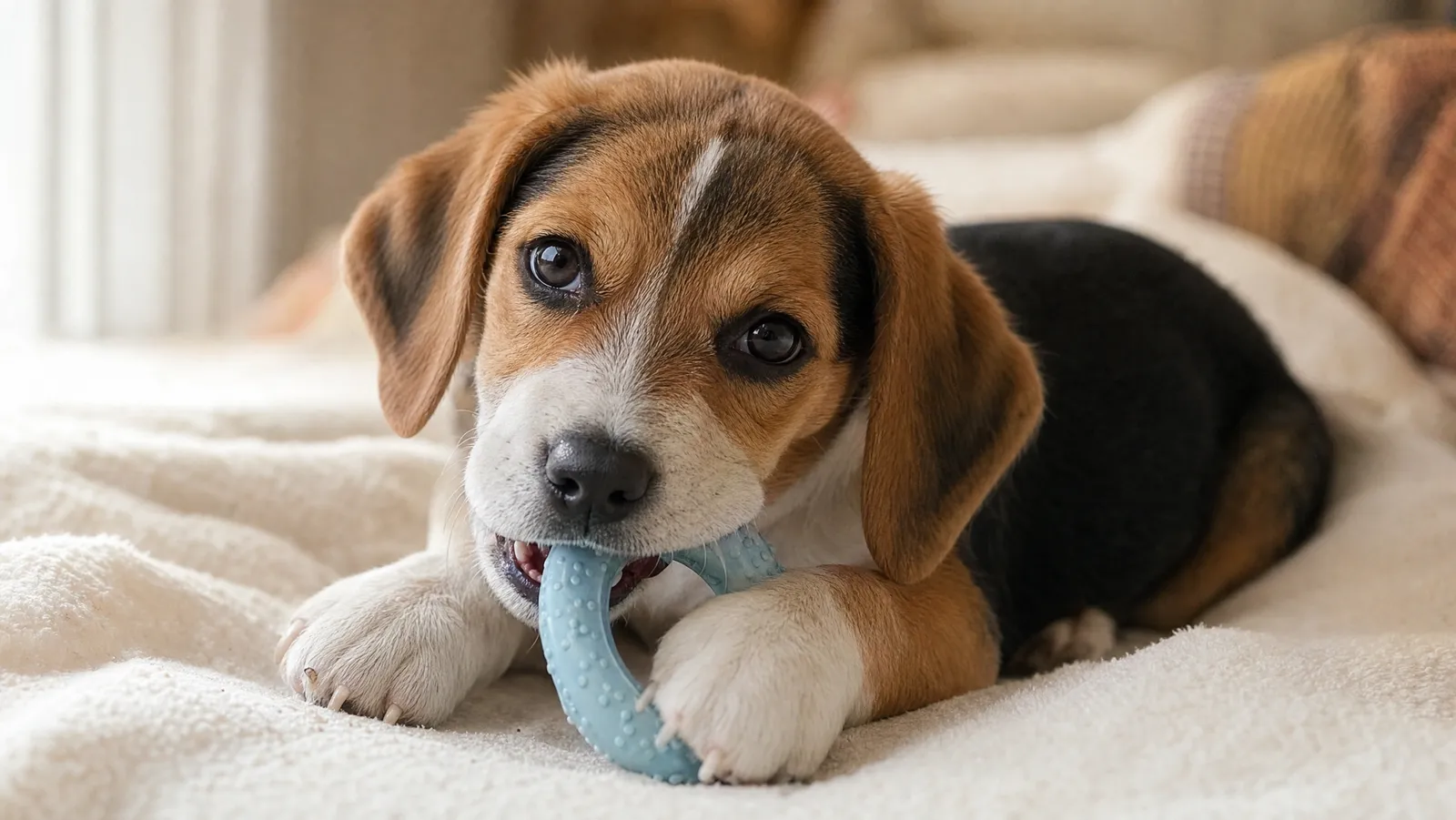
Ridges and nubs are meant to soothe sore gums while helping clean teeth, and it is freezer-friendly, which is the feature we would actually plan around. It is made in the soft material intended for teething puppies with gentle chewing styles, and Nylabone is explicit that it is not intended for powerful chewers or for puppies that already have their adult teeth. That warning is a feature, not a flaw — it tells you exactly which puppy this is for.
The X-small Nylabone Puppy Chew Teething Ring Bone is about $3 as of October 2026 and is sized for puppies up to 15 pounds.
Puppy Chew Toys for Teething We'd Skip
This is not a matter of taste. These categories come up again and again in veterinary dentistry, and the reasoning is the same every time: a dog's tooth loses against an object that will not yield.
- Real bones, cooked or raw. VCA Hospitals groups bones with the materials to avoid entirely for a teething puppy. In a Vetstreet roundup, board-certified veterinary dentists list cooked bones among the products dogs should not chew on, alongside antlers and cow hooves.
- Antlers and dried cow hooves. Same list, same reason. Veterinary dentist Dr. Jan Bellows, quoted in that roundup, frames the goal positively: look for a chew that bends and lets the teeth sink in. An antler does neither.
- Hard nylon for a baby-toothed puppy. VCA Hospitals specifically names nylon among the extremely hard materials to avoid while the teeth are still developing. Soft puppy-formula nylon is a different product — the starter kit above separates the two deliberately — but a firm adult nylon bone has no place in a four-month-old's mouth.
- Tennis balls as chew toys. According to the AKC, the fuzz on a tennis ball is quite abrasive, and dirt and sand make it more so, acting like sandpaper and gradually blunting a dog's teeth. The AKC also notes that eating the fuzz can cause choking and intestinal blockages requiring surgery, and that half a tennis ball can lodge at the back of the throat and block the airway. Supervised fetch, fine. Unsupervised chewing, no.
- Anything you cannot dent. The fingernail test covers rocks and the next hard novelty chew that shows up on the market.
Two neighboring questions deserve their own articles rather than a paragraph here: the best puppy teething chews, which is a consumables question rather than a toy question, and when do puppies stop biting, which is behavior rather than hardware.
How Many Teething Toys Does a Puppy Need?
Fewer than the internet implies, used better. Four to six chews is plenty, with only two or three out at any time.
The reason is novelty, not frugality. The ASPCA suggests introducing something new or rotating your dog's chew toys every couple of days so they do not get bored with the same old toys, and Humane World for Animals recommends rotating toys weekly, keeping only a few available at a time with a variety of types accessible. A toy that has been in the closet for five days is interesting again on day six, and interesting is the whole mechanism by which a chew toy saves your baseboards.
Rotation also builds in the safety habit. Every swap is a free inspection: flip the toy, feel the edges, look for splits and missing nubs, and bin anything that is coming apart. If you are assembling a full kit rather than just teething chews, we cover the rest of the categories in must-have toys for a new puppy.
How to Get the Most From a Teething Toy for Puppies
The toy is half the work. The habits around it are the other half.
Freeze one, every night. Keep a soak-and-freeze toy or a stuffed rubber toy in the freezer so there is always a cold option at the hour your puppy is worst. VCA Hospitals' point about freezing to ease inflammation and discomfort is easy to act on once it is a routine rather than a decision.
Swap, do not scold. VCA Hospitals frames the goal as not discouraging all chewing but directing your puppy toward acceptable items. When teeth land on your hand or a chair leg, trade for the toy and praise the switch. Our fuller approach is in how to stop puppy biting.
Supervise, then contain. The ASPCA advises supervising your dog when they are loose in the house and using crates and baby gates when you cannot, so they only have access to things they are allowed to chew. That is also the simplest way to honor every manufacturer warning on this page at once.
Make the toy better than the alternative. Smear a little paste inside a stuffable chew, or hand the toy over before the chewing starts rather than after. Puppies are not choosing your shoe over the toy out of spite — the shoe was just closer.
When to Check In With Your Vet
None of this is a diagnosis, and a teething puppy is usually just a teething puppy. Still, a few things are worth a phone call rather than a wait-and-see:
- A baby tooth that has not fallen out. The AKC advises letting your veterinarian know if you notice baby teeth remaining, since they may need to be removed.
- A swallowed piece of a chew. The ASPCA's position statement on dog chews and treats asks owners to consult a veterinarian immediately if a pet consumes a chunk of chew material.
- A tooth that looks broken, or chewing that suddenly stops. Either is a reason to have the mouth looked at rather than something to interpret yourself.
- Bleeding gums beyond the light spotting many owners see during teething, or a mouth that seems painful to touch. Your vet can tell you quickly whether it is normal.
The Bottom Line
Buy for the tooth stage, not the marketing. For a puppy still on baby teeth, that means soft natural rubber, soft puppy-specific nylon, fabric freeze toys, and digestible chews — and it means walking past anything your fingernail cannot mark. If you want one toy, get the KONG Puppy; if you want two, add something you can freeze.
Then do the unglamorous part: rotate a small set, inspect at every swap, stay in the room, and retire toys early. For the wider picture — the timeline, the biting, and what is actually happening in that sore little mouth — start with our complete guide to puppy teething and biting.
Our top picks

KONG makes this one from a customized soft natural rubber developed for a growing puppy's 28 baby teeth, so it gives under pressure instead of fighting back. It also bounces for fetch and takes a stuffing of kibble, snacks, or paste, which keeps it useful long after the teething weeks.
What we love
- Soft natural rubber developed for a puppy's baby teeth
- Stuffable with Easy Treat, kibble, snacks, or paste to extend playtime
- Bounces, so it doubles as a fetch toy
- Made in the USA with globally sourced materials
Keep in mind
- KONG states no dog toy is indestructible — supervise and remove it if damaged
- This is the Small size, so check the fit for your puppy
Soak it, freeze it, hand it over — the cold is the whole point. The soft stuffed polyester shell holds water, and at 8.5 inches it is easy for a puppy to carry off to a corner and work on.
What we love
- Soak-and-freeze design for a cool, soothing chew
- Soft stuffed polyester shell with fringe to chew and carry
- Helps redirect chewing away from furniture, shoes, and household items
- Doubles as a cool-down toy on hot days
Keep in mind
- Fabric toy, so it needs supervision and replacing once damaged
- Has to be soaked and frozen ahead of time, so you need a second one in rotation

Two chew toys plus one edible chew, built around the idea that chewing needs change as the teeth do. You start on the soft material made for teething puppies and graduate to the tougher material once the adult teeth are in.
What we love
- Covers two developmental phases in one box: soft for teething, tougher for adult teeth
- Includes a digestible bacon-flavored chew with no artificial colors, flavors, or preservatives
- Chicken flavor infused throughout the chew toys
- Three pieces, so you learn what your puppy actually prefers
Keep in mind
- The tougher chew is not for a puppy still on baby teeth — hold it back
- Only one of the three pieces is edible, and it is gone once eaten

An edible, fully digestible ring with no plastic and no rawhide, enriched with calcium and DHA omega-3. The ring shape is easier for small paws to pin down than a bone shape, and a pack of six is enough to keep one on hand for the rough evenings.
What we love
- Edible and fully digestible — no plastic and no rawhide
- Enriched with calcium and DHA omega-3
- Textured ring that small paws can hold more easily than a bone
- Pack of six, made in the USA
Keep in mind
- Designed for puppies 3 months and older, so it is not for a very young pup
- It is a consumable, not a toy — each ring is gone once chewed

The spiky nubs are the point here: they massage gums and help clean teeth while a puppy works the toy over. It also floats and bounces, which makes it one of the few teething toys that carries over into fetch and water play.
What we love
- Spiky nubs massage gums and help clean teeth while chewing
- Floats and bounces, so it works for fetch and water play
- Intended for teething pups and small adult dogs
Keep in mind
- At 5 in x 3.5 in x 1 in it is sized for small mouths — check the fit first
- The gum-soothing claim is the manufacturer's, not a clinical finding

The cheapest way to get a purpose-built teething chew into the house. Ridges and nubs are meant to soothe sore gums while helping clean teeth, and it is freezer-friendly, which is the feature we would actually use.
What we love
- Lowest price of our six picks
- Ridges and nubs intended to soothe sore gums while helping clean teeth
- Freezer-friendly, so you can chill it for extra teething relief
- Chicken flavor infused throughout; made in the USA
Keep in mind
- Explicitly not intended for powerful chewers or puppies with adult teeth
- X-small only — sized for puppies up to 15 pounds
Frequently asked questions
What are the best teething toys for a puppy?
The best teething toys for a puppy are soft enough to indent with a fingernail, too large to swallow, and freezable. Our picks are the KONG Puppy soft natural rubber chew, the Pupstages Cool Teething Stick for cold relief, the Nylabone New Puppy Starter Kit, N-Bone Puppy Teething Rings for an edible option, the Pupstages Cutie Chewies hedgehog for gum massage, and the X-small Nylabone teething ring bone on a budget.
At what age does a puppy need teething toys?
Start before the worst of it. According to the AKC, a puppy's roughly 28 baby teeth are usually all in by five to six weeks of age, and those teeth begin falling out around 12 to 16 weeks as the adult set pushes through. The AKC advises offering safe chew toys at that point. By about six months the puppy teeth should be gone, with roughly 42 adult teeth in place.
Can I freeze my puppy's teething toy?
Usually yes, and it helps. VCA Hospitals notes that you can freeze toys and treats to help ease inflammation and discomfort, much like people freeze teething rings for human babies. The ASPCA similarly lists ice cubes, toys made to be frozen, and frozen wet washcloths as things that may help numb teething pain. Use toys designed for freezing, and keep the fingernail test in mind — nothing should freeze rock hard.
Are hard nylon chews safe for a teething puppy?
Not while the baby teeth are still in. VCA Hospitals advises avoiding anything extremely hard, including nylon, bones, and antlers, because those materials can fracture developing teeth. Soft puppy-specific nylon is a different product from the firm adult version, and good starter kits separate the two. Once the adult teeth are fully in, a firmer chew becomes reasonable — your vet can tell you when your puppy is there.
When should I throw a teething toy away?
As soon as it stops being whole. VCA Hospitals advises removing a toy if you notice it breaking apart or missing pieces, and Humane World for Animals says to discard toys once they start breaking into pieces or are torn. Build a quick inspection into your routine — flip each toy over once a day and feel for cracks, splits, and chewed-off edges. KONG itself states that no dog toy is indestructible.
About the author
James Martin
I'm an animal lover through and through. I grew up with dogs, my family always had at least one pet, and today I share my home with a rescue who is the love of my life. I started Healthy Puppy Review to help owners cut through the marketing noise and make confident, well-researched choices about their dog's health and happiness.