Puppy Potty Training Bells: Teaching Your Puppy to Ask to Go Outside
The bell method gives your puppy one clear way to tell you they need out — but it is a signal bolted onto a schedule, not a substitute for one. Here is how to hang it, the four training steps with realistic timelines, and the fix for the puppy who rings it every ten minutes.

Contains affiliate links · our policy
In this guide
- What a Potty Bell Actually Teaches
- The Bell Rides on Top of a Fixed Potty Interval
- Choosing and Hanging Puppy Bells for Door Potty Training
- How to Potty Train a Puppy With a Bell: The Four Steps
- When Your Puppy Rings the Bell Constantly
- Troubleshooting Potty Bells for Puppy Training
- When a Bell Is the Wrong Fit
- What "Trained" Looks Like, and When
- What We'd Do
- Our Top Picks
- FAQ
A puppy potty training bell works because it gives your puppy one clear, repeatable way to tell you something they can already feel. Most puppies need one to three weeks of consistent pairing before they ring it on their own — not one afternoon. And the bell is a communication tool bolted onto an existing schedule, not a replacement for one.
Healthy Puppy Review is reader-supported: if you buy through a link on this page we may earn a small commission, at no extra cost to you.
That last point is the one most bell guides skip. A puppy who is not already going out on a fixed interval has nothing to ask for — you cannot teach a signal for an event that happens at random. If the basics are still shaky, start with potty training a puppy from day one and come back.
What a Potty Bell Actually Teaches
Two things happen, in order.
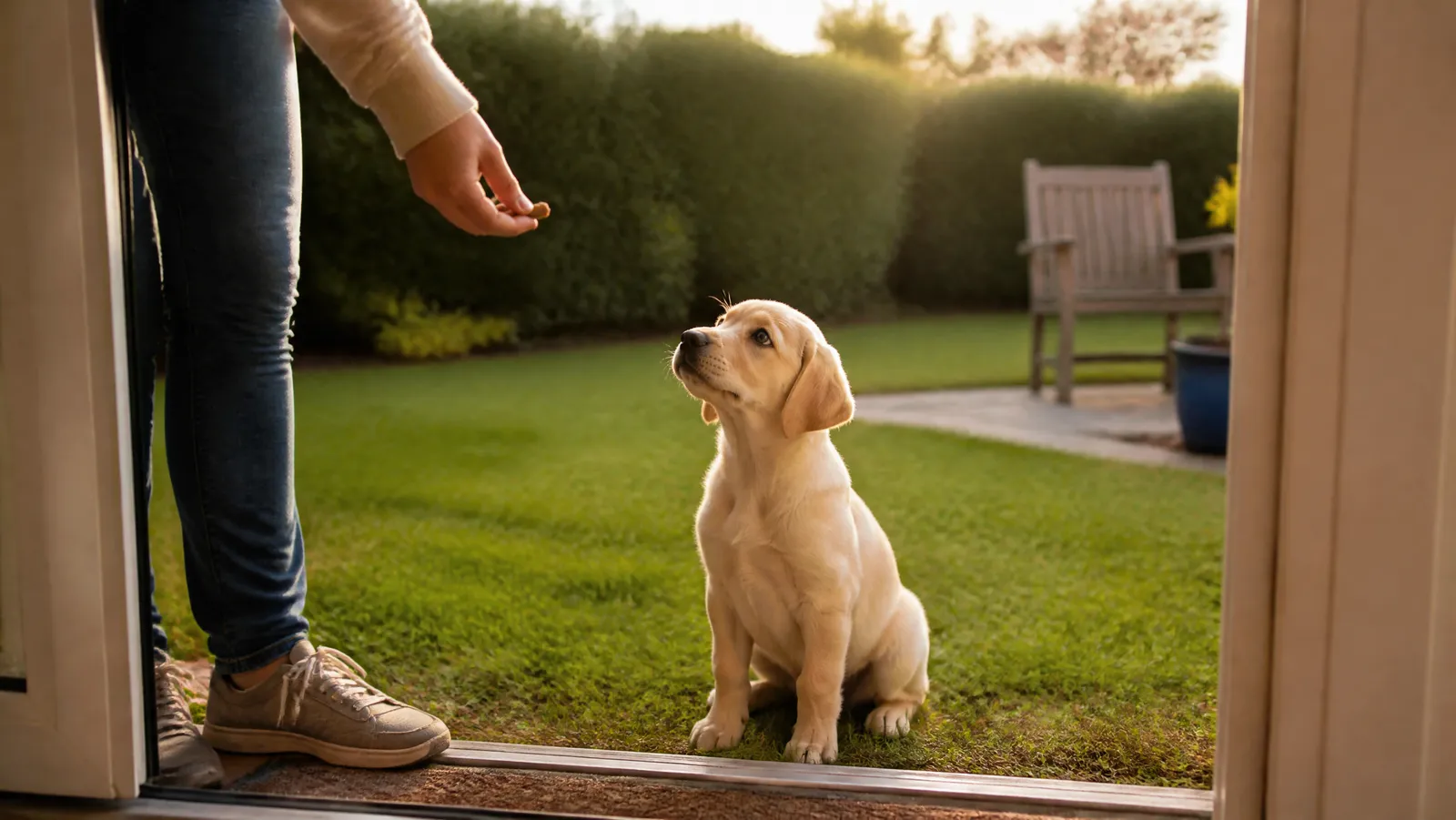
First, association. Every time you open the door for a potty trip, you ring the bell yourself. Humane World for Animals describes the method in those terms: to train a dog to signal when they need to potty, start by associating a specific action, like ringing a bell or barking at the door, with going outside. After enough repetitions the jingle stops being noise and starts predicting the door.
Then the puppy tries it. Once ringing reliably produces what they want — door open, grass, relief — they start doing it on purpose. The American Kennel Club's instruction here is short: keep it up until your dog begins to ring the bell without any signal from you.
That is the whole mechanism, and it has a hard limit. The bell does not teach bladder control. It teaches a puppy who already needs to go how to say so. VCA Animal Hospitals notes that once a puppy is physically mature enough to hold her bladder consistently, she can learn to ask to be taken outside, and lists a bell on the door as one way to teach it.
The Bell Rides on Top of a Fixed Potty Interval
Humane World for Animals gives the planning figure: a puppy may be able to hold their bladder for about one hour for every month of age, and recommends taking a puppy out at least every two hours, plus after waking, after play and after eating or drinking. VCA Animal Hospitals is tighter for waking hours — every one to two hours, and every half hour during high-energy play.
Those trips are the raw material: twelve door openings a day is twelve pairings, and two teaches nothing. Our puppy potty training schedule by age has the hour-by-hour version, and we would run it for a week before a bell goes near the doorknob.
The bell also has to point at one outcome, which makes it the natural next step for a puppy already going outdoors reliably — finish the move from pee pads to outside first. A puppy who still has an indoor option gets a muddled message from a signal that just means the door opens.
Choosing and Hanging Puppy Bells for Door Potty Training
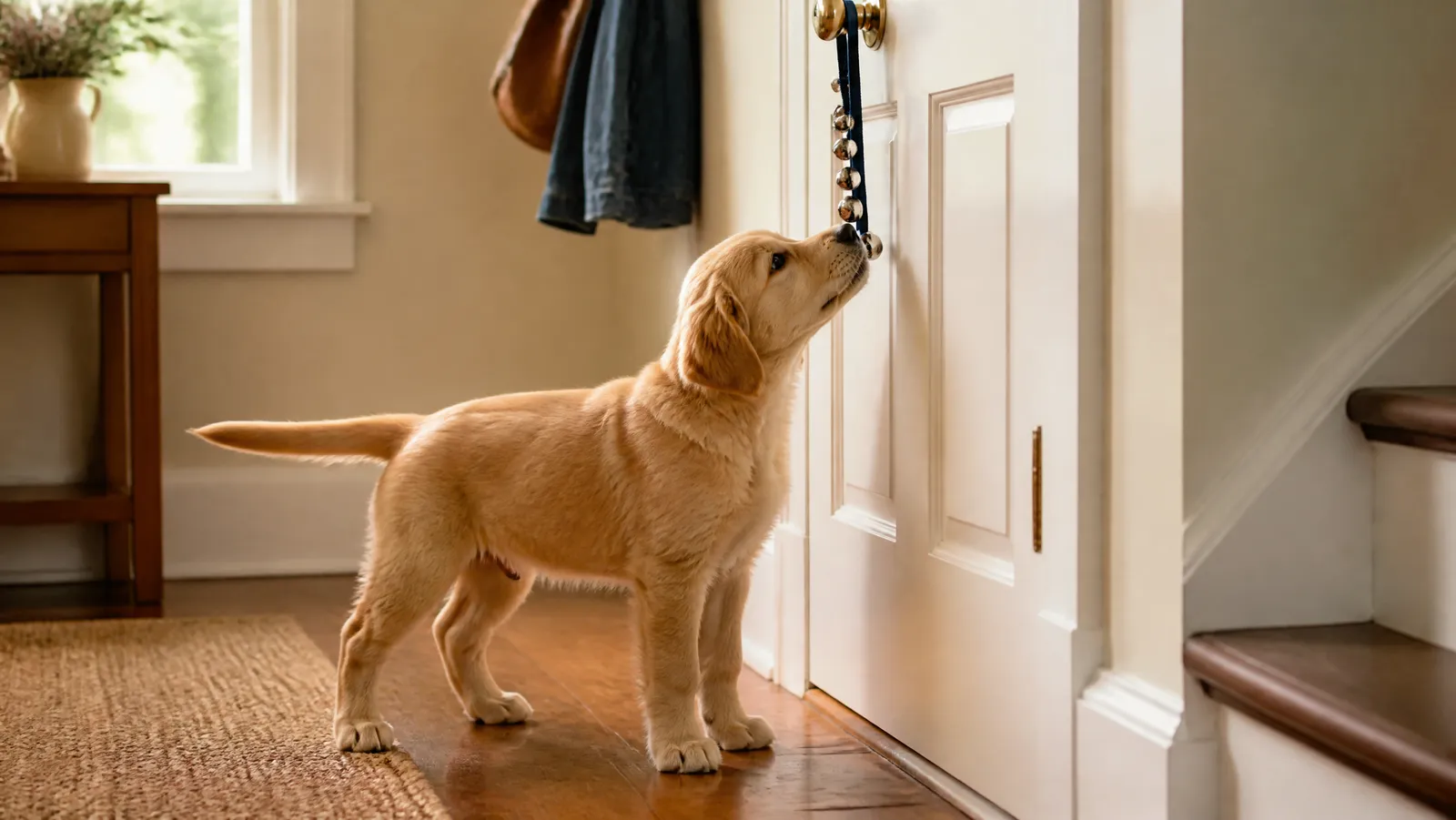
Height matters more than anything else. Dogster's vet-reviewed guide, reviewed by veterinarian Dr. Amanda Charles, says to adjust the height so your dog can ring it with their nose while keeping all four paws on the ground. Too high trains a jump; too low and the puppy blunders into it all day until the sound means nothing.
One door, and it has to be the one you use. The AKC says to place the bell near the door you use most frequently to take your dog out to potty — not the front door because it is nearer the sofa.
Watch the door swing. The mistake we see most often: the strap hangs where the opening door sweeps it, so the bells ring on their own all day and the signal turns into noise. Hang them on the handle or the trim beside the frame, then open the door once slowly to check.
We would start with the Luckyiren Upgraded Puppy Bells, about $5.99 as of September 2026 — a nylon doorknob strap whose three snap positions let you adjust the height as your puppy grows. Luckyiren says the plated jingle bells use a stainless steel inner ball, describes the tone as clear, and states that the product requires completing the training process in the instructions to work. Unusually honest for a package: this is one of the cheapest items on any list of the best puppy potty training supplies, and one of the few that does nothing on its own.
How to Potty Train a Puppy With a Bell: The Four Steps
| Step | What you do | Realistic timeline | | --- | --- | --- | | 1. Introduce | Bells on the floor. Let the puppy sniff and touch, reward any interest | 1–2 days | | 2. Pair | Ring the bell yourself on every potty trip, with the same short phrase | 1–2 weeks | | 3. Transfer | Pause at the door and wait 3–5 seconds before ringing it yourself | 3–7 days | | 4. Confirm | Puppy rings unprompted; you answer every time | Ongoing |
Step 1 — Introduce the bell (1 to 2 days). The AKC's first step is to let your dog inspect and explore the bell, to make sure it is not something they will be worried about, rewarding any interest or engagement. Do this on the floor, before the strap touches the door.
Step 2 — Pair it on every trip (1 to 2 weeks). Hang the strap. Every trip now runs the same way: ring the bell, say the same short phrase, open the door, leash on, straight to the spot. The AKC's version: each time you are taking your dog out, you ring the bell. The word matters less than the sameness. Reward after the elimination, not after the ring — VCA Animal Hospitals advises giving the reward while you are still outside near the area of elimination rather than when you get back inside.
Step 3 — Transfer it to the puppy (3 to 7 days). Walk to the door and wait three to five seconds doing nothing. If the puppy noses the bells, open the door instantly. If nothing happens, ring it yourself and go anyway, without comment. If a week of this produces nothing, go back to luring the touch: K9 of Mine's bell-training guide has you hold a lure treat under the thumb of your target hand at the bell, and Pupford's training guide suggests putting a small amount of dog-friendly peanut butter or other spreadable food on the bell to entice the dog to touch it. Read the label first: the ASPCA warns that xylitol, found in some peanut butters and sometimes listed on labels as birch sugar or wood sugar, can cause serious harm or even death in dogs.
Step 4 — Confirm it (ongoing). The first unprompted ring is when the whole thing turns on, and the way to lose it is by not answering. The AKC is unambiguous: any time your dog rings the bell, offer lots of praise and immediately take them outside. A puppy who rings twice in week two and gets ignored has learned that the bell does not work, and that lesson sticks fast.
When Your Puppy Rings the Bell Constantly
This is the failure mode everyone ends up searching for, and it is not a puppy problem. It is a payout problem.
The bell rings, the door opens, and the puppy spends four minutes sniffing the fence line and eating grass. Nothing about that trip involved a bladder. What the puppy learned is that the bell opens doors and open doors are fun. Within a week you have a dog ringing every ten minutes.
Dogster's vet-reviewed guide states the goal cleanly: you do not want them ringing the bell constantly because they simply want to go outside, it has to mean that it is potty time and nothing else. Its fix is to take them out to their potty area, wait several minutes, and bring them inside without praise or treats if they do not go to the bathroom. VCA Animal Hospitals gets there from the other direction, advising that play time and freedom to run off leash in a fenced yard be postponed until your puppy has finished eliminating — which, VCA notes, teaches a puppy to toilet quickly when brought out.
The protocol we would run:
- The bell rings, you answer. Every time, during training.
- Leash on, even in a fenced yard.
- Straight to the potty spot. Humane World for Animals recommends choosing a consistent bathroom spot outside and always taking your puppy there on a leash.
- Stand still for three to five minutes. No talking, no petting, no wandering the yard. Boring is the active ingredient.
- If they go, pay immediately, on the grass.
- If they do not, back inside, neutrally. No scolding. Try again in twenty minutes.
The rule that holds it together: play and yard time never immediately follow a bell ring. Playing outside is fine — it is your idea, on your timing, ten minutes later, so the ring never buys it.
The same fix covers the puppy who rings from boredom or because it gets a human off the sofa; attention is a payout too, and a dull leashed trip is a poor one. Be realistic: in our experience this takes several consistent days of unrewarding outcomes, not one evening, and everyone in the house has to run the same protocol.
What you should not do is punish the ringing. Humane World for Animals states that scolding a puppy or rubbing their nose in it will only make them fearful and slow progress, and VCA Animal Hospitals warns that punishing a puppy for a natural act can make them think they should never toilet near a person. A puppy who becomes worried about the bell stops using it. If accidents are creeping back too, that is a house-training problem — our guide to potty training regression works through the causes in order, starting with the medical ones.
Troubleshooting Potty Bells for Puppy Training
Frightened of the sound. Desensitize, and never press a paw against the bells. Dogster's vet-reviewed guide suggests ringing the bell gently while offering treats, to show the sound is nothing to fear.
Never touches it. Back to step 1 with the strap on the floor, rewarding any contact, then lure the touch with a treat held in your target hand, or a small smear of dog-safe spreadable food on the bell. Measure the height again with the puppy standing at the door.
Paws it hard enough to pull it down. Usually a height problem: bells hung low invite a foot. Rehang at nose height, and open the door only for nose contact.
Two dogs, one bell. The confident dog often rings for both, and the puppy collects free trips they never asked for. Take them out one at a time during training.
More than one exit. Once the first door is solid — unprompted rings, most days, for a couple of weeks — add a second. Not sooner; two half-learned signals are worse than one clean one. Use an identical strap, then repeat step 2 there for a week. The BLUETREE 2-pack, about $9.99 as of September 2026, is built for this: BLUETREE says each of its two straps carries seven large 1.4-inch bells it calls thick-walled and loud, with three levels of length adjustment.
When a Bell Is the Wrong Fit
Apartments and hallway doors. If your door opens onto a shared corridor, a jingle strap announces every trip to the neighbors, and the gap between ring and grass is an elevator ride. A button-and-chime setup often fits better — the AKC treats a bell and a button as interchangeable throughout its guide. Our apartment puppy potty training guide covers the rest.
Deaf puppies. A dog does not strictly need to hear the bell for the association to form — K9 of Mine notes that even deaf dogs can be taught to ring bells, because what they learn is that contact with the bell earns them something. Still, a visual cue or floor-mat target on the same routine is often the more honest fit.
Nobody can hear it upstairs. A quiet strap on the back door is useless if you work on the second floor. Move to louder bells, or a button that chimes where you are.
What "Trained" Looks Like, and When
Trained is not one lucky ring. It is the puppy ringing unprompted, mostly when they need to go, at a frequency that tracks their bladder — with you no longer ringing it yourself.
Dogster's vet-reviewed guide says that with the proper approach you can often teach a dog to use the bells in as little as two to three weeks, and the AKC says most dogs catch on to ringing a bell or pushing a button to get access to going outside very quickly. Our read, for a puppy on a real schedule: the first unprompted ring usually lands in week one to week three, with reliability a few weeks after that.
Keep the outer timeline in view. Humane World for Animals puts typical house-training at four to six months, varying with the puppy's size, age and previous habits, and the AKC's month-plus-one rule — age in months plus one, in hours — is the ceiling on how long a puppy can comfortably wait. A bell shortens neither, and will not stop accidents caused by asking a ten-week-old to hold it for four hours. If the timeline is what worries you, how long potty training actually takes has the honest version.
What We'd Do
A potty bell has one job: closing the gap between "my puppy needs to go" and "somebody noticed." It earns its six dollars the first night your puppy rings instead of squatting behind the armchair.
But it only works bolted to a routine that already exists — a fixed interval, a leash, one boring patch of grass, the reward handed over outside — and it breaks the moment a ring pays out in playtime. Hang the bells at nose height, ring them yourself a hundred times without complaint, and answer every ring for the first month.
If the pieces underneath are shaky, our complete house-training guide walks through them in order, and overnight potty trips are worth sorting out before you ask a puppy to signal at 2 a.m.
Our top picks

Luckyiren Upgraded Puppy Bells Dog Doorbells for Door Knob / Potty Training

BLUETREE 2-Pack Dog Doorbells for Potty Training (7 Extra-Large 1.4-Inch Bells)
A plain nylon doorknob strap that does the one job a potty bell has to do: hang at your puppy's nose height and stay there. Luckyiren says the plated jingle bells use a stainless steel inner ball and describes the tone as clear, and that the sewing and snap connection points on the heavy-duty nylon belt are reinforced. Three snap positions mean you can shorten it as a small puppy grows into a bigger one.
What we love
- Three snap positions let you match the bells to your puppy's nose height and re-adjust as they grow
- Maker describes the belt as heavy-duty nylon with reinforced sewing and snap points
- Cheap enough that a chewed strap is not a real loss
Keep in mind
- A doorknob strap only works on a door with a knob or lever — it is not a wall-mounted option
- Luckyiren states plainly that the product requires completing the training process in the instructions to work, which is the honest version of what a bell is
Two identical straps in one pack, which is what you want once the first door is solid and you are adding a second exit. BLUETREE says each strap carries seven large 1.4-inch bells that are thick-walled and loud, on a heavy-duty nylon belt with three levels of length adjustment. Louder matters when the second door is further from where you actually sit.
What we love
- Two straps per pack, so both doors get an identical sound and feel
- Maker describes the 1.4-inch bells as thick-walled and loud, which helps if you are upstairs
- Three length adjustments per strap for different dog sizes and door heights
Keep in mind
- Seven large bells is a lot of noise in a small apartment, and easier for a door swing to set off accidentally
- Two straps invite you to hang both at once — the method works better one door at a time
Frequently asked questions
How long does it take to bell train a puppy?
Plan on one to three weeks of consistent pairing before you get an unprompted ring. Dogster's vet-reviewed guide, reviewed by veterinarian Dr. Amanda Charles, says that with the proper approach you can often teach a dog to use the bells in as little as two to three weeks, and the American Kennel Club says most dogs catch on to ringing a bell or pushing a button to get access to going outside very quickly. The variable is not usually the puppy — it is how many door openings you pair the bell with each day. Ten to fourteen pairings a day gets you there; two does not.
Can I start bell training before my puppy is potty trained?
You can start the pairing step immediately, but do not expect the puppy to ask until their body can back it up. VCA Animal Hospitals frames it this way: once your puppy is physically mature enough to hold her bladder consistently, she can learn to ask to be taken outside, and a bell attached to the door is one of the ways to teach that. Humane World for Animals notes that a puppy may be able to hold their bladder for only about one hour for every month of age, so an eight-week-old has very little margin to signal with.
My puppy rings the bell just to go outside and play. How do I fix it?
Make the outcome dull. Dogster's vet-reviewed guide is direct about the goal — you do not want a dog ringing the bell constantly because they simply want out, it has to mean potty time and nothing else — and the fix it gives is to take them to their potty area, wait several minutes, and bring them back inside without praise or treats if they do not go. VCA Animal Hospitals says the same thing from the other direction: play time and off-leash freedom in a fenced yard should be postponed until your puppy has finished eliminating. Expect several consistent days before the ringing drops off.
Should I give a treat every time my puppy rings the bell?
Reward the ring early on, then move the reward to the grass. The American Kennel Club suggests treating and rewarding your dog for interest or engagement with the bell while you are first introducing it, and once the dog is ringing on their own, offering lots of praise and immediately taking them outside. After that, the payout should follow the elimination rather than the ring. VCA Animal Hospitals advises that the reward be given while you are still outside near the area of elimination rather than when you get back inside, which is what keeps the bell attached to peeing rather than to snacks.
What if my puppy is scared of the bell?
Slow down, and never force it. The American Kennel Club's first step is to let your dog inspect and explore the bell to make sure it is not something they will be worried about, which is exactly the step people skip when they hang it on the door on day one. If the sound startles your puppy, Dogster's vet-reviewed guide recommends ringing the bell gently to desensitize them while offering treats to show it is nothing to worry about. Work at a distance the puppy is comfortable with, and never take a paw and press it against the bells.
About the author
James Martin
I'm an animal lover through and through. I grew up with dogs, my family always had at least one pet, and today I share my home with a rescue who is the love of my life. I started Healthy Puppy Review to help owners cut through the marketing noise and make confident, well-researched choices about their dog's health and happiness.