Why Does My Puppy Bite Me? The Five Real Reasons
A puppy biting you is almost always normal development, not aggression. But mouthing has five different drivers — teething, unfinished bite inhibition, overtiredness, accidental reinforcement, and plain under-stimulation — and each one needs a different response. Here is the tell that identifies each, the fix that follows from it, and the warning signs that are worth a professional.

Contains affiliate links · our policy
In this guide
- Why Do Puppies Bite Their Owners? Five Causes at a Glance
- Reason 1: Why Do Puppies Bite When Teething?
- Reason 2: Bite Inhibition Is a Skill, and You Inherited the Lesson
- Reason 3: Why Does My Puppy Keep Biting Every Evening?
- Reason 4: Teeth Make Hands Move and Voices Rise
- Reason 5: An Under-Exercised Body or an Under-Worked Brain
- Give Those Teeth a Legal Target
- Normal Mouthing vs. Warning Signs Worth Taking Seriously
- What to Do This Week
- Our Top Picks
- FAQ
In almost every case your puppy bites you because biting is how puppies gather information, play, and get relief from sore gums, not because something is wrong with them. According to the AKC, puppies use their mouths to investigate their environment, play with littermates, and cope with teething discomfort, and it describes mouthing and gentle play-biting as normal behaviors during puppyhood.
Healthy Puppy Review is reader-supported: we may earn a commission from links on this page, at no extra cost to you.
So the honest answer to why does my puppy bite me is almost never aggression. It is a developmental stage with a predictable shape, and once you can see where biting fits in the teething timeline the behavior stops feeling personal. The AKC says most puppies become significantly less mouthy as they finish teething and mature, often between four and six months of age.
That is the reassurance. The diagnosis is the useful part, because mouthing has at least five separate drivers and they do not share a fix. A teething puppy needs something to chew. An overtired one needs a nap and no chew at all. Give the second puppy the first puppy's answer and the evening gets worse.
Why Do Puppies Bite Their Owners? Five Causes at a Glance
- Teething discomfort — chewing pressure on sore gums.
- Unfinished bite inhibition — the lesson littermates and mom started, and you now have to finish.
- Overtiredness and overstimulation — the evening meltdown that gets mistaken for rage.
- Attention and reinforcement — teeth make hands move and voices rise.
- An under-exercised body or an under-worked brain — energy with nowhere legal to go.
Owners tend to frame this as puppy teething vs biting, as though it has to be one or the other. Most puppies are running two or three of these at once. Work out which one is loudest this week and the response picks itself.
Reason 1: Why Do Puppies Bite When Teething?
Because the mouth genuinely hurts and pressure helps. The AKC's teething timeline says puppies have about 28 baby teeth, all of which should be in by weeks five to six, and that those teeth begin to shed from around weeks 12 to 16 as the adult set pushes through. It describes the process as painful and the remaining puppy teeth as razor sharp. By about six months, the AKC says, all the puppy teeth should have fallen out and the roughly 42 adult teeth should have grown in.
The AKC also notes that teething can last up to six months and makes puppies even more likely to chew and mouth things. So this is not a bad week. It is a season.
The tell. Teething mouthing is slow and grinding rather than snappy. The puppy applies steady pressure to anything with give — a wrist, a cuff, a chair leg — and you start finding what the AKC describes as crumb- to rice-sized shed teeth around the house.
The fix. The AKC's advice at this stage is simply to offer safe chew toys, kept within arm's reach of wherever the biting happens. The week-by-week detail is in the puppy teething timeline, worth reading before you conclude that nothing is working.
Reason 2: Bite Inhibition Is a Skill, and You Inherited the Lesson
Puppies are not born knowing how hard is too hard. The ASPCA says young dogs usually learn bite inhibition during play with other dogs, and that through those interactions dogs learn to control the intensity of their bites so that no one gets hurt. It also makes the consequence plain: adult dogs who mouth people probably never learned not to do so during puppyhood.
The timing matters. The AVSAB's position statement on puppy socialization calls the first three months of life the primary and most important window, because it is the period when sociability outweighs fear, and it says puppies can begin socialization classes as early as seven to eight weeks of age. Most puppies change homes partway through that window, which means part of the curriculum transfers to you.
The tell. The bite has no brakes. A puppy with some inhibition adjusts when play gets too rough; one without it applies the same force whatever you do, and often escalates when you react.
The fix. Teach force control before you try to remove the mouth altogether. The AKC's version is to say ouch or yip in a high-pitched voice when the puppy bites you, because it mimics what their mother and littermates did when a bite was too hard. Our full protocol lives in how to stop puppy biting, including what to do when the high-pitched sound makes your particular puppy worse.
Reason 3: Why Does My Puppy Keep Biting Every Evening?
Often because they are exhausted rather than wired. The AKC says puppies usually sleep 18 to 20 hours a day, and that sleep is essential to healthy growth, contributing to the development of the central nervous system, brain, immune system and muscles. The AKC does not link short sleep to mouthing, but in our experience a puppy running short on that often does not get slower — they get faster and sharper, the way an overtired toddler does.
The ASPCA lists arousal and conflict among the things that can prompt a dog to become mouthy, and an overtired puppy at 7pm is arousal with nothing left to regulate it.
The tell. It is clock-driven. Same window, most days, usually late afternoon or evening. The ASPCA's list of signs that often come before mouthing is a useful checklist here: dilated pupils, repeated jumping, raised fur over the shoulders, back and tail, body checking, leash tugging or grabbing, staring at or targeting body parts or clothing, panting, and either difficulty paying attention or hyper-focus on a person or object. A puppy in that state will refuse a toy they loved an hour earlier and ignore a cue they definitely know. This is the stage that has new owners searching when do puppies stop biting at eleven at night.
The fix. An enforced nap before the window, not after the meltdown. The ASPCA includes crates among the management techniques that stop a dog practising the behavior at times you cannot actively train — which is the whole argument for crate training your puppy rather than hoping they settle on the rug. A predictable day helps for the same reason, which is part of why we push a predictable puppy feeding schedule: meals, naps and activity at roughly the same times give you something to schedule the nap against.
Reason 4: Teeth Make Hands Move and Voices Rise
Some biting persists because it works. The ASPCA says several things can prompt a dog to become mouthy, including a history of being rewarded for the behavior — often unintentionally. For a bored puppy, the reward is rarely food. It is the squeal, the hands snatching away, the chase down the hallway, and three humans suddenly very interested in them.
The tell. The biting starts when your attention goes elsewhere. You pick up a phone, open a laptop, or start a conversation, and the puppy goes for a hand, an ankle or a trouser hem. It also escalates rather than settles when you react loudly.
The fix. Stop paying it. In our experience the hardest part is not the technique, it is getting four people in a house to respond the same way, because one person who still shrieks and runs keeps the whole behavior funded. The flip side matters just as much: notice the puppy who is lying down chewing their own toy and pay attention to that instead. Attention is the currency here, so spend it on the version you want repeated.
Reason 5: An Under-Exercised Body or an Under-Worked Brain
Mouthing is often the only job a puppy can find. The ASPCA puts it directly: mental and physical exercise are both equally important, all dogs need some form of both daily, and every dog is different in how much they need. It suggests supplying the mental half through training games or interactive toys daily.
The brain half is the one most owners skip. A puppy who has walked for 30 minutes but has not had to solve anything all day is still looking for work, and your hands are the nearest moving object.
The tell. Biting is noticeably worse after a quiet day indoors, and noticeably better after a sniffy walk, a short training session, or a food puzzle. If ten minutes of nose work buys you an hour of calm, you have found your reason.
The fix. Add structured brain work before you add distance. We would be cautious about long forced exercise on a growing puppy and ask your vet what is appropriate for your breed and age before ramping anything up. If your toy bin is thin, our must-have toys for a new puppy roundup covers what earns its place.
Give Those Teeth a Legal Target
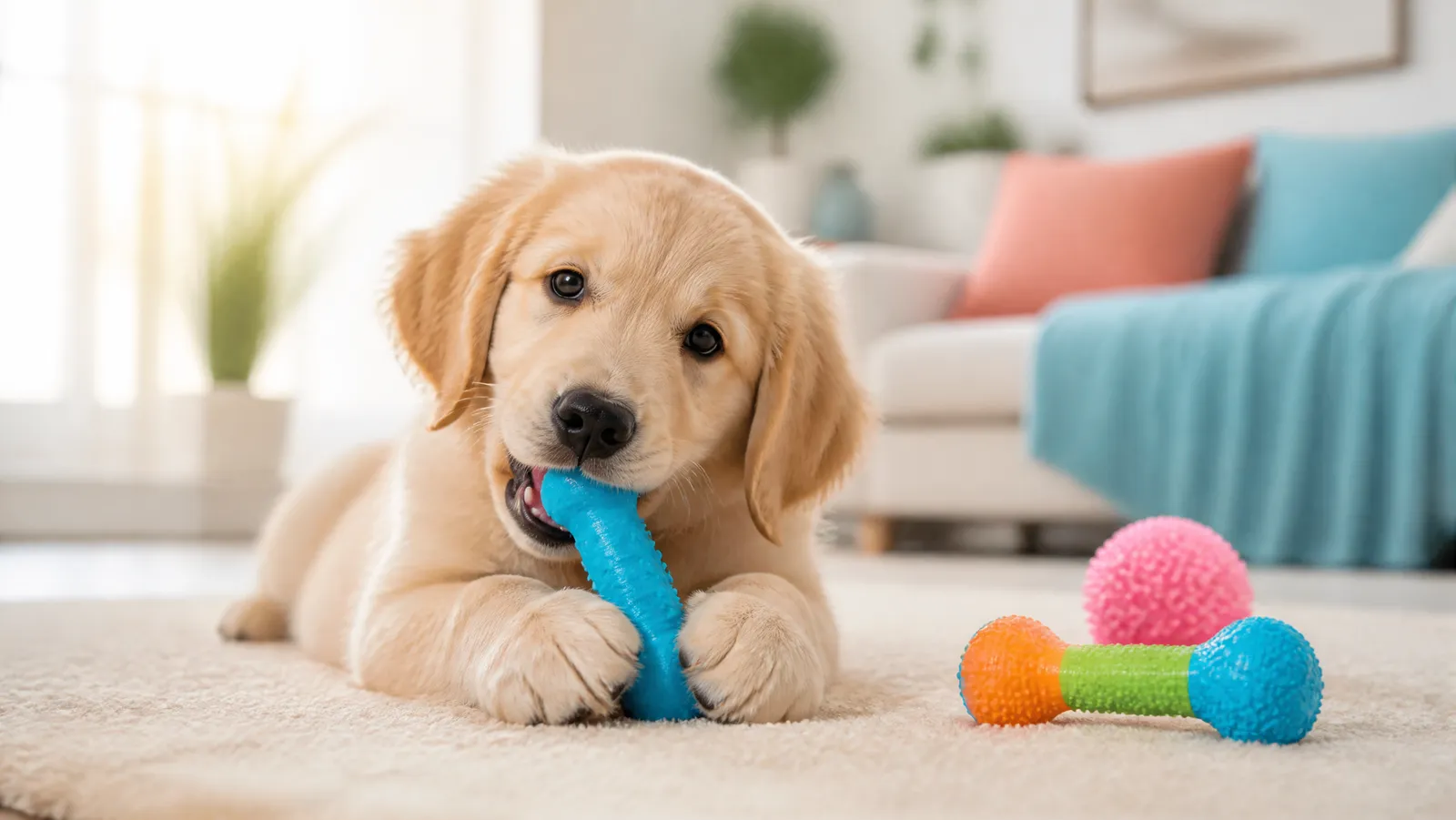
Whichever reason is driving it, the mouth needs somewhere to go that is not you. Two cheap KONG puppy chews cover most of the ground here, and both are built for the baby-teeth stage rather than for a dog with a full adult set.
The KONG Puppy Natural Rubber Teething Chew Toy runs about $7 as of October 2026. KONG says the rubber was developed for a growing puppy's teeth and is gentle on their 28 baby teeth, and because it bounces it works as a fetch toy as well as a chew — handy when the real problem is reason five rather than reason one. Stuff it and it becomes a settle tool instead of a play object.
The KONG Puppy Goodie Bone is about $8 as of October 2026 and uses the same puppy rubber in a bone shape made for puppies who like to carry things around. The Goodie Grippers at each end take snacks or paste, which is what makes it useful during the evening hour.
Two cautions come straight from KONG. The company states that no dog toy is indestructible and says to supervise play and remove the toy if it is damaged, so neither is an unsupervised chew. Both are also deliberately soft: the formulation is aimed at baby teeth, so once the adult teeth are in you should be reassessing rather than buying the same thing in a bigger size. For the wider comparison, see the best puppy teething toys.
Normal Mouthing vs. Warning Signs Worth Taking Seriously
We are not going to diagnose aggression in an article, and nobody should do it for you from a photo either. But it is worth knowing what the difference looks like, because owners who cannot name it tend to either panic or ignore it.
The ASPCA's description of playful mouthing is a relaxed body and face — the muzzle may look wrinkled, but you will not see much tension in the facial muscles. Its description of aggressive behavior is the opposite picture: the body looks stiff, the dog may wrinkle his muzzle and pull back his lips to expose the teeth, and it notes that serious, aggressive bites are usually quicker and more painful than those delivered during play.
Things we would take to a professional rather than troubleshoot at home:
- A body that goes stiff or freezes, especially paired with a low growl and a hard stare.
- Bites that break skin outside any play context.
- Tension or freezing over a food bowl, a chew or a stolen item.
- Biting that the AKC's threshold covers — mouthing that seems unusually intense, causes injury, or does not improve with consistent training.
- Any sudden change in mouth sensitivity, which is a reason to have your vet look at the teeth rather than a behavior problem to train through.
The ASPCA's recommendation, if you suspect the behavior fits its description of aggression, is to consult a qualified professional such as a Certified Applied Animal Behaviorist or a board-certified veterinary behaviorist, and it notes you can also seek help from a Certified Professional Dog Trainer. Getting an experienced set of eyes on it early is cheaper and kinder than waiting to see.
What to Do This Week
Pick the reason, not the technique. Then run one change for seven days before you judge it.
- Count the sleep. If your puppy is well short of the 18 to 20 hours the AKC describes, start there — in our experience it is the change that helps the most evenings.
- Put a chew in every room the puppy uses, so redirection takes two seconds instead of two minutes.
- Agree one household response to teeth on skin and get every adult using it.
- Add ten minutes of brain work, not ten more minutes of fetch.
- Write down when the bad hour starts. Patterns are much easier to fix than moods.
Mouthing is loud, it is temporary, and it is the most normal thing a four-month-old puppy does. For the full picture of how the mouth, the teeth and the calendar fit together, our guide to puppy teething and biting is the place to start.
Our top picks

KONG makes this in a softer natural rubber the company says was developed for a growing puppy's teeth and is gentle on their 28 baby teeth, which is exactly the window this article is about. Because it bounces, the same toy works as a fetch object when the real problem is a puppy with nothing to do.
What we love
- Softer puppy-specific rubber, per KONG, aimed at baby teeth
- Stuffable with treats, kibble or paste, which KONG says extends playtime and helps with crate training
- Bounces, so it doubles as a fetch toy rather than only a chew
- Made in the USA with globally sourced materials
Keep in mind
- Built around baby teeth, so you will be reassessing once the adult teeth arrive
- KONG states no dog toy is indestructible and says to supervise play and remove the toy if damaged, so this is not a leave-them-to-it chew

The bone shape is built for growing puppies who like to carry and play, and the Goodie Grippers on each end take KONG Puppy Snacks or Easy Treat. KONG says the puppy rubber soothes sore teeth and gums, which is a manufacturer claim rather than a clinical one, but the softer formulation is the part that matters here.
What we love
- Same natural puppy rubber formulation KONG uses across its puppy line
- Goodie Grippers hold snacks or paste at both ends, which buys you quiet minutes
- Shape made for puppies who want to carry a chew around
- Made in the USA with globally sourced materials
Keep in mind
- A stuffed chew needs supervision, and KONG says to remove the toy if it is damaged
- Soft puppy rubber is the wrong tool for a dog with adult teeth
Frequently asked questions
Is my puppy biting me out of aggression?
Almost certainly not. The AKC describes mouthing and gentle play-biting as normal behaviors during puppyhood, driven by investigation, play and teething discomfort. The ASPCA's distinction is body language rather than force: a playful dog has a relaxed body and face without much tension in the facial muscles, while an aggressive dog's body looks stiff, and he may wrinkle his muzzle and pull back his lips to expose his teeth. If you see the second picture, get a professional assessment rather than another article.
At what age do puppies stop biting?
It fades rather than stops. The AKC says most puppies become significantly less mouthy as they finish teething and mature, often between four and six months of age, and notes that teething itself can last up to six months. Its teething timeline puts all the adult teeth in place by around six months in most puppies. Expect gradual improvement across weeks, with bad evenings scattered through it, rather than a clean finish line.
Why does my puppy bite me when I pet him?
Usually arousal rather than objection. The ASPCA lists arousal, conflict, inappropriate play and a history of being rewarded for the behavior as things that can prompt a dog to become mouthy, and petting a wound-up puppy supplies moving hands at exactly the wrong moment. We would pet in short bouts, stop while the puppy is still calm, and save the hands-on affection for after a nap or a chew rather than before one.
How do I tell teething biting from play biting?
Watch the mouth, not the intent. Teething chewing tends to be slow, grinding pressure applied to anything with give, and the AKC notes you will find crumb- to rice-sized shed baby teeth around the home from roughly weeks 12 to 16. Play biting is faster, follows your movement, and arrives with a wagging body. Most puppies do both in the same evening, so the useful question is which one is loudest right now.
Should I let my puppy chew on my hands during play?
We would not build the habit. The ASPCA says young dogs usually learn bite inhibition during play with other dogs, where they learn to control the intensity of their bites so that no one gets hurt, and it notes that adult dogs who mouth people probably never learned not to do so during puppyhood. Keeping an object between your skin and the teeth gives the puppy a clearer rule, and it is a rule children and visitors can follow too.
About the author
James Martin
I'm an animal lover through and through. I grew up with dogs, my family always had at least one pet, and today I share my home with a rescue who is the love of my life. I started Healthy Puppy Review to help owners cut through the marketing noise and make confident, well-researched choices about their dog's health and happiness.