Why Isn't My Puppy Potty Training? Troubleshooting a Difficult Case
A puppy who still isn't getting it almost never has a comprehension problem. It is a medical problem, a schedule that outruns the bladder, a spot that still smells, accidental punishment, or inconsistent follow-through — and a three-day log tells you which.

Contains affiliate links · our policy
In this guide
- Before You Change Anything, Keep a Three-Day Log
- Cause 1: A Medical Problem, and Why It Goes First
- Cause 2: The Schedule Is Outrunning the Bladder
- Cause 3: The Puppy Who Pees Inside Right After Going Outside
- Cause 4: The Spot Still Smells Like a Bathroom
- Cause 5: Punishment, Including the Kinds Owners Don't Count
- The Two-Week Reset for a Difficult Puppy
- When Potty Training Isn't Working but Your Puppy Is Normal
- When to Bring in a Professional
- The Log Is What Finds It
- FAQ
If you are asking why your puppy is not potty training, the answer is almost never comprehension. A stalled case usually traces to one of five causes: a medical problem, a schedule that outruns the bladder, a spot that still smells, punishment you did not count as punishment, or inconsistent follow-through. Order matters — you cannot train your way out of the first one.
This is the troubleshooting page for puppy potty training, written for the owner who already has a schedule, already owns the enzymatic cleaner, and is eight weeks in with a puppy still peeing in the hallway. If you have started wondering whether your puppy is simply not understanding potty training, or whether something is medically wrong, cause one answers that.
One distinction first: if your puppy was clean for weeks and then started having accidents again, that is potty training regression — a different problem with a different fix. This article is for the puppy who never got there.
Before You Change Anything, Keep a Three-Day Log
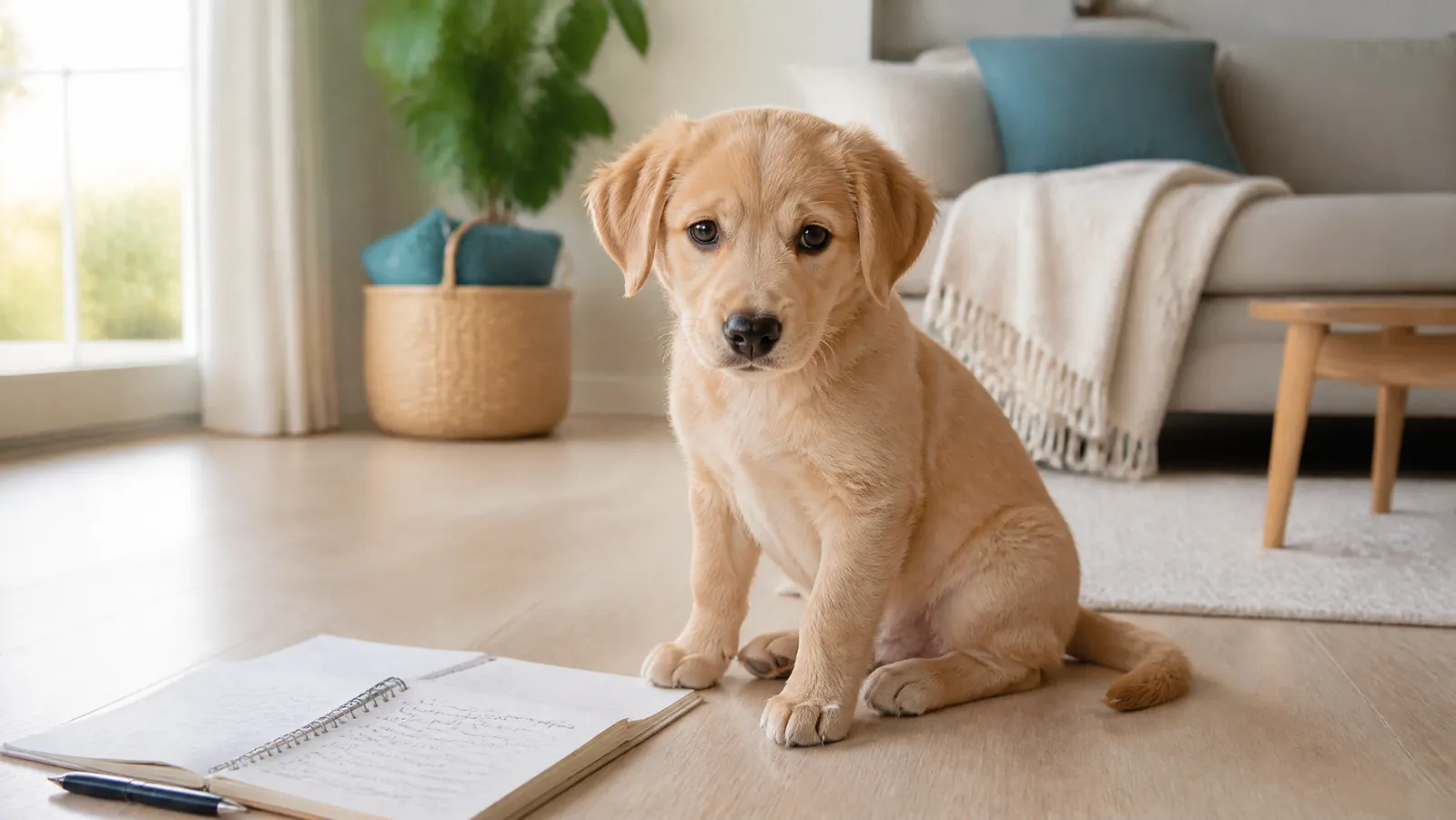
This is the most useful thing in the article and almost nobody does it. For three days, change nothing and write down two columns.
- Every trip outside: time, and the result — urine, stool, both, or nothing.
- Every accident: time, room, surface, and urine or stool.
Three days beats eight weeks of impressions, because memory averages: it says "he has accidents constantly," while the log says eleven of fourteen landed between 1 p.m. and 5 p.m. on the same two rugs — a schedule gap plus an odor problem. You cannot fix a pattern you cannot see.
One confound: if there are pads down, a puppy using one is doing the right thing on the wrong surface, so read the log accordingly — and see whether puppy pee pads work.
What Your Log Is Telling You
| What your log shows | The likely cause | What to change first | | --- | --- | --- | | Accidents cluster in one time window | The interval is too long for that stretch of day | Add a trip in the middle of that window | | Same room or same rug every time | Residual odor plus unsupervised access | Enzyme-clean the spot, close the room | | Within 20 minutes of coming back inside | Incomplete emptying, or the reward arriving at the door | Leash the trip, wait it out, pay at the spot | | No pattern, plus straining, blood, or extra drinking | Medical | Book the vet before changing any training | | Stool rather than urine, loose or frequent | Gastrointestinal, possibly parasites | Take a fresh fecal sample to your vet |
If the log says "overnight only," read puppy potty training at night instead — that is a crate, water and timing problem, not a comprehension one.
Cause 1: A Medical Problem, and Why It Goes First
Today's Veterinary Practice states that medical conditions should be the top differentials for soiling in puppies refractory to house training — the clinical phrase for exactly what you are living through.
VCA Animal Hospitals advises that if your dog is house soiling, particularly if the behavior started suddenly, it is important to ask your veterinarian to check for a physical illness. The conditions VCA groups here include kidney or liver disease, diabetes, Cushing's disease, cystitis, urinary stones, inflammatory bowel disease and intestinal parasites. The American Kennel Club adds that a urinary tract infection can easily lead to accidents indoors, because your puppy will be unable to hold it until getting outside.
There is also a congenital possibility. The American College of Veterinary Surgeons describes ectopic ureter — a ureter that does not enter the bladder in the correct position — as an abnormality dogs are born with, with signs that can appear in a young puppy or sometimes a young adult, and notes that female dogs are around 20 times more likely to be diagnosed with it. ACVS lists difficulty potty training and urine leakage while lying down or sleeping among the signs, and VCA Animal Hospitals adds that the leakage may be constant or intermittent.
These signs mean book the appointment today rather than reading further. They are signs your veterinarian will want to see, not diagnoses:
- Straining or squatting repeatedly with little coming out
- Blood in the urine, or urine that looks unusually dark or cloudy
- Dribbling while asleep or lying down, or damp bedding after a nap
- Drinking noticeably more than usual
- Watery or bloody stool, or diarrhea lasting more than a day
- Lethargy, vomiting, or a puppy off their food
Today's Veterinary Practice describes the baseline work-up for a house-soiling dog under five as a physical examination, a urinalysis and imaging of the lower urinary tract, plus intestinal parasite screening if the dog is defecating indoors. Bring the log and a fresh stool sample.
Cause 2: The Schedule Is Outrunning the Bladder
If your puppy is physically fine, this is where most stalled cases live — a plumbing problem, not a learning one.
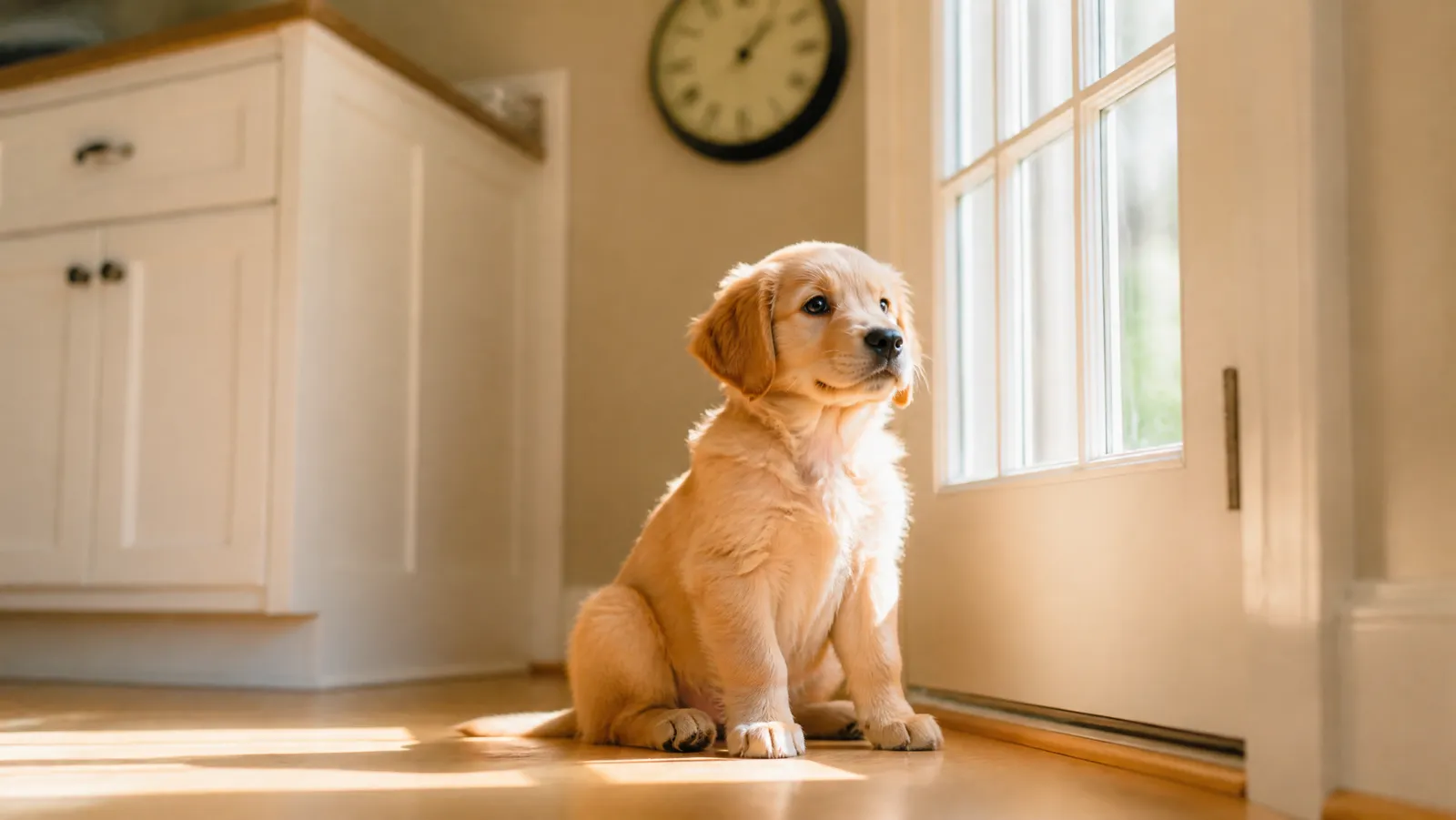
According to the American Kennel Club, puppies cannot control their bladder until about 16 weeks old, and after that can typically hold it for roughly the same number of hours as their age in months plus one. Humane World for Animals uses a tighter version: about one hour per month of age.
Both are ceilings for a resting puppy, not targets for an awake one. VCA Animal Hospitals suggests a trip every one to two hours while a puppy is awake, well inside either rule. Small breeds hold less than the arithmetic implies, and an excited puppy empties faster than a sleeping one — the rule is a guideline, not a guarantee.
Two gaps hide in almost every log we see:
- The long afternoon stretch. Between lunch and the end of the workday sits a three- or four-hour block where nobody opened the door. Most puppies under four months lose that bet eventually.
- The gap between the last evening trip and bedtime. The 8 p.m. trip happens, then dishes, a show, bed at 11 — three unsupervised hours after the last drink.
Our puppy potty training schedule by age has the intervals hour by hour. If the afternoon gap is a work-hours problem, potty training a puppy while working full time covers the coverage options honestly.
Cause 3: The Puppy Who Pees Inside Right After Going Outside
This is the version that makes owners angriest: you stood in the cold for ten minutes, they did nothing, and four minutes after coming in there is a puddle by the sofa. Three causes, and they stack.
The trip did not empty them. Puppies often go twice, and plenty of owners head in after the first. VCA Animal Hospitals is direct about the loose-in-the-yard version: do not send puppies outside alone, because most puppies left alone outside become distracted and do not eliminate until they are back indoors.
The trip was a play session. If outside means sniffing, leaves and a game, the puppy has no reason to finish the job — the fun is already happening.
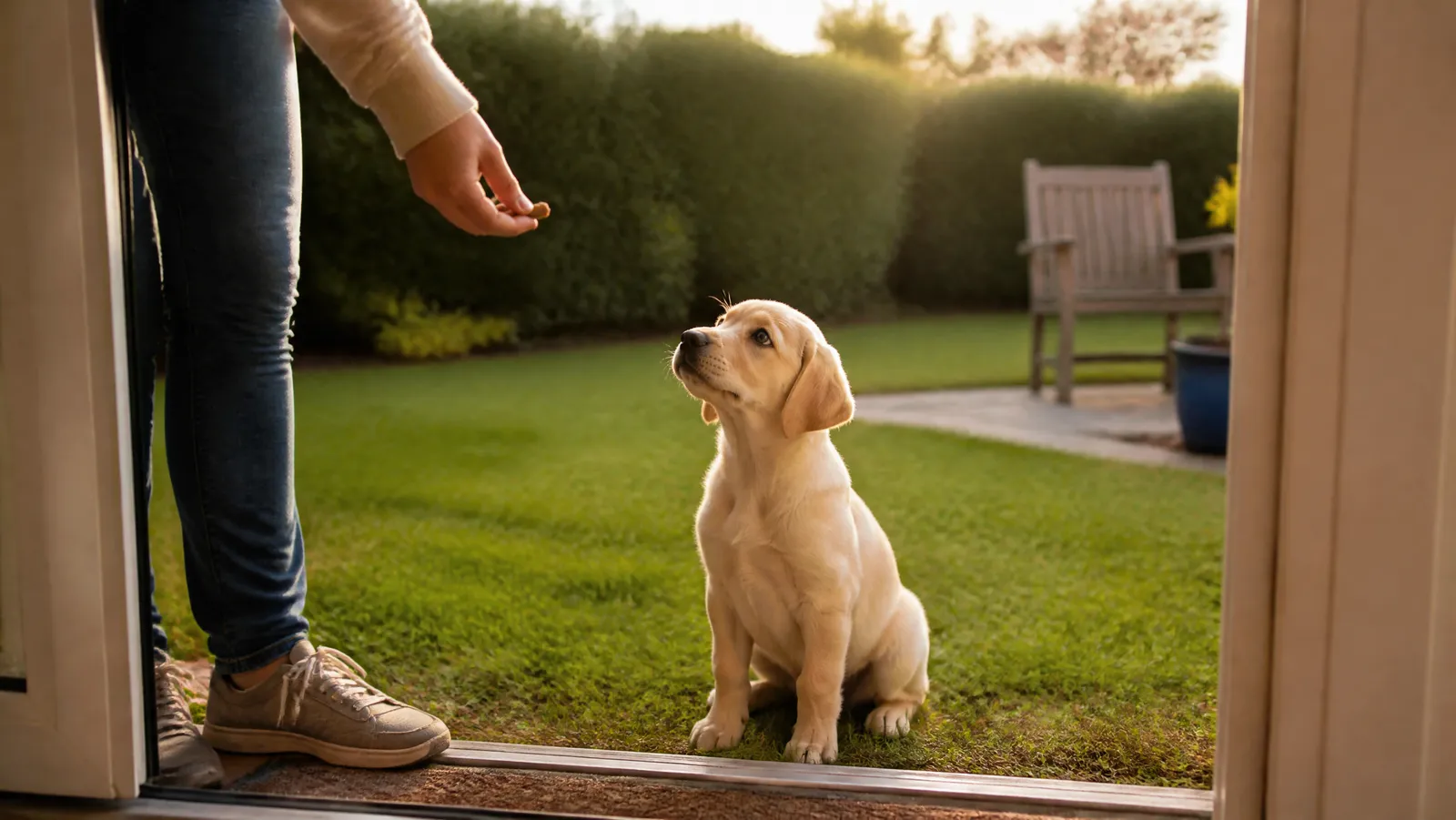
The reward arrived inside. VCA specifies that the reward should be given while you are still outside near the area of elimination rather than when you get back inside. A treat handed over at the back door rewards walking through the back door.
The fix is unglamorous:
- Leash every trip, even in a fenced yard — a six-foot lead and a small circle.
- Go to the same spot, then be boring. No talking, no eye contact, no wandering.
- Use a cue phrase while they are going. Humane World recommends a specific word or phrase, used consistently.
- Wait out the full sequence. Do not turn for the door the second the first job is done.
- Pay at the spot, within seconds — treat and quiet praise, in the grass, before you move. Then play, as a second reward.
If nothing has happened after five minutes, VCA's advice is to take the puppy back inside and supervise closely. Crate or tether, retry in ten. Never release them loose on a failed trip — that is the moment the hallway accident gets made.
Cause 4: The Spot Still Smells Like a Bathroom
VCA Animal Hospitals notes that dogs are often attracted to previously soiled spots, and Humane World for Animals advises cleaning soiled areas thoroughly to remove scents that might encourage repeat accidents. If your log shows the same rug repeatedly, supervision will not out-argue the smell.
The part owners miss is the accidents they never found. Preventive Vet explains that the wavelengths in a blacklight cause phosphorus and proteins in urine to glow, making old stains visible, and that the darker the room the better it works. Sweep at night, expect false positives because plenty of household substances fluoresce too, and clean every mark.
Ordinary carpet cleaner will not do it. Our guide to cleaning puppy accidents covers enzymatic cleaners and how much to use on carpet padding, and our round-up of the best puppy potty training supplies covers which ones are worth the money.
Cause 5: Punishment, Including the Kinds Owners Don't Count
This is the cause people are least likely to spot in themselves, because most of it does not feel like punishment. It feels like reacting.
It counts if you have done any of these: the sharp "no" from across the room, carrying the puppy to the mess and pointing at it, cleaning up while radiating disappointment, crating them straight afterwards, or just the tone that arrives before you can stop it.
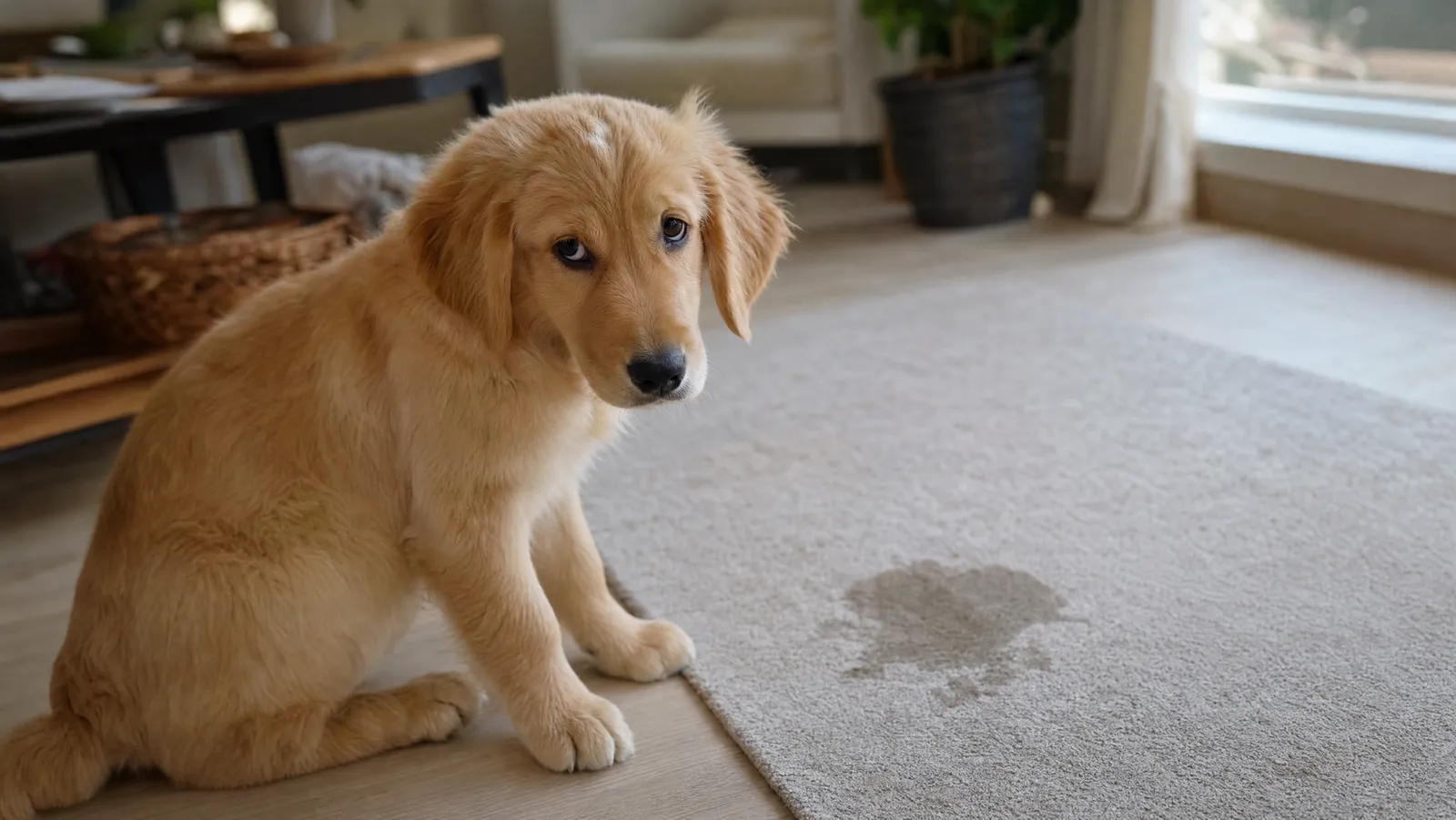
The consequence explains cause three exactly. VCA Animal Hospitals warns that punishing your puppy for a natural act can make them think they should never toilet near a person. The puppy has not learned "do not go in the house" — they cannot draw that line. They have learned "do not go where the human can see me," which is why they produce nothing on the leash with you standing right there, then go behind the couch ten minutes later.
Timing makes it worse. The ASPCA is explicit that a dog will not learn anything by being scolded for a past accident, even one a few minutes old. VCA adds that a scolded dog becomes confused and possibly frightened, and may even look "guilty" — which owners read as proof the dog knew. It is not.
The wider evidence runs one way. Today's Veterinary Practice counsels avoiding verbal or physical punishment because it can cause fear, anxiety and aggression and does not teach a puppy where to eliminate. The American Veterinary Society of Animal Behavior states that based on current scientific evidence it recommends only reward-based methods for all dog training, and that there is no evidence aversive methods are more effective in any context. AVSAB lists avoidance among the documented consequences of aversive methods — precisely what a hiding puppy is doing.
If you have done this, it is recoverable, and most owners have done it — usually at 6 a.m. on a bad week, before anyone explained the mechanism. The repair is boring: stop reacting to indoor accidents, clean them silently, interrupt anything in progress with a neutral sound rather than a shout, carry them out to finish, and over-pay every outdoor success for a fortnight.
The Two-Week Reset for a Difficult Puppy
Run this for fourteen days once your vet has signed off. It will feel like going backwards. That is the point: you are rebuilding a record of successes, which you cannot do in a house where accidents are still possible.
- Shrink the space. The ASPCA advises limiting the dog's run of the house to the one or two rooms where you can see her at all times. Baby gates, not good intentions.
- Tether or crate whenever you are not actively watching. Humane World for Animals suggests tethering the puppy to you or a nearby piece of furniture with a six-foot leash when not actively playing. "Same room" is not supervision.
- Cut thirty minutes off your current interval. For most puppies under four months that lands at every 30 to 60 minutes while awake, inside VCA's one-to-two-hour guidance for awake puppies.
- Run every trip the way cause three describes: leashed, same spot, five silent minutes, paid at the spot.
- Keep logging. Without numbers, week two feels identical to week one.
- Expand one room per accident-free week. Not two. For full unsupervised freedom, VCA Animal Hospitals suggests waiting until your puppy has gone 8 to 12 weeks without mistakes.
If two honest weeks produce no improvement at all, that sends you back to your vet rather than further into training.
When Potty Training Isn't Working but Your Puppy Is Normal
Some owners who find this page do not have a problem — they have a calendar expectation no puppy was going to meet.
The American Kennel Club notes that puppies cannot control their bladder until about 16 weeks, so a twelve-week-old having accidents is not failing — they are not yet equipped. Humane World for Animals puts typical housetraining at four to six months, varying with size, age and previous habits, and the AKC adds that the timeline varies significantly from puppy to puppy.
So: partial reliability in the four-to-six-month range, full reliability later, with real variation either side. For the variables that move it, we wrote how long potty training takes. A five-month-old with one accident a week is not a difficult case. One a day is.
When to Bring in a Professional
The threshold we would use: over six months, a clean bill of health, a tight two-week reset run, and a log still showing daily accidents. The two credentials worth knowing do different jobs.
A certified professional dog trainer handles mechanics — supervision, timing, reward delivery, and the parts of your routine you cannot see from inside it. The ASPCA describes CPDT certification as requiring working hours as a trainer, letters of recommendation and a standardized test on canine behavior, learning theory and husbandry.
A board-certified veterinary behaviorist is a veterinarian first. The ASPCA notes they complete a residency in behavior and pass a qualifying examination, and can prescribe medication where treatment calls for it. That is the route when house soiling is tangled up with anxiety or fear.
One filter on whoever you hire: AVSAB advises steering clients away from trainers observed using aversive methods, or discussing out-dated ideas such as "dominance," "leader of the pack" or "alpha" theories. For a puppy already hiding to eliminate, that is the difference between fixing the problem and deepening it.
The Log Is What Finds It
Almost every case we have seen resolves once the right cause is identified. The reason it takes eight weeks is that people change five things at once and cannot tell which worked. Three days of writing it down, a vet visit, then one cause at a time.
Your puppy is not stubborn and is not slow. They are working with a bladder a few weeks behind their legs, and rules they can only learn from what happens in the two seconds after they go. If you want the mechanics again from the start — cue words, reward timing, crate sizing, cleanup — our step-by-step potty training method is where to restart.
Frequently asked questions
Why is my puppy not potty training after weeks of trying?
Almost never because they do not understand it. Today's Veterinary Practice states that medical conditions should be the top differentials for soiling in puppies refractory to house training, so a vet visit comes before any change to your training. After that, the usual causes are mechanical rather than mental: an interval longer than the puppy's bladder can manage, a spot that still carries odor, a reward that arrives at the back door instead of at the grass, or punishment that has taught the puppy to eliminate out of your sight. A three-day log of every trip and every accident usually points at one of them within 48 hours.
Why does my puppy pee inside right after going outside?
Usually because the outdoor trip did not finish the job. VCA Animal Hospitals advises against sending puppies outside alone, noting that until they are trained, most puppies left outside alone become distracted and do not eliminate until they are back indoors. The second culprit is reward timing. VCA is specific that the reward should be given while you are still outside near the area of elimination rather than when you get back inside — a treat handed over at the door rewards coming in, not going out. Leash the trip, stand still, wait out the full sequence, and pay at the spot.
At what age should a puppy be fully potty trained?
Later than most owners expect. The American Kennel Club notes that puppies cannot control their bladder until they are about 16 weeks old, which means everything before that is habit-building rather than reliability. Humane World for Animals puts typical housetraining at four to six months, varying with the puppy's size, age and previous housetraining habits, and the AKC adds that the timeline varies significantly from puppy to puppy. For full freedom, VCA Animal Hospitals suggests waiting until your puppy has gone 8 to 12 weeks without mistakes. A five-month-old with occasional accidents is not behind.
Will punishing my puppy for accidents make potty training faster?
The evidence points the other way, and it can create the exact problem you are trying to fix. VCA Animal Hospitals warns that punishing your puppy for a natural act can make them think they should never toilet near a person — which is how you end up with nothing on the leash outside and a puddle behind the couch. The ASPCA adds that a dog will not learn anything by being scolded for a past accident, even one a few minutes old. AVSAB's position statement recommends that only reward-based training methods are used for all dog training, including the treatment of behavior problems.
When should I call a trainer or a veterinary behaviorist about house training?
When your puppy is past six months, has a clean bill of health, and a genuinely tight two-week reset has not moved the numbers. The two credentials do different jobs. The ASPCA describes a certified professional dog trainer as someone who has accrued a requisite number of working hours, provided letters of recommendation and passed a standardized test covering canine behavior, learning theory and husbandry. A board-certified veterinary behaviorist is a veterinarian who has completed a residency in behavior and passed a qualifying examination, and who can prescribe medication where it is warranted.
About the author
James Martin
I'm an animal lover through and through. I grew up with dogs, my family always had at least one pet, and today I share my home with a rescue who is the love of my life. I started Healthy Puppy Review to help owners cut through the marketing noise and make confident, well-researched choices about their dog's health and happiness.